Pekka Buttler, 08/2026
Introduction

Yashica was one of the Japanese camera industry’s most influential second-tier manufacturers, helping to democratise high-quality photography while serving as a bridge between the consumer and professional markets. Although Yashica itself never achieved the market dominance of Canon, Nikon or Minolta, its history reflects several of the defining trends of post-war Japanese photography: first the rise of vertically integrated optical manufacturing, and later the growing importance of building ecosystems through the collaboration with specialist contract manufacturers.
A brief history of Yashica
1945–1958 Yashima Seiki
The company was founded in 1945 as Yashima Seiki Seisakusho (八洲精機製作所) (rough translation: Yashima Precision Works), manufacturing war materiel subcomponents (until the end of the war) and subsequently electronic subcomponents. In 1949 the company was incorporated as Yashima Seiki K. K.
Yashica made its first camera in 1953 and changed its name to Yashima Kōgaku Seiki K.K. (Yashima Optical Precision Instruments) to reflect its new mission. Also in 1953 the company launched the first camera (an inexpensive entry-level camera) under the Yashica brand. Yashica is a compression of Yashima and Camera, echoing several other camera brand names1.
Importantly, Yashima was a camera manufacturer and did not manufacture its own lenses. Instead, the lenses on Yashica cameras – whether TLRs or fixed-lens rangefinders – were sourced from Tomioka Optical works (‘Tomioka’).Yashica’s use of Tomioka lenses gave even its early products a reputation for optical quality that exceeded their modest price. The Yashikor and later Yashinon lenses established the company’s reputation among enthusiasts.
1958–1974 Yashica’s growth years
In 1958 the company was re-incorporated as K.K. Yashica (bringing the company name in line with its products and that of its US sales subsidiary). The same year saw Yashica launch its first camera for 35 mm film and buying the Nicca Camera company (manufacturers of optically ambitious but economically failing interchangeable lens rangefinders), which was renamed Taihō Optical and was made a Yashica subsidiary.
1960 saw the launch of Yashica’s first interchangeable lens SLR, the Pentamatic. Like some of the other ambitious Japanese entries into the SLR market (including Canon, Minolta and Nikon), the Pentamatic used its own proprietary lens mount (see the JAPB article on the Yashica Pentamatic mount). Alas Yashica did not quite have the market power to launch another proprietary lens mount and hence Yashica in 1961 launched its parallel ‘J’ series of SLR cameras using the M42 thread mount (which was at this stage used by several other camera companies and lens makers).
At the same Yashica continued diversifying into almost every segment of the camera market, while continuing innovating in technologies that would make cameras more easy to use (most notably auto exposure). Given Yashica’s background in electronics component manufacture, it is no surprise that Yashica was at the forefront of integrating electronics into cameras – both compact cameras as well as SLRs.
1968 was a year of consolidation for Yashica. Yashica first merged its former subsidiary Taihō Optical into the company, and went on to acquire its long-time optics supplier Tomioka Optical. Now Yashica was set to conquer the (camera) world: it had leading edge electronics, world class optics, a manufacturing capability second to none. It only lacked one thing: something to make consumers choose a Yashica camera over the established rivals (Canon, Minolta, Nikon or Pentax)
1974–1983 Yashica’s ‘golden’ years
1974 saw the launch of “Top Secret Project 130” – the collaboration between Yashica, Carl Zeiss (West) and Porsche Design on launching a new line of professional-level cameras. The result of this collaboration was the 1975 reintroduction of the “Contax” brand into SLR photography, the merging of Zeiss optics design prowess with Yashica manufacturing capabilities, the launch of a camera (the Contax RTS) that had been designed to centre on the ergonomics of photography. All this was facilitated by the bringing together of Yashica’s electronics and manufacturing capabilities with the optics know-how from Zeiss, mediated by a brand-new lens mount: the Contax/Yashica mount. If Yashica had previously lacked that ‘something’ that would make a discerning buyer choose a Yashica camera (and lenses) over a premium camera brand, the Contax system and its Zeiss lenses could certainly be just that.
While Zeiss initially manufactured a fair share of the ‘Carl Zeiss’ lenses for the Contax/Yashica system in West Germany, production increasingly shifted to Japan and Tomioka’s old manufacturing plant. Yashica had managed to bootstrap itself into the crème de la crème, but that had come at a cost.
First, the Contax/Yashica system never quite matched the sales targets the partners had hoped for. On the one hand, the professional clientele (which the ambitious Contax pro lineup was squarely gunning for) were too married to their existing systems to switch over ‘en masse’. While the RTS did set a new standard, it did not become a sales hit. At the same time, competition in the prosumer SLR field was heating up as the mid 70s saw several key entries into the prosumer market2. At the same time, Yashica had stretched its means to breaking point, forcing the company to look for further allies.
1983–2005 Yashica / Kyocera
This lead to Japanese Ceramics and electronics giant Kyocera acquiring Yashica in 1983. Suddenly Yashica again had financial resources that could be brought to bear should a) there be a need and b) there be a good enough plan to invest in. This timing was fortuitous, as everyone and their aunt saw that the autofocus revolution was around the corner. Even so, Minolta’s 1985 launch of the first functional (and decently functioning) autofocus SLR system took the industry a bit by surprise, leading to that everyone else scrambled to try to catch up3.
Yashica launched their first AF system in 1987, notably without the co-operation of Zeiss4. While it was not the most bungled AF SLR system implementation, neither was it a commercial success, and by the mid 1990s Yashica effectively discontinued its first foray into Autofocus SLR manufacture.
Instead of trying to compete in manufacturing autofocus SLRs against the likes of Canon, Minolta, Nikon and Pentax (which were effectively carving up the market), Kyocera/Yashica decided to focus on trying to bring autofocus to the rangefinder market (a market that had been dominated by Leica for decades). Thus the Contax G system (1994) was born. The Contax G was a superbly designed rangefinder camera with splendid interchangeable optics (by partner Carl Zeiss) in a modern autofocus package. The Contax G became an icon, and used sets still garner high prices in the secondhand market, but even though it was a moderate commercial success, it did neither unseat Leica nor revive the rangefinder segment.
Also, in the mid 1990s, it was clear that the next watershed moment to challenge all the incumbents would be digital photography. While the technology clearly was not there yet (just as AF had not been a mature-enough technology in 1981) it was also clear that digital professional photography was only a matter of time.
But Yashica was not yet done trying to change the world. In 1998 Yashica/Kyocera (again in collaboration with Zeiss) launched the Contax 645 – a professional autofocus medium format camera and in 2000 Yashica/Kyocera launched the Contax N series of 35 mm autofocus cameras (this time in collaboration with Zeiss), including the camera that would become the world’s first full frame digital SLR (the Contax N digital). in 2005 – with a long list of uphill battles and few commercial successes to tally – Kyocera announced that it would withdraw from everything camera-related. Many were disappointed and sad, but few were surprised.
Yashica lens mounts
Yashica Pentamatic (1959/60–1962)
The Yashica Pentamatic was Yashica’s first line of interchangeable lens SLR cameras and it used its own proprietary bayonet mount. While the Pentamatic line of cameras was economically unsuccessful and discontinued early, it started Yashica on its path as an ambitious SLR camera manufacturer.
Yashica Pentamatic mount specifications
Mount type: Bayonet (lens release on body)
Flange focal distance: 43 mm
Film format: 36mm x 24mm (‘Full frame’)
Mount communication: One lever to facilitate aperture stop-down (camera-to-lens). The same lever moves to indicate the chosen aperture (but it is unclear whether Yashica had plans to use this functionality for lens-to-camera communication).
Identifying the Yashica Pentamatic mount
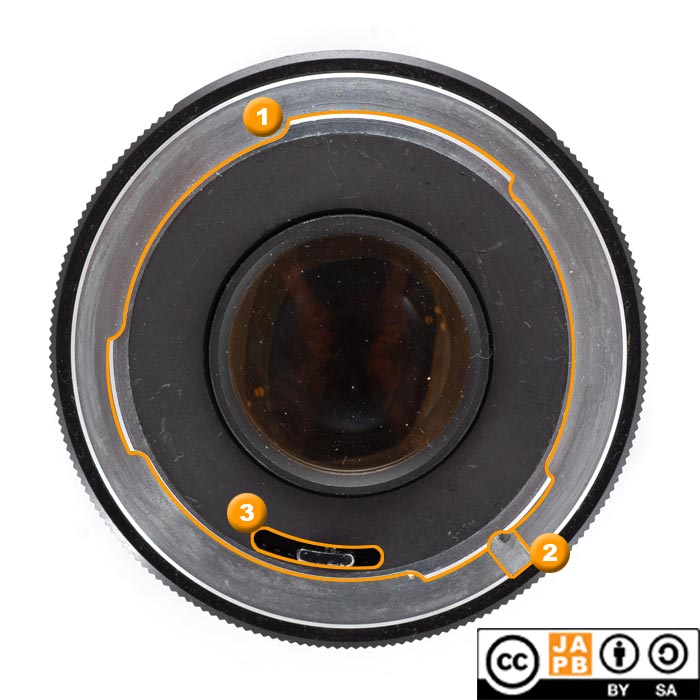
Key characteristics of the mount of Yashica Pentamatic lenses:
[1] Three-pronged male bayonet. All edges tapered. Locking notch at 05:00 position.
[2] Locking groove at 05:00 o’clock.
[3] Dual-purpose aperture stop-down and aperture indicator lever.
READ MORE in the JAPB article on the Yashica Pentamatic mount.
Yashica M42 (1961–1975)
When Yashica in 1961 introduced the Yashica Penta J SLR, it did so in the hope of being able to get some added traction for its cameras based on the wide availability of M42 lenses. If the Pentamatic’s competitiveness had been limited by its relatively meagre lens roster (and the risk of users being stranded with incompatible lenses should the Pentamatic system fail), neither risk was pressing in the case of an M42 mount camera.
While there has never been a universal interchangeable lens mount, the M42 is as close as it gets, with camera manufacturers from every corner of the world5 using it. However, as the JAPB article on the M42 mount clearly shows, the M42 mount was limited both through its limited ability to facilitate lens<->camera communication as well as (subsequently) through an increasing fragmentation of the mount with several key manufacturers introducing their extensions to the M42 mount (many of which were less than compatible with other marque’s cameras).
Importantly, while Yashica built its position as a camera manufacturing powerhouse on the back of the M42 mount, Yashica is almost alone among the mount’s main users in not having made any proprietary extensions to the vanilla M42 mount. Even the Yashica Electro AX (1972) managed to introduce aperture priority auto exposure without adding anything to the M42 lenses that would have limited their compatibility6.
However, with previously committed users of the M42 mount gradually abandoning the mount for their proprietary solutions, also Yashica could see the writing on the wall. They needed a new lens mount, but they also did not want to repeat the errors made with the Pentamatic mount.
Contax / Yashica (1975–2005)
The Contax/Yashica lens mount was the result of Yashica’s collaboration with Carl Zeiss in the design and launch of a new camera system to break into the contested pro segment. While the Contax/Yashica line of cameras and lenses did not fully meet the commercial hopes of its instigators, it has to be classed as a successful (and long-lived) system, introduced into an increasingly competitive market.
Contax/Yashica mount specifications
Mount type: Bayonet (lens release on body)
Flange focal distance: 45,5 mm
Film format: 36mm x 24mm (‘Full frame’)
Mount communication: Two levers: one for indicating the selected aperture (lens-to-camera); another for aperture stop-down (camera to lens).
Identifying the Contax/Yashica mount
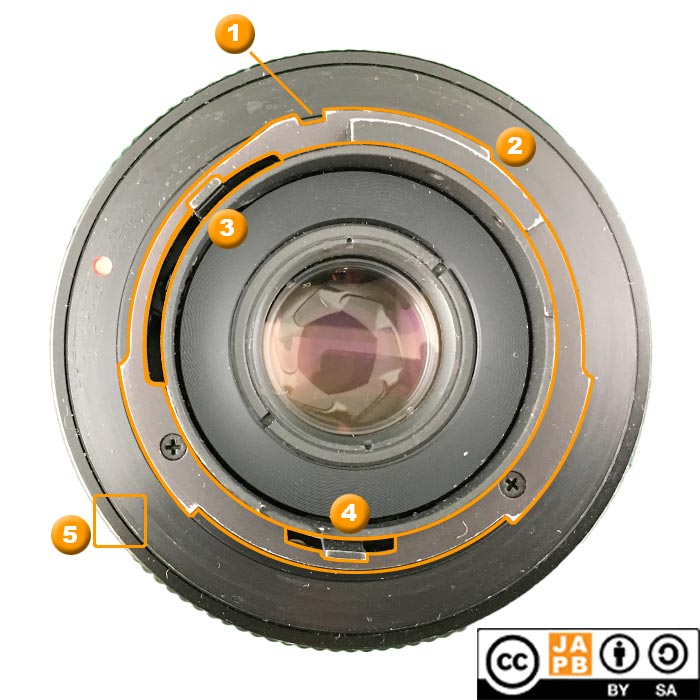
Key characteristics of the C/Y mount
[1] Locking notch at 11:30
[2] Three-pronged bayonet mount, two straight edges, three tapered edges, and one very shallow edge.
[3] Aperture indicator lever
[4] Stop-down lever
[5] Place where (if this was an MM lens) the indicator prong would be
READ MORE in the JAPB article on the Contax/Yashica lens mount.
Yashica AF (1987–1995)
Yashica (now under Kyocera management) decided to launch its autofocus SLR system without the support of Carl Zeiss. The resulting system can safely be said to have disappointed the accountants at Kyocera.
Yashica AF mount specifications
Mount type: Bayonet (male-type)
Flange focal distance: 45,8 mm (measured)
Film format: 36mm x 24mm (‘Full frame’)
Mount communication (mechanical): aperture stop-down (camera-to-lens); slot-drive AF (camera-to-lens)
Mount communication (electronic): 5/10 electronic contacts (spring-loaded at the camera-end). Early (pre-power zoom) lenses with 5 contacts; power zoom lenses with 10 contacts. Entire extent of communication (designed/implemented) unknown to JAPB
Identifying the Yashica AF mount
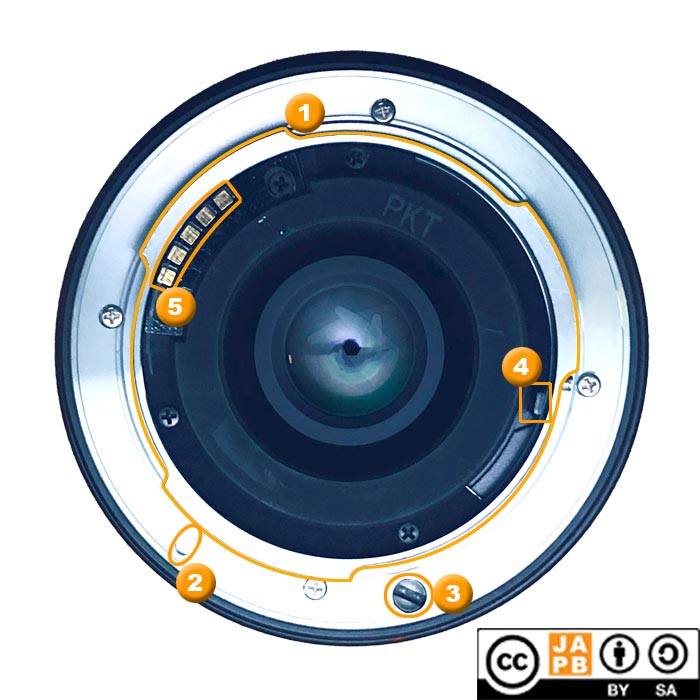
Key characteristics of the mount of Yashica AF lenses:
[1] Three-pronged male bayonet. All edges tapered.
[2] Locking groove at roughly 07:30 o’clock.
[3] Slot-drive screw at roughly 05:30 position
[4] Stop-down lever
[5] Electronic contacts between 10:00 and 12:00 (5 on regular AF lenses; 10 on power zoom lenses).
[not visible] Yashica AF lenses lack an aperture ring.
READ MORE in the JAPB article on the Yashica AF mount
Contax G (1994–2005)
In 1994 Kyocera/Yashica launched the Contax G series of interchangeable lens autofocus rangefinder cameras. These small marvels were the first serious attempt to reinvent the rangefinder, and while ultimately not successful in unseating Leica, the system has to receive credit for ambition, attention to detail and thinking outside the box.
Mount type: Combination of bayonet and breech-lock.
Flange focal distance: 29 mm
Film format: 36mm x 24mm (‘Full frame’)
Mount communication: Electronic contacts for communicating aperture and lens ID; slot-drive screw for driving autofocus.
Identifying the Contax G mount
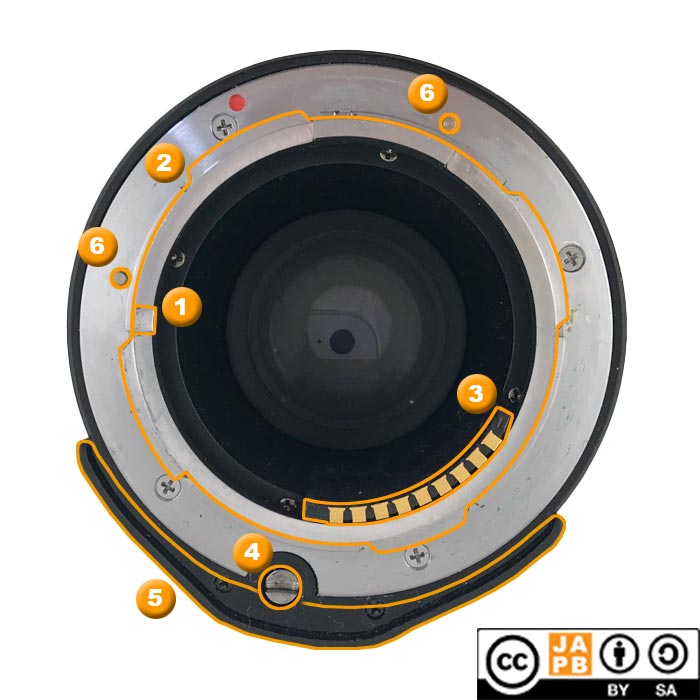
Key characteristics of the Contax G -mount:
[1] Locking notch at 3 o’clock (but, unusually, on the rearwards facing end of the “bayonet”, not on the flange and not on a bayonet prong)
[2] Bayonet-like construction with four prongs
[3] Bank of electronic contacts
[4] Slot-drive screw
[5] Bulge (housing gearing for slot-drive)
[6] Pins for detecting mounting on camera (or adapter)
READ MORE in the JAPB article on the Contax G lens mount
Contax 645 (1998–2005)
The Contax 645 was Kyocera’s bid to construct a pro-level autofocus medium format system. While it found a delighted audience among studio photographers, it was far from a runaway success.
(JAPB does not currently have details to offer on the Contax 645 mount)
Contax N (2000–2003)
In the year 2000 Yashica/Kyocera made its final attempt to produce a pro-level autofocus SLR system with the Contax N system (including the world’s first full frame digital SLR). The system was commercially very unsuccessful.
READ MORE in the JAPB article on the Contax N lens mount
Yashica interchangeable lens cameras (and lenses)
Given JAPB’s focus on legacy lenses, this listing focuses on interchangeable lens SLRs and the yashica lenses made for those systems.
Yashica Pentamatic mount cameras and lenses
| Name | Years | Mount | Notes |
|---|---|---|---|
| Yashica Pentamatic | 1959/607–61 | Pentamatic | Support for semi-automatic aperture |
| Yashica Pentamatic II | 1960–61 | Pentamatic | Support for fully automatic aperture |
| Yashica Pentamatic S | 1961–62 | Pentamatic | Support for semi-automatic aperture and clip on light-meter |
| Naming | Mainline specifications | Mounts | Optical construction | Introduced | Filter thread | MFD | Aperture mechanism | Notes |
|---|---|---|---|---|---|---|---|---|
| Yashica (Tominon) Super YASHINON-R | 35 mm f/2.8 | Pentamatic | 6e / 5g | 1959/60 | 52 mm | 0,3m | preset | |
| Yashica Super YASHINON-R | 35 mm f/2.8 | M42 & Pentamatic8 | unknown | 1961 | 46 mm | 1m | preset | |
| Yashica YASHINON Auto | 55 mm f/1.8 | Pentamatic | 6e / 4g | 1959/60 | 52 mm | 0,5m | automatic | supplied with Pentamatic and Pentamatic S |
| Yashica YASHINON Auto | 58 mm f/1.7 | Pentamatic | 6e / 4g | 1960 | 52 mm | 0,5m | automatic | supplied with Pentamatic II |
| Yashica (Tominon) Super YASHINON-R | 100 mm f/2.8 | Pentamatic | 6e / 4g | 1959/60 | 52 mm | 1m | preset | |
| Yashica Super YASHINON-R | 135 mm f/2.8 | M42 & Pentamatic | unknown | 1961 | 55 mm | 1,7m | preset | |
| Yashica Super YASHINON-R K.C. | 135 mm f/3.5 | Pentamatic | 4e / 3g | 1960 | 52 mm | 1,5m | preset | |
| Yashica Super YASHINON-R K.C. | 180 mm f/3.5 | Pentamatic | 4e / 3g | 1960 | 62 mm | 2m | preset | |
| Yashica Super YASHINON-R | 200 mm f/4.5 | M42 & Pentamatic | unknown | 1961 | unknown | 3m | preset | |
| Yashica Super YASHINON-R K.C. | 250 mm f/4 | Pentamatic | 4e / 3g | 1960 | 72 mm | 3m | preset | |
| Yashica Super YASHINON-R | 300 mm f/5.5 | M42 & Pentamatic | unknown | 1961 | unknown | 8m | preset | |
| Yashica Super YASHINON-R | 400 mm f/6.3 | M42 & Pentamatic | unknown | 1961 | unknown | 9m | preset |
Yashica M42 mount cameras and lenses
Yashica M42 Mount Cameras
| Name | Years | Mount | Notes |
|---|---|---|---|
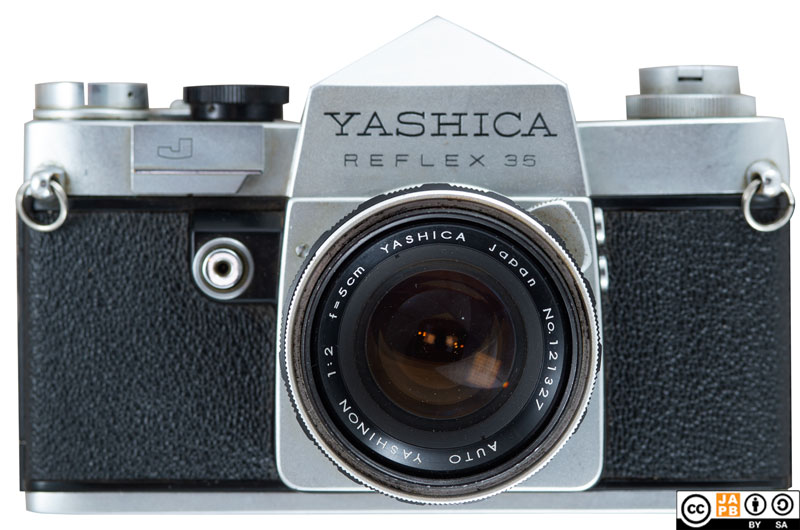
| Yashica Penta J (Reflex 35) | 1961–64 | M42 | 1/500 s max ss, no self-timer, no fully-automatic aperture |
| Yashica J-3 | 1962–64 | M42 | Built in CdS meter and self-timer. |
| Yashica J-5 | 1964–65 | M42 | 1/1000 s max ss |
| Yashica J-P | 1964–66 | M42 | |
| Yashica J-4 | 1965 | M42 | Support for semi-automatic aperture and clip on light-meter |
| Yashica J-7 | 1966–67 | M42 | 1/1000 s max ss |
| Yashica TL Super | 1966–71 | M42 | 1/1000 s max ss, Through-the lens, stop-down metering, indicator needle |
| Yashica TL | 1967–69 | M42 | Same as TL Super, Except no mirror lock-up and slower max SS |
| Yashica TL Electro-X | 1968–74 | M42 | electronically timed semi-variable ss, indicator lamps |
| Yashica TL-E | 1969 | M42 | As TL, except with indicator lamps in place of needle. |
| Yashica TL Electro-X ITS | 1970–74 | M42 | Same as Electro-X, except black |
| Yashica (TL) Electro | 1972–78 | M42 | Bare bones version of TL Electro-X |
| Yashica Electro-AX | 1972–74 | M42 | Aperture Priority Auto exposure |
| Yashica FFT | 1973–74 | M42 | 1/1000 s max SS, TTL metering (bare bones body) |
M42 mount Yashica lenses
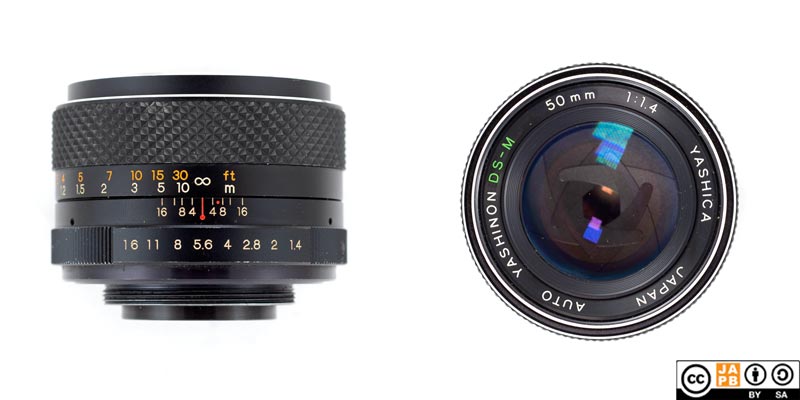
The table below tries to scrape together what information there is on Yashica/Yashinon lenses for the M42 mount. Some of these lenses are so rare that I have never seen them but they are nevertheless well documented in Yashica brochures and price lists.
| Naming | Mainline specs | Optical construction | Introduced | Filter thread | MFD | Aperture mechanism | Notes |
|---|---|---|---|---|---|---|---|
| Yashica YASHINON-DS Auto | 20 mm f/3.3 | 11e / 9g | 1972 or later | 72 mm | 0,3 m | Automatic | |
| Yashica YASHINON-DX | 21 mm f/3.3 | 8e / 5g | 1967 | 55 mm | 0,8 m | Manual | Invasive design. Can be used on SLRs only with mirror lock-up. |
| Yashica YASHINON-DS | 21 mm f/3.3 | 8e / 5g | 1972 or later | 55 mm | 0,8 m | Manual | |
| Yashica YASHINON DS-M | 24 mm f/2.8 | 9e / 8g | 1972 or later | 62 mm | 0,3 m | Automatic | |
| Yashica YASHINON-DX | 29 mm f/2.8 | 8e / 7g | 1967 | 62 mm | 0,4 m | Automatic | |
| Yashica YASHINON-DS | 28 mm f/2.8 | 8e / 7g | 1972 or later | 52 mm | 0,3 m | Automatic | |
| Yashica YASHINON DS-M Auto | 28 mm f/2.8 | 8e / 7g | 1972 or later | 52 mm | 0,3 m | Automatic | |
| Yashica YASHIKOR Auto | 28 mm f/2.8 | 7e / 6g | unknown | 62 mm | 0,3 m | Automatic | |
| Yashica Super YASHINON-R | 35 mm f/2.8 | unknown | 1961 | 46 mm | 1 m | Preset | also for Pentamatic |
| Yashica Super YASHINON-DX | 35 mm f/2.8 | 6e / 5g | 1966 or later | 52 mm | 0,45 m | Preset | |
| Yashica YASHINON-DX | 35 mm f/2.8 | 6e / 5g | 1966 | 52 mm | 0,4 m | Automatic | |
| Yashica YASHIKOR | 35 mm f/2.8 | 6e / 5g | unknown | 52 mm | 0,5 m | Automatic | |
| Yashica YASHINON-DS | 35 mm f/2.8 | 6e / 5g | 1972 or later | 52 mm | 0,3m | Automatic | |
| Yashica YASHINON DS-M | 35 mm f/2.8 | 7e / 6g | 1972 or later | 52 mm | 0,3 m | Automatic | |
| Yashica YASHINON Auto | 50 mm f/2 | 6e / 4g | 1961 | 46 mm | 0,55 m | Semi-automatic | |
| Yashica YASHINON-DX | 50 mm f/2 | 6e / 5g | unknown | 52 mm | 0,5 m | Automatic | [data sheet] |
| Yashica YASHINON-DS | 50 mm f/2 | 6e / 5g | 1972 or later | 52 mm | 0,5 m | Automatic | |
| Yashica YASHINON-DS | 50 mm f/1.9 | 6e / 5g | 1972 or later | 52 mm | 0,5 m | Automatic | |
| Yashica YASHINON-DX | 50 mm f/1.7 | 6e / 5g | unknown | 52 mm | 0,5 m | Automatic | |
| Yashica YASHINON-DS | 50 mm f/1.7 | 6e / 5g | 1972 or later | 52 mm | 0,5 m | Automatic | |
| Yashica YASHINON DS-M | 50 mm f/1.7 | 6e / 5g | 1972 or later | 52 mm | 0,5 m | Automatic | |
| Yashica YASHINON-DX | 50 mm f/1.4 | 7e / 6g | unknown | 55 mm | 0,6 m | Automatic | |
| Yashica YASHINON-DS | 50 mm f/1.4 | 7e / 6g | 1972 or later | 55 mm | 0,5 m | Automatic | |
| Yashica YASHINON DS-M | 50 mm f/1.4 | 7e / 6g | 1972 or later | 55 mm | 0,5 m | Automatic | [data sheet] |
| Yashica YASHINON DS-M | 55 mm f/1.2 | 7e / 6g | 1972 or later | unknown | 0,5 m | Automatic | Often sold as ‘Tomioka YASHINON DS-M’ |
| Yashica YASHINON Auto | 55 mm f/1.8 | 6e / 4g | 1964 | 52 mm | 0,5 m | Automatic | |
| Yashica Macro YASHINON | 60 mm f/2.8 | 6e / 5g | unknown | 58 mm | 0,235 m | Preset | Often sold as ‘Tomioka Macro YASHINON” |
| Yashica YASHINON-DX | 100 mm f/2.8 | 5e / 4g | 1966 | 52 mm | 1,2 m | Automatic | |
| Yashica Super YASHINON-R | 135 mm f/2.8 | unknown | 1961 | 55 mm | 1,7 m | Preset | also for Pentamatic |
| Yashica Super YASHINON-DX | 135 mm f/2.8 | 5e / 4g | unknown | 55 mm | 1,5 m | Preset | |
| Yashica YASHINON-DX | 135 mm f/2.8 | 5e / 4g | 1966 | 55 mm | 1,5 m | Automatic | |
| Yashica YASHINON DS-M | 135 mm f/2.8 | 5e / 4g | 1972 or later | 55 mm | 1,5 m | Automatic | |
| Yashica YASHIKOR | 135 mm f/2.8 | 4e / 4g | unknown | 58 mm | 1,5 m | Automatic | |
| Yashica Super YASHINON-R | 200 mm f/4.5 | unknown | 1961 | unknown | 3 m | Preset | also for Pentamatic |
| Yashica YASHINON-DX | 200 mm f/4 | 5e / 4g | 1966 | 55 mm | 2,5 m | Automatic | |
| Yashica YASHINON DS-M | 200 mm f/4 | 5e / 4g | 1972 or later | 55 mm | 2,5 m | Automatic | |
| Yashica YASHIKOR | 200 mm f/3.5 | 6e / 5g | unknown | unknown | 2,5 m | Automatic | |
| Yashica Super YASHINON-R | 300 mm f/5.5 | unknown | 1961 | unknown | 8 m | Preset | also for Pentamatic |
| Yashica YASHINON-DX | 300 mm f/5.6 | 5e / 4g | 1967 | 58 mm | 4,5 m | Automatic | |
| Yashica Super YASHINON-R | 400 mm f/6.3 | unknown | 1961 | unknown | 9 m | Preset | also for Pentamatic |
| Yashica YASHINON-DX | 400 mm f/5.6 | 5e / 5g | 1967 or later | 77 mm | 8m | Automatic | |
| Yashica YASHINON-DX Reflex | 500 mm f/5 | 6e / 5g | unknown | no filter | 10 m | Fixed | |
| Yashica YASHINON Reflex | 500 mm f/8 | 6e / 5g | 1973 | no filter | 4 m | Fixed | |
| Yashica Super YASHINON-R | 600 mm f/8 | 2e / 1g | unknown | 37 mm (rear) | 13 m | Preset | |
| Yashica Super YASHINON-R | 800 mm f/8 | 2e / 1g | unknown | 37 mm (rear) | 25 m | Preset | |
| Yashica YASHINON Reflex | 1000 mm f/11 | 6e / 5g | 1973 | no filter | 8 m | Fixed | |
| Yashica YASHINON Auto | 45-135 mm f/3.5 | 15e / 10g | unknown | 77 mm | 1,9 m | Automatic | |
| Yashica YASHINON-R | 75–230 mm f/4.5 | 13e / 8g | unknown | 67 mm | 2,5 m | Preset | |
| Yashica YASHINON Auto | 75–230 mm f/4.5 | 13e / 8g | 1967 | 67 mm | 2,5 m | Automatic | |
| Yashica YASHINON-DX | 80–160 mm f/4 | 14e / 10g | 1966 | 62 mm | 2,5 m | Automatic | |
| Yashica YASHINON-R | 90–190 mm f/5.8 | 7e / 6g | unknown | 55 mm | 2 m | Preset | |
| Yashica YASHINON Auto | 90–190 mm f/5.8 | 7e / 6g | unknown | 55 mm | 2 m | Automatic |
Yashica M42 lens generations
Yashica M42 lenses went through several generations, and understanding those can help understand the table above:
• Generation 1 (1961–1965) lenses that predate the DX series, including preset lenses, and early semi-automatic and automatic lenses. How to identify: The lens name does not contain either ‘DX’ or ‘DS’
• Generation 2 (1966–1971) DX series lenses. Auto aperture lenses (with the exception of the Super YASHINON DX lenses) with A/M aperture mode selector switch. Mostly single-coated. How to identify: The lens name contains ‘DX’
• Generation 3 (1972–1978) DS series lenses. All auto aperture lenses mostly without A/M aperture mode selector switch. DS lenses mostly single-coated and DS-M lenses multi-coated. How to identify: The lens name contains ‘DS’
Yashikor was always a budget option to the Yashinon lenses.
Yashica (and Contax) Contax/Yashica mount cameras and lenses
Contax and Yashica cameras for the C/Y system
Cameras for the Contax/Yashica system were sold under two brands: ‘Contax’ and ‘Yashica’. Initially both of these were manufactured by Yashica, but later Yashica outsourced some of the lower end Yashica models to be manufactured by Cosina (to Yashica specifications).
| Name | Introduced | Max ss. | Exposure modes9 | Weight10 | Notes |
|---|---|---|---|---|---|
| Contax RTS | 1975 | 1/2000 s | A M | 700g | |
| Yashica FX-1 | 1975 | 1/1000 s | M (metered) | 700 g | |
| Yashica FX-2 | 1976 | 1/1000 s | M (metered) | 690 g | |
| Yashica FR | 1976 | 1/1000 s | A M | 650 g | |
| Yashica FR-I | 1977 | 1/1000 s | A M | 690 g | |
| Yashica FR-II | 1978 | 1/1000 s | A M | 670 g | |
| Contax 139Q | 1979 | 1/1000 s | A M | 500 g | |
| Yashica FX-3 | 1979 | 1/1000 s | M (metered) | 450 g | |
| Yashica FX-7 | 1979 | 1/1000 s | M (metered) | 450 g | FX-7 is same as FX-3 except top is in chrome |
| Contax 137MD | 1980 | 1/1000 s | A M | 640 g | Integrated motor drive |
| Yashica FX-D | 1980 | 1/1000 s | A M | 500 g | |
| Contax RTS II | 1982 | 1/2000 s | A M | 735g | |
| Contax 137MA | 1982 | 1/1000 s | A M | 665 g | Advanced version of 137MD |
| Yashica FX-A | 1982 | 1/1000 s | A M | 600 g | |
| Yashica FX-70 | 1983 | 1/1000 s | A M | 560 g | |
| Yashica FX‑3 Super | 1984 | 1/1000 s | M (metered) | 445 g | |
| Contax 159MM | 1984/85 | 1/4000 s | P A M | 520 g | First Contax body to use MM lenses to allow program auto. |
| Yashica FX-103 Program | 1985 | 1/1000 s | P A M | 460 g | First Yashica body to use MM lenses to allow program auto. |
| Yashica FX‑7 Super | 1985 | 1/1000 s | M (metered) | 445 g | FX-7 Super is same as FX-3 Super except top is in chrome |
| Yashica FX-3 Super 2000 | 1986 | 1/2000 s | M (metered) | 445 g | ‘2000’ in honour of shorter shutter speed. |
| Yashica FX‑7 Super 2000 | 1986 | 1/2000 s | M (metered) | 445 g | FX-7 Super 2000 is same as FX-3 Super 2000 except top is in chrome |
| Contax 167MT | 1986/87 | 1/4000 s | P A S M | 620 g | |
| Yashica 107 MP | 1988 | 1/2000 s | P A M | 520 g | |
| Yashica 108 MP | 1989 | 1/2000 s | P A M | 520 g | |
| Yashica 109 MP | 1989 | 1/2000 s | P A M | 520 g | |
| Contax RTS III | 1990 | 1/8000 s | P A S M | 1150 g | |
| Contax ST | 1992 | 1/6000 s | P A S M | 800 g | |
| Contax S2 | 1992 | 1/4000 s | M (metered) | 565 g | Spot metering, but no automation |
| Contax S2b | 1994 | 1/4000 s | M (metered) | 565 g | CW metering, but no automation |
| Contax RX | 1994 | 1/4000 s | P A S M | 865 g | Focus confirmation in viewfinder |
| Contax AX | 1996 | 1/6000 s11 | P A S M | 1120 g | In-body autofocus by shifting film plane12 |
| Contax Aria | 1998 | 1/4000 s | P A S M | 460 g | |
| Contax RX II | 2002 | 1/4000 s | P A S M | 570 g | Like RX, but no focus confirmation. Japan-only. |
It seems that initially both Yashica and Contax brands were intended to play important roles in the camera and lens lineup, but after autofocus took the 35 mm SLR market by storm and the C/Y system receded into a niche (characterised by an emphasis on high-quality manual focus photography), the Contax brand took over (in cameras) and the Carl Zeiss lenses took the fore.
In terms of C/Y mount lenses, it pays to present Carl Zeiss and Yashica lenses separately:
Carl Zeiss lenses for the C/Y system
Looking first at the Zeiss lenses, it is important to distinguish between AE lenses (that cannot be used in Program auto or shutter priority modes) and MM lenses that support those modes as well. Most lenses exist in both variants, while some exist only in one or the other. Regarding long tele lenses, my know-how on the introduction and availability of AE/MM variants is sadly limited.
| Naming | Mainline specs | AE | MM | Optical construction | Production start | Filter thread | MFD | Notes |
|---|---|---|---|---|---|---|---|---|
| Carl Zeiss Distagon T* | 15 mm f/3.5 | Y | N | 13e / 12g | 1976 | built-in filters | 0,16 m | |
| Carl Zeiss F-Distagon T* | 16 mm f/2.8 | Y | N | 8e / 7g | 1975 | built-in filters | 0,3 m | Fisheye lens |
| Carl Zeiss Distagon T* | 18 mm f/4 | Y | Y | 10e / 9g | 1975 | clip-on, 70 mm | 0,3 m | |
| Carl Zeiss Distagon T* | 21 mm f/2.8 | N | Y | 15e / 13g | 1994 | 82 mm | 0,25 m | |
| Carl Zeiss Distagon T* | 25 mm f/2.8 | Y | Y | 8e / 7g | 1975 | 55 mm | 0,25 m | [data sheet] |
| Carl Zeiss Distagon T* | 28 mm f/2 | Y | Y | 9e / 8g | 1976 | 55 mm | 0,24 m | “Hollywood”13 |
| Carl Zeiss Distagon T* | 28 mm f/2.8 | Y | Y | 7e / 7g | 1976 | 55 mm | 0,25 m | [data sheet] |
| Carl Zeiss Distagon T* | 35 mm f/1.4 | Y | Y | 9e / 8g | 1975 | 67 mm | 0,3 m | [data sheet] |
| Carl Zeiss Distagon T* | 35 mm f/2.8 | Y | Y | 6e / 6g | 1975 | 55 mm | 0,4 m | [data sheet] |
| Carl Zeiss PC-Distagon T* | 35 mm f/2.8 | Y | N | 9e / 9g | 1979 | clip-on, 70 mm | 0,3 m | Perspective correction lens. |
| Carl Zeiss Tessar T* | 45 mm f/2.8 | Y | Y | 4e / 3g | 1982 | 49 mm | 0,6 m | [data sheet] |
| Carl Zeiss Planar T* | 50 mm f/1.4 | Y | Y | 7e / 6g | 1975 | 55 mm | 0,45 m | [data sheet] |
| Carl Zeiss Planar T* | 50 mm f/1.7 | Y | Y | 7e / 6g | 1979 | 55 mm | 0,6 m | [data sheet] |
| Carl Zeiss Planar T* | 55 mm f/1.2 | N | Y | 8e / 7g | 1997 | 77 mm | 0,6 m | Special Edition: “100 years Planar” |
| Carl Zeiss Makro-Planar T* | 60 mm f/2.8 Macro | Y | Y | 6e / 4g | 1976 | 67 mm | 0,25m | [data sheet] 1:1 macro lens |
| Carl Zeiss Makro-Planar T* | 60 mm f/2.8 Macro C | N | Y | 6e / 4g | 1993 | 55 mm | 0,27 m | compact 1:2 macro lens |
| Carl Zeiss Planar T* | 85 mm f/1.2 | Y | Y | 8e / 7g | 1983/1993 | 77 mm | 1 m | Special edition 50/60 years Contax |
| Carl Zeiss Planar T* | 85 mm f/1.4 | Y | Y | 6e / 5g | 1975 | 67 mm | 1 m | [data sheet] |
| Carl Zeiss Sonnar T* | 85 mm f/2.8 | Y | Y | 5e / 4g | 1975 | 55 mm | 0,9 m | [data sheet] |
| Carl Zeiss Planar T* | 100 mm f/2 | Y | Y | 6e / 5g | 1979 | 67 mm | 1 m | |
| Carl Zeiss Makro-Planar T* | 100 mm f/2.8 Macro | Y | N | 7e / 7g | 1985 | 67mm | 0,45 m | 1:1 macro lens |
| Carl Zeiss Sonnar T* | 100 mm f/3.5 | Y | Y | 5e / 4g | 1983 | 55 mm | 1 m | |
| Carl Zeiss S-Planar T* | 100 mm f/4 | Y | N | 6e / 4g | 1976 | 55 mm | N/A | Bellows lens |
| Carl Zeiss Planar T* | 135 mm f/2 | Y | Y | 5e / 5g | 1975 | 72 mm | 1,5 m | |
| Carl Zeiss Sonnar T* | 135 mm f/2.8 | Y | Y | 5e / 4g | 1975 | 55 mm | 1,6 m | [data sheet] |
| Carl Zeiss Sonnar T* | 180 mm f/2.8 | Y | Y | 6e / 5g | 1978 | 72 mm | 1,4 m | |
| Carl Zeiss Aposonnar T* | 200 mm f/2 | N | Y | 10e / 8g | 1994 | (internal) | 1,8 m | |
| Carl Zeiss Tele-Tessar T* | 200 mm f/3.5 | Y | N | 6e / 5g | 1975 | 67 mm | 1,8 m | |
| Carl Zeiss Tele-Tessar T* | 200 mm f/4 | Y | Y | 6e / 5g | 1983 | 55 mm | 1,5 m | |
| Carl Zeiss Tele-Apotessar T* | 300 mm f/2.8 | Y | N | 7e / 6g | 1985 | (internal) | 3,5 m | |
| Carl Zeiss Tele-Tessar T* | 300 mm f/4 | Y | Y | 5e / 5g | 1976 | 82 mm | 3,5 m | |
| Carl Zeiss Mirotar T* | 500 mm f/4.5 | N/A | N/A | 5e / 5g | unknown | 49 mm (internal) | 3,5 m | Mirror lens |
| Carl Zeiss Tele-Apotessar T* | 500 mm f/5.6 | ? | ? | 9e / 7g | unknown | clip-on | 4,9 m | |
| Carl Zeiss Mirotar T* | 500 mm f/8 | N/A | N/A | 6e / 4g | 1998? | 82 mm | 3,5 m | Mirror lens |
| Carl Zeiss Tele-Apotessar T* | 800 mm f/8 | ? | ? | 8e / 6g | unknown | clip-on | 4 m | |
| Carl Zeiss Mirotar T* | 1000 mm f/5.6 | N/A | N/A | 5e / 5g | unknown | 60 mm (internal) | 12 m | Mirror lens |
| Carl Zeiss Vario-Sonnar T* | 28–70 mm f/3.5–4.5 | N | Y | 9e / 8g | 1999 | 67 mm | 0,5 m | |
| Carl Zeiss Vario-Sonnar T* | 28–85 mm f/3.3–4 | N | Y | 16e / 13g | 1988 | 82 mm | 0,6 m | |
| Carl Zeiss Vario-Sonnar T* | 35–70 mm f/3.4 | N | Y | 10e / 10g | 1986 | 67 mm | 0,7 m | + macro mode |
| Carl Zeiss Vario-Sonnar T* | 35–135 mm f/3.3–4.5 | N | Y | 16e / 15g | 1993 | 82 mm | 1,2 m | + macro mode |
| Carl Zeiss Vario-Sonnar T* | 40–80 mm f/3.5 | Y | N | 13e / 9g | 1975 | 55 mm | 1,2 m | |
| Carl Zeiss Vario-Sonnar T* | 70–210 mm f73.5 | Y | N | 15e / 12g | 1979 | 67 mm | 1,8 m | + macro mode |
| Carl Zeiss Vario-Sonnar T* | 80–200 mm f/4 | N | Y | 13e / 10g | 1986 | |||
| Carl Zeiss Vario-Sonnar T* | 100–300 mm f/4.5–5.6 | N | Y | 12e / 7g | 1994 | 67 mm | 1,5 m |
Yashica lenses for the C/Y system
Yashica lenses were intended to play second fiddle to the Contax lenses, but that does not make them bad lenses. Especially the ML (multi-layer) series were intended to compete head-on with the lenses from other Japanese brand manufacturers. As part of the collaboration with Carl Zeiss, Yashica also gained access to Zeiss’ coating technology, so in that respect Yashica was able to compete with the best.
The DSB-series of lenses were, on the other hand, intended as a budget offering and they were often subcontracted for manufacturing at other Japanese lensmakers (but to Yashica specifications). These also did not sport the latest coatings.
Starting in the late 1980s, some zooms started being sold as ‘MC‘ lenses. How these (and the quality of their coatings) relate to the ML series of lenses I have no hard data on.
For some years, Yashica sold a selection of its DSB lenses on the US market under the unassuming ‘YUS‘ brand. Nowhere would these lenses say ‘Yashica’ as YUS was an acronym of “Yashica United States”
| Brand | Line | Mainline specs | Optical construction | Introduced | Filter thread | MFD | Notes |
|---|---|---|---|---|---|---|---|
| Yashica | ML | 15 mm f/2.8 | 10 e / 7g | 1975 | Built-in | 0,3 m | (fisheye) |
| Yashica | ML | 21 mm f/3.5 | 12e / 8g | 1975 | 72 mm | 0,3 m | |
| Yashica | ML | 24 mm f/2.8 | 9e / 8g | 1975 | 62 mm | 0,3 m | |
| Yashica | DSB | 24 mm f/2.8 | 8e / 8g | unknown | 52 mm | 0,27 m | |
| Yashica | ML | 28 mm f/2.8 (I) | 8e / 7g | 1975 | 52 mm | 0,3 m | |
| Yashica | ML | 28 mm f/2.8 (II) | 7e / 7g | unknown | 52 mm | 0,3 m | [data sheet] |
| Yashica | DSB | 28 mm f/2.8 | unknown | unknown | 52 mm | 0,3 m | (also YUS) |
| Yashica | ML | 28 mm f/2.8 c | 5e / 5g | unknown | 49 mm | 0,23 m | |
| Yashica | ML | 35 mm f/2.8 (I) | 7e / 6g | 1975 | 52 mm | 0,3 m | |
| Yashica | ML | 35 mm f/2.8 (II) | 6e / 5g | unknown | 52 mm | 0,3 m | [data sheet] |
| Yashica | ML | 50 mm f/1.4 | 7e / 6g | 1975 | 52 mm | 0,5 m | |
| Yashica | ML | 50 mm f/1.7 | 6e / 5g | 1975 | 52 mm | 0,5 m | |
| Yashica | ML | 50 mm f/1.9 | 6e / 5g | 1985 | 52 mm | 0,5 m | |
| Yashica | ML | 50 mm f/1.9 c | 6e / 5g | 1988 | 49 mm | 0,5 m | |
| Yashica | DSB | 50 mm f/1.9 | 6e / 4g | 1976 | 52 mm | 0,5 m | [data sheet] |
| Yashica | ML | 50 mm f/2 | 6e / 4g | 1981 | 52 mm | 0,5 m | |
| Yashica | ML | 55 mm f/1.2 | 7e / 6g | 1975 | 55 mm | 0,5 m | |
| Yashica | DSB | 55 mm f/2 | 6e / 4g | unknown | 52 mm | 0,5 m | |
| Yashica | ML | 55 mm f/4 macro | 4e / 3g | 1975 | 52 mm | 0,25 m | 1:2 macro |
| Yashica | ML | 55 mm f/2.8 macro | 6e / 4g | 1979 | 52 mm | 0,25 m | 1:2 macro |
| Yashica | ML | 100 mm f/3.5 macro | 6e / 4g | 1979 | 55 mm | 0,44 m | 1:2 macro |
| Yashica | ML | 100 mm f/4 | 5e / 3g | 1975 | 52 mm | N/A | bellows lens |
| Yashica | DX | 100 mm f/4 | 5e / 3g | unknown | 35,5 mm | 14,7 cm (working distance) | medical lens with ring flash |
| Yashica | ML | 135 mm f/2.8 | 5e / 4g | 1975 | 55 mm | 1,5 m | |
| Yashica | ML | 135 mm f/2.8 c | 5e / 4g | unknown | 52 mm | 1,5 m | |
| Yashica | DSB | 135 mm f/2.8 | unknown | unknown | 55 mm | 1,8 m | (also YUS) |
| Yashica | ML | 200 mm f/4 | 5e / 4g | 1975 | 55 mm | 2,5 m | |
| Yashica | ML | 200 mm f/4 c | 5e / 4g | unknown | 58 mm | 2,5 m | |
| Yashica | ML | 300 mm f/5.6 | 5e / 4g | 1975 | 58 mm | 4,5 m | |
| Yashica | ML | 300 mm f/5.6c | 6e / 3g | unknown | 58 mm | 4,5 m | |
| Yashica | 500 mm f/8 reflex | 6e / 5g | 1975 | none | 4 m | mirror lens | |
| Yashica | ML | 500 mm f/8 reflex | 8e / 6g | 1982 | none | 2,5 m | mirror lens |
| Yashica | 1000 mm f/11 reflex | 6e / 5g | 1975 | built-in | 8 m | mirror lens | |
| Yashica | ML | 28–50 mm f/3.5 | 10e / 8g | 1979 | 72 mm | 1 m | |
| Yashica | MC | 28–70 mm f/3.5–4.8 | unknown | unknown | unknown | unknown | |
| Yashica | DSB | 28–80 mm f/3.8–4.8 | unknown | unknown | 67 mm | 0,8 m | |
| Yashica | MC | 28–80 mm f/3.9–4.9 | unknown | 1991 | 58 mm | 0,48 m | |
| Yashica | ML | 28–85 mm f/3.5–4.5 | 15e / 13 g | 1984 | 67 mm | 1,7 m | + macro mode |
| Yashica | ML | 28–210 mm f/3.5–5.6 | 14e / 12g | unknown | 72 mm | 2,5 m | + macro mode |
| Yashica | ML | 35–70 mm f/3.5 | 8e / 8g | 1980 | 62 mm | 1 m | |
| Yashica | MC | 35–70 mm f/3.5–4.5 | 11e / 8g | 1988 | 52 mm | 0,8 m | |
| Yashica | ML | 35–70 mm f/3.5–4.8 | 7e / 7g | 1986 | 52 mm | 0,7 m | |
| Yashica | ML | 35–70 mm f/4 | 7e / 7g | unknown | unknown | unknown | |
| Yashica | ML | 35–105 mm f/3.5–4.5 | 15e / 11g | 1982 | 55 mm | 1,5 m | |
| Yashica | DSB | 35–105 mm f/3.8–4.8 | 15e / 14g | unknown | 55 mm | 1,4 m | |
| Yashica | DSB | 38–90 mm f/3.5 | 12e / 11g | unknown | 67 mm | 1,5 m | |
| Yashica | ML | 42–75 mm f/3.5–4.5 | 7e / 7g | 1980 | 55 mm | 1,2 m | |
| Yashica | DSB | 70–180 mm f/4.5 | unknown | unknown | 52 mm | 1,5 m | |
| Yashica | ML | 70–210 mm f/4 | unknown | 1979 | 62 mm | 2,5 m | |
| Yashica | DSB | 70–210 mm f/4 | 14e / 10g | 1979 | 58 mm | 2,5 m | |
| Yashica | ML | 70–210 mm f/4.5 | 12e / 9g | 1984 | 55 mm | 1,5 m | |
| Yashica | ML | 70–210 mm f/4.5–5.6 | 10e / 7g | unknown | 52 mm | 1,5 m | + macro mode |
| Yashica | MC | 70–210 mm f/4.5–5.6 | unknown | unknown | 52 mm | 1,5 m | |
| Yashica | DSB | 75–150 mm f/3.9 | unknown | unknown | 58 mm | 2 m | (also YUS) |
| Yashica | ML | 75–150 mm f/4 | 12e / 9g | 1983 | 52 mm | 1,5 m | |
| Yashica | DSB | 75–200 mm f/4.5 | 13e / 9g | unknown | unknown | unknown | |
| Yashica | MC | 75–200 mm f/4.5 | 13e / 9g | 1989 | 55 mm | 1 m | |
| Yashica | ML | 80–200 mm f/4 (I) | 15e / 11g | 62 mm | 2,5 m | ||
| Yashica | ML | 80–200 mm f/4 (II) | 12e / 9g | 1980 | 55 mm | 1,9 m | |
| Yashica | ML | 100–300 mm f/5.6 | 13e / 10g | 1982 | 58 mm | 1,5 m |
Yashica AF cameras and lenses
Because Carl Zeiss in the mid 80s did not believe autofocus would become something high-paying consumers would be interested in, the Contax/Yashica system did not evolve into an autofocus system. Instead, Kyocera/Yashica went at it alone and launched their autofocus system in late 1987.
The Yashica 230-AF (and follow-on) cameras were generally seen as technologically advanced and received better-than-decent reviews. While the new lens mount was not compatible with the previous Contax/Yashica mount, Kyocera/Yashica offered an autofocus adapter (which was also a 1,6x teleconverter) to allow some use for previous Contax/Yashica lenses.
| Name | Other names | Introduced | integrated flash | body weight |
|---|---|---|---|---|
| Yashica 230-AF | Yashica 350–AF | 1987 | Accessory | 530 g |
| Yashica 200-AF | Kyocera 210-AF | 1987 | no | 527 g |
| Yashica 270 Autofocus | Yashica 230-AF Super | 1990 | yes | 605 g |
| Yashica 300 Autofocus | 1993 | yes | 400 g |
The Yashica 300 Autofocus even introduced power zoom capability and a number of lenses were modernised to support this functionality. However, in 1995 Kyocera/Yashica decided to discontinue the system. Before that, 15 lenses had been introduced for the system.
| Brand | Mount | Mainline specs | Optical construction | Introduced | Filter thread | MFD | Notes |
|---|---|---|---|---|---|---|---|
| Yashica/Kyocera | AF | 24 mm f/2.8 | 9e / 8g | 1987 | 58 mm | 0,25 m | |
| Yashica/Kyocera | AF | 28 mm f/2.8 | 6e / 6g | 1987 | 49 mm | 0,3 m | |
| Yashica/Kyocera | AF | 50 mm f/1.8 | 6e / 4g | 1987 | 49 mm | 0,45 m | |
| Yashica/Kyocera | AF | 60 mm f/2.8 | 7e / 5g | 1987 | 58 mm | 0,24 m | 1:1 macro lens |
| Yashica/Kyocera | AF | 28–70 mm f/3.5–4.5 | 11e / 8g | 1991 | 52 mm | 0,5 m | |
| Yashica/Kyocera | AF | 28–70 mm f/3.5–4.5 PZ | 11e / 8g | 1993 | 52 mm | 0,5 m | |
| Yashica/Kyocera | AF | 28–85 mm f/3.5–4.5 Macro | 13e / 9g | 1987 | 62 mm | 0,9 m | |
| Yashica/Kyocera | AF | 35–70 mm f/3.3–4.5 Macro | 8e / 7g | 1987 | 52 mm | 0,33 m | |
| Yashica/Kyocera | AF | 35–105 mm f/3.5–4.5 Macro | 15e / 13g | 1987 | 58 mm | 1,2 m | |
| Yashica/Kyocera | AF | 70–210 mm f/4.5 | 12e / 9g | 1987 | 58 mm | 1,5 m | |
| Yashica/Kyocera | AF | 70–210 mm f/4–5.6 Macro | 13e / 9g | 1991 | 52 mm | 1,2 m | |
| Yashica/Kyocera | AF | 70–210 mm f/4–5.6 PZ Macro | 13e / 9g | 1993 | 52 mm | 1,2 m | |
| Yashica/Kyocera | AF | 75–300 mm f/4.5–5.6 Macro | 14e / 10g | 1987 | 62 mm | 1,7 m | |
| Yashica/Kyocera | AF | 75–300 mm f/4–5.6 Macro | 14e / 11g | 1993 | 55 mm | 1,5 m | |
| Yashica/Kyocera | AF | 80–200 mm f/4-4.8 | 11e / 8g | 1987 | 52 mm | 1,8 m |
Contax G cameras and Carl Zeiss lenses for the system
There were only two cameras made for the Contax G system, but some would argue that no-one could need more.
| Name | Years | Notes |
|---|---|---|
| Contax G(1) | 1994–1996 | |
| Contax G2 | 1996–2005 | Improved Autofocus, faster max shutter speed, support for zoom lens. |
Original G1 bodies were later firmware updated to support the prime lenses launched after 1994. This is referred to a ‘green label’ G1 (because the update was signified with a green sticker inside the film compartment)
| Lens name and specs | Introduced | Optical construction | MFD | Filter thread | Compatibility | Notes |
|---|---|---|---|---|---|---|
| Carl Zeiss Hologon T* 16 mm f/8 | 1994 | 5e / 3g | 0,3 m | none | All | Uses external viewfinder. |
| Carl Zeiss Biogon T* 21 mm f/2.8 | 1996 | 9e / 7g | 0,5 m | 55 mm | Green label G1 and G2 | |
| Carl Zeiss Biogon T* 28 mm f/2.8 | 1994 | 7e / 5g | 0,5 m | 46 mm | All | |
| Carl Zeiss Planar T* 35 mm f/2 | 1996 | 7e / 5g | 0,5 m | 46 mm | Green label G1 and G2 | |
| Carl Zeiss Planar T* 45 mm f/2 | 1994 | 6e / 4g | 0,5 m | 46 mm | All | |
| Carl Zeiss Sonnar T* 90 mm f/2.8 | 1994 | 5e / 4g | 1 m | 46 mm | All | |
| Carl Zeiss Vario-Sonnar T* 35–70 mm f/3.5–5.6 | 1999 | 13e / 8g | 1 m | 46 mm | Only G2 |
Contax 645 cameras and lenses
To be filled out later.
Contax N cameras and lenses
The Contax N system was a short-lived attempt at creating a high-end modern AF system. It seems Kyocera was hoping to create a platform that could serve both analog and digital camera lineups, including the world’s first full-frame dSLR. Problematically, the system failed commercially and was officially discontinued in 2005 as Kyocera decided to exit the camera business.
| Name | Years | Notes |
|---|---|---|
| Contax N1 | 2001–05 | Very advanced film SLR targeted at Pro market |
| Contax NX | 2002–05 | Prosumer advanced film SLR |
| Contax N Digital | 200214–05 | Pro-level camera body featuring a full-frame digital sensor (the first at its time) |
The entire lineup of lenses for the Contax N system were co-designed by Carl Zeiss and Kyocera and manufactured by Kyocera in Japan. Manufacturing standards are said to have been unusually high, because Kyocera seriously wanted to launch the Contax N system to rival the pro hardware by Canon and Nikon. However, as the system’s commercial success remained elusive, the lineup of lenses is (understandably) on the short side:
| Lens name and specs | Introd. | Optical construction | MFD | Filter thread | Weight | Length / diameter | Notes |
|---|---|---|---|---|---|---|---|
| Carl Zeiss Planar T* 50 mm f/1.4 | 2000 | 7e / 6g | 0,45 m | 67 mm | 310 g | 55 mm / 80 mm | |
| Carl Zeiss Planar T* 85 mm f/1.4 | 2002 | 10e / 9g | 0,83 m | 82 mm | 800 g | 80 mm / 90 mm | |
| Carl Zeiss Makro-Sonnar T* 100 mm f/2.8 | 2000 | 12e / 8g | 0,32 m | 72 mm | 960 g | 130 mm / 86 mm | |
| Carl Zeiss Tele-Apotessar T* 400 mm f/4 | 2002 | 7e / 6g | 2,9 m | 112 mm | 3580 g | 290 mm / 120 mm | |
| Carl Zeiss Vario-Sonnar T* 17–35 mm f/2.8 | 2002 | 15e / 10g | 0,5 m | 95 mm | 900 g | 96 mm / 102 mm | |
| Carl Zeiss Vario-Sonnar T* 24–85 mm f/3.5–4.5 | 2000 | 14e / 12g | 0,5 m | 82 mm | 570 g | 71 mm / 90 mm | |
| Carl Zeiss Vario-Sonnar T* 28–80 mm f/3.5–5.6 | 2002 | 7e / 7g | 0,5 m | 55 mm | 380 g | 70 mm / 76 mm | |
| Carl Zeiss Vario-Sonnar T* 70–200 mm f/3.5–4.5 | 2002 | 14e / 11g | 1 m | 67 mm | 620 g | 106 mm / 78 mm | |
| Carl Zeiss Vario-Sonnar T* 70–300 mm f/4–5.6 | 2000 | 16e / 11g | 1,5 m | 72 mm | 1070 g | 129 mm / 88 mm |
Back to the listing of all JAPB company profiles
Footnotes
- Similarly Konica is a compression of Konishiroku and camera and Leica of Leitz and camera ↩︎
- Looking back, the mid 70s were a hot time in the prosumer SLR segment with new, interesting entries from both Canon (AE-1 in 1976), Minolta (XG and xd series in 1977), Nikon (launch of Ai mount and new cameras in 1977), Olympus (OM-2 in 1975) and Pentax (launch of the K-mount and new camera lines in 1975–76) ↩︎
- You can read more about this watershed moment in the JAPB article on autofocus ↩︎
- There are reports that indicate that Zeiss was dubious about whether autofocus would ever catch on among pros and aficionados; another explanation is that Zeiss simply felt the technology was not yet ripe for high-end optics. ↩︎
- Edixa, Zeiss Ikon and Kamerawerke/Pentacon in West and East Germany; KMZ Zenit in the Soviet Union; Yashica, Pentax, Mamiya and Fuji i Japan, as well as uncountable lens brands (both third party manufacturers and house brands). ↩︎
- In essence the Electro AX did this by reversing the normal logic of the M42 mount. Instead of keeping the lens wide open and only stopping down for metering or for the taking of the picture, the Electro AX used all its lenses in stop-down mode (hence allowing constant stopped down metering), instead adding a button to the camera for opening up the lens’ aperture (for framing or focusing). A kludge, but a a working solution. ↩︎
- Some sources indicate the Pentamatic was launched already 1959. ↩︎
- After the 1961 launch of the Yashica Penta J with M42 mount, some new lenses were made available for
both mounts. ↩︎ - M=Manual; A=Aperture-priority; S=Shutter-priority; P=Program auto. P and S modes alway necessitate MM (multi-mode) lenses. ↩︎
- Without lens, film or batteries. Numbers are based on online sources and vary in some cases, so small differences should be taken with a pinch of salt. ↩︎
- 1/6000 s in AE, 1/4000 s in manual mode. ↩︎
- You can read more about this autofocusing method in the JAPB article on autofocus ↩︎
- This lens was co-developed with Pentax (and the first generation Pentax K 28 mm f/2 lens is basically the same) and has garnered a reputation especially among those who reuse C/Y era Carl Zeiss lenses as an budget entry into cinematography with Zeiss lenses. ↩︎
- The Contax N Digital was introduced already 2001, but Kyocera struggled in getting it mass-production ready. ↩︎