Pekka Buttler 08/2026
Contax N mount specifications and identification
Current: 2000–2005
Mount type: Three-pronged male bayonet mount
Flange focal distance: 48 mm
Film format: 36mm x 24mm (‘Full frame’)
Mount communication: 10 electronic contacts (spring-loaded on the camera-end), no levers or other mechanical arrangements.
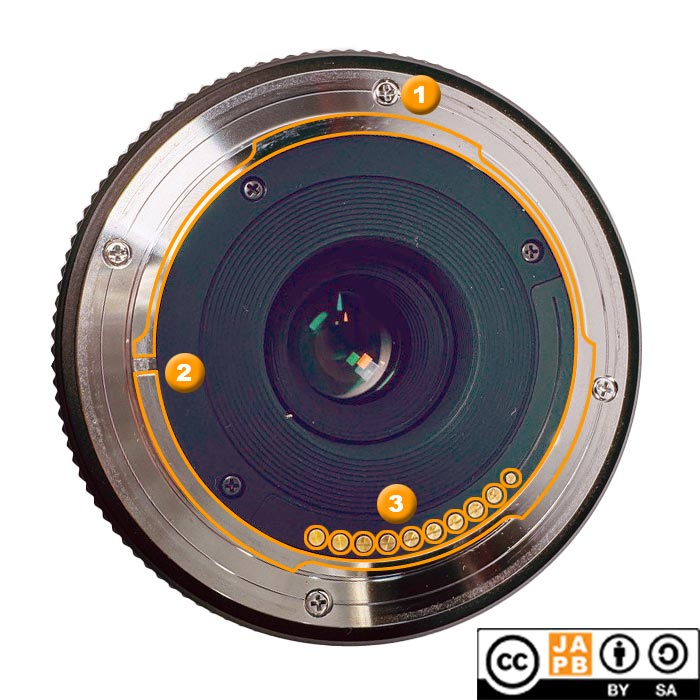
Key characteristics of the Contax N -mount:
[1] Three-pronged bayonet mount, all edges rounded
[2] Locking notch/groove* at 09:00
[3] Bank of 10 electronic contacts (spring-loaded on the camera end)
No levers or slot drive screws.
Introducing the Contax N mount
The Contax N system was a short-lived attempt at creating a high-end modern AF system. It seems Kyocera was hoping to create a platform that could serve both analog and digital camera lineups, including the world’s first full-frame dSLR. Problematically, the system failed commercially and was officieally discontinued in 2005 as Kyocera decided to exit the camera business.
Contax N mount cameras
| Name | Years | Notes |
|---|---|---|
| Contax N1 | 2001–05 | Very advanced film SLR targeted at Pro market |
| Contax NX | 2002–05 | Prosumer advanced film SLR |
| Contax N Digital | 20021–05 | Pro-level camera body featuring a full-frame digital sensor (the first at its time) |
Contax N mount lenses
The entire lineup of lenses for the Contax N system were co-designed by Carl Zeiss and Kyocera and manufactured by Kyocera in Japan. Manufacturing standards are said to have been unusually high, because Kyocera seriously wanted to launch the Contax N system to rival the pro hardware by Canon and Nikon. However, as the system’s commercial success remained elusive, the lineup of lenses is (understandably) on the short side:
| Lens name and specs | Introd. | Optical construction | MFD | Filter thread | Weight | Length / diameter | Notes |
|---|---|---|---|---|---|---|---|
| Carl Zeiss Planar T* 50 mm f/1.4 | 2000 | 7e / 6g | 0,45 m | 67 mm | 310 g | 55 mm / 80 mm | |
| Carl Zeiss Planar T* 85 mm f/1.4 | 2002 | 10e / 9g | 0,83 m | 82 mm | 800 g | 80 mm / 90 mm | |
| Carl Zeiss Makro-Sonnar T* 100 mm f/2.8 | 2000 | 12e / 8g | 0,32 m | 72 mm | 960 g | 130 mm / 86 mm | |
| Carl Zeiss Tele-Apotessar T* 400 mm f/4 | 2002 | 7e / 6g | 2,9 m | 112 mm | 3580 g | 290 mm / 120 mm | |
| Carl Zeiss Vario-Sonnar T* 17–35 mm f/2.8 | 2002 | 15e / 10g | 0,5 m | 95 mm | 900 g | 96 mm / 102 mm | |
| Carl Zeiss Vario-Sonnar T* 24–85 mm f/3.5–4.5 | 2000 | 14e / 12g | 0,5 m | 82 mm | 570 g | 71 mm / 90 mm | |
| Carl Zeiss Vario-Sonnar T* 28–80 mm f/3.5–5.6 | 2002 | 7e / 7g | 0,5 m | 55 mm | 380 g | 70 mm / 76 mm | |
| Carl Zeiss Vario-Sonnar T* 70–200 mm f/3.5–4.5 | 2002 | 14e / 11g | 1 m | 67 mm | 620 g | 106 mm / 78 mm | |
| Carl Zeiss Vario-Sonnar T* 70–300 mm f/4–5.6 | 2000 | 16e / 11g | 1,5 m | 72 mm | 1070 g | 129 mm / 88 mm |
Adapting Contax N lenses
Adapting to SLRs: Besides using your Contax N lenses on one of the three Contax N bodies, there is no easy way. While the Contax N mount has a comparably generous flange focal distance (48 mm), the issue is the lens’ electronic nature (no aperture control). In practice, a full-functionality adapter would need to be a smart adapter, and there is simply not space for that.
I have seen examples of Contax N lenses having been modified for use on Canon EF cameras, but unless you know a highly proficient camera mechanic, I cannot recommend exploring this route.
Adapting to mirrorless: Again, the main challenge is the electronic communication that the lens requires. To that end, there are two potential approaches: smart adapters and adapters with a built-in diaphragm. Regarding smart adapters there are several alternatives on the market at least for the Sony FE mount. Similarly, there are some adapter manufacturers that adapters from Contax N to Sony FE that have an adjustable diaphragm, but depending on the lens type, such adapters may lead to hard vignetting.
In sum, Contax N lenses are among the more difficult to adapt lenses out there
Footnotes:
- The Contax N Digital was introduced already 2001, but Kyocera struggled in getting it mass-production ready. ↩︎