Pekka Buttler 09/2026
Introduction and table of contents
This article aims to offer a very thorough summary of lenses made by Tōkyō Kōgaku K. K. (Topcon). If you already know about Topcon (the company) or do not care, please continue reading. Otherwise we recommend you also have a look at the Topcon company profile on JAPB.
While this article is the result of copious reading, research, scouring endless-seeming eBay listings and some collecting as well, I do not claim to know it all. Hence I welcome all improvements or insights that you might offer.
Also, I have not found enough detailed information on the Topcon lenses produced for the Leica thread mount (LTM). Hence these are not included in the current version of this compendium. If you have something to add, please leave a comment or be in touch.
Naming
Like many Japanese camera companies, the name of the company and its various businesses do not always share names. In the case of Topcon, the actual company name (during its camera era) was Tokyo Kogaku (latinised), whereas ‘Topcon’ was the sales name of Tokyo Kogaku cameras, and ‘Topcor’ was the sales name of Tokyo Kogaku lenses (whether for Topcon cameras or cameras of other brands). Subsequently (and only after having exited the camera and lens business) in 1989 Tokyo Kogaku K. K. officially changed its name to ‘Topcon Corporation’.
Topcon camera technology
It aids in understanding the generations of Topcon lenses, if one also has a grasp of the cameras that those lenses were manufactured for. Hence, we will quickly summarise the systems that these lenses were part of:
Topcon ‘pro’ cameras
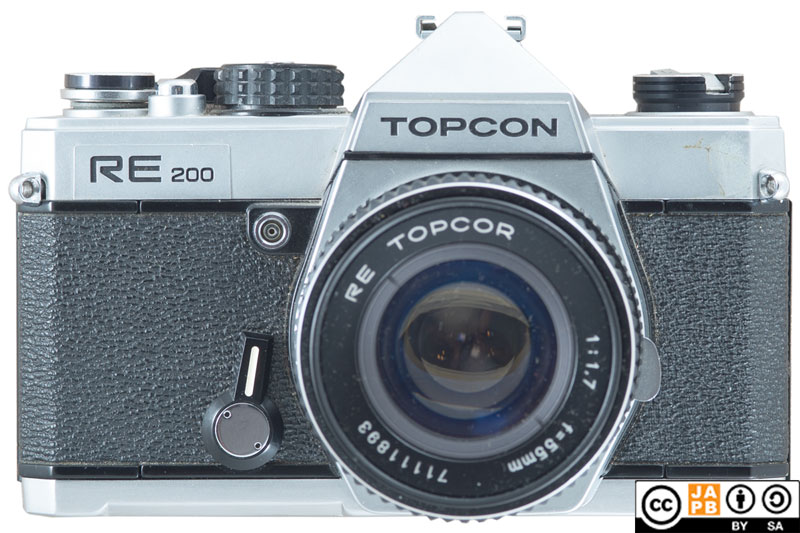
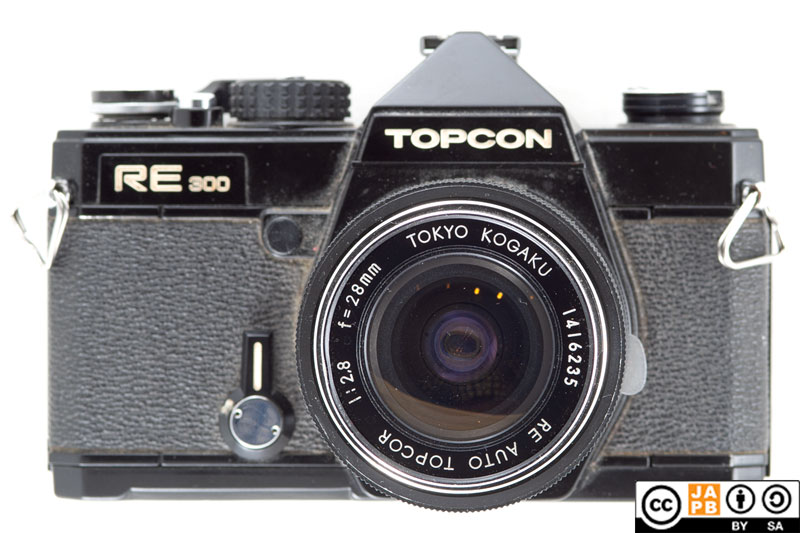
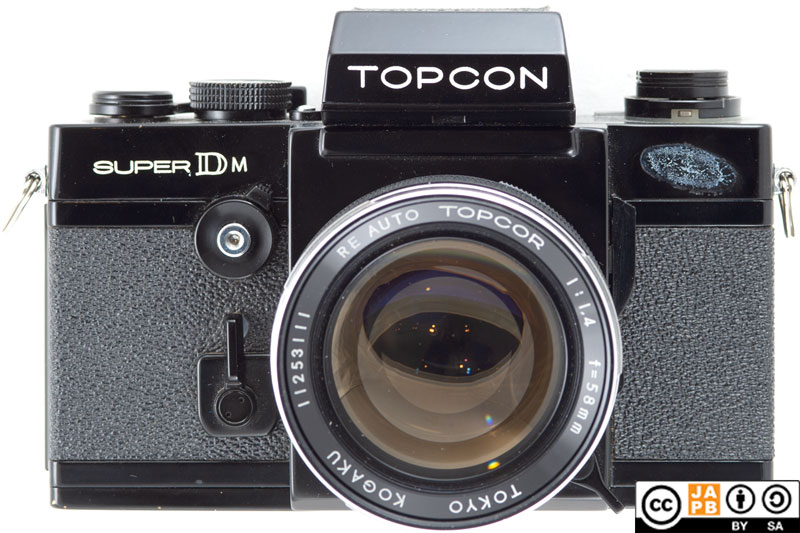
Topcon’s lineup of ‘pro’ cameras began in 1957 with the Topcon R and ended effectively with the Topcon Super DM (discontinued 1977). These cameras were characterised by Topcon’s generations of extensions on the venerable Exakta mount. Below some images as well as a table summarising the trajectory of these cameras.
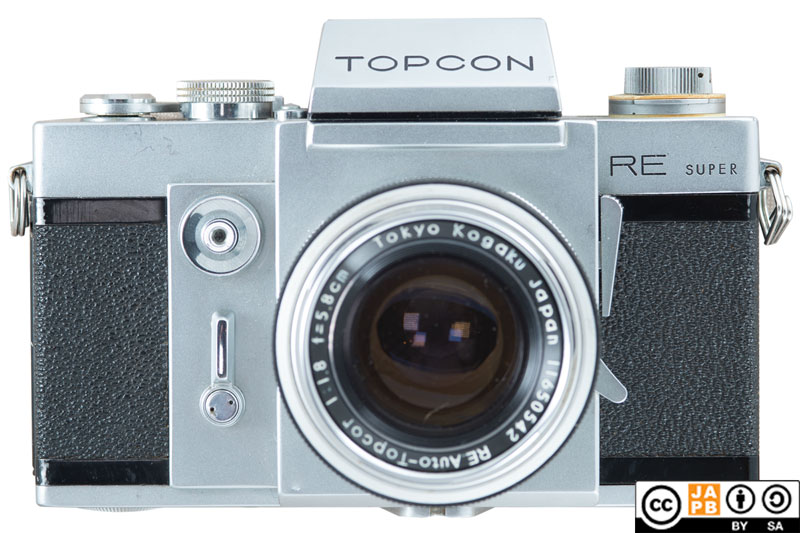
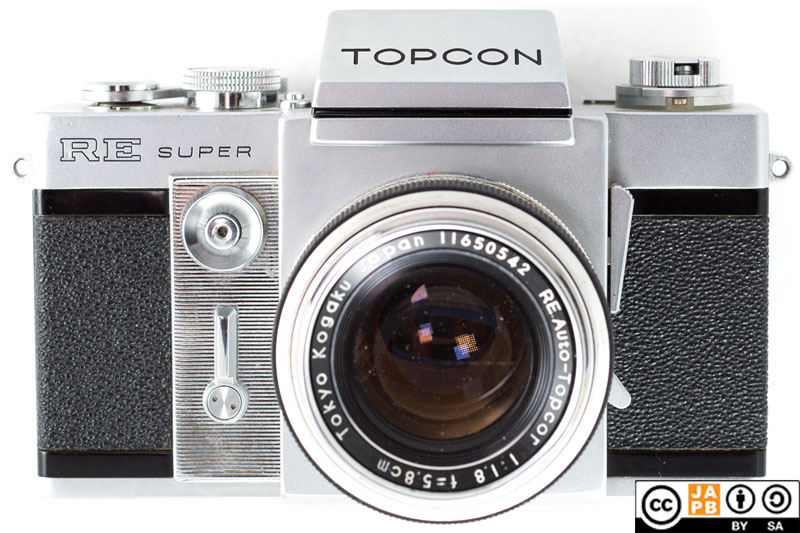
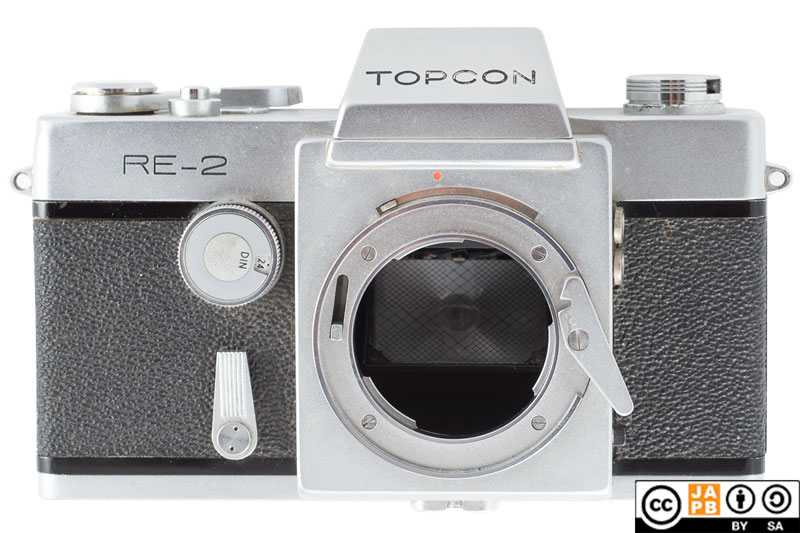
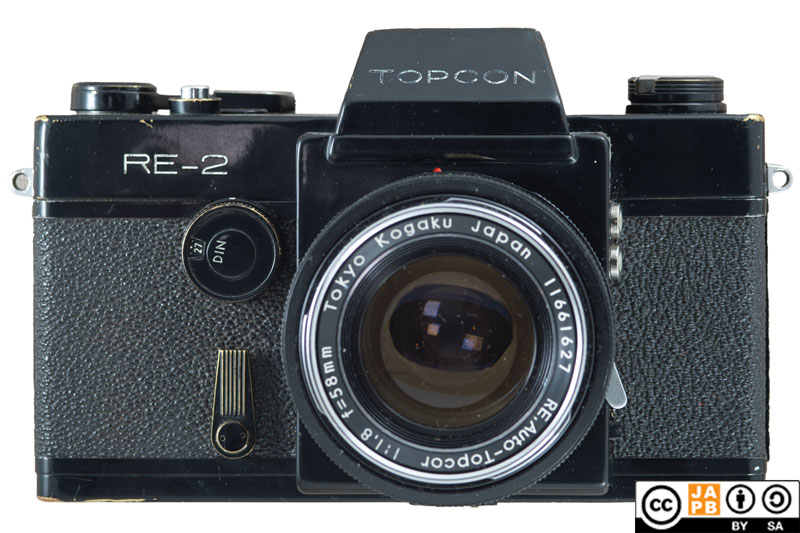
| Camera models | Year(s) | Designed for | Compatible with | Camera-lens interaction |
|---|---|---|---|---|
| Topcon R | 1957 | Auto-Topcor lenses with Stop-down using PAD | R-Topcor lenses with preset aperture | Only using PAD |
| Topcon R II Topcon R III (automatic) | 1960 1960 | F.Auto Topcor lenses with two-way aperture communication | R-Topcor lenses with preset aperture | Camera->Lens: Auto Aperture Lens->Camera: Aperture communication (not implemented on R II or R III) |
| Topcon RS | 1962 | F.Auto Topcor lenses with two-way aperture communication | R-Topcor lenses with preset aperture. RE.Auto Topcor lenses with two-way aperture communication | Camera->Lens: Auto Aperture |
| Topcon RE Super Topcon RE-2 Topcon Super D Topcon Super DM | 1963 1965 1972 1973 | RE.Auto Topcor lenses with two-way aperture communication | R-Topcor lenses with preset aperture | Camera->Lens: Auto Aperture Lens->Camera: Aperture communication |
| RE 200 RE 300 | 1977 1978 | RE Topcor lenses with two-way aperture communication | R-Topcor lenses with preset aperture RE.Auto Topcor lenses with two-way aperture communication | Camera->Lens: Auto Aperture Lens->Camera: Aperture communication |
Topcon R (1957)
Tokyo Kogaku launched the Topcon R interchangeable lens SLR in 1957. It was designed to use the Exakta bayonet for attaching lenses, but Topcon did not copy the Exakta mount in its entirety. For instance Topcon cameras had their shutter button on the right-hand side, whereas Exakta cameras had the shutter button on the left-hand side. This also meant that Exakta and Topcon-lenses using pressure-activated diaphragms and other pass-through devices were not compatible. Topcon also never implemented the external Exakta mount. See more about the differences between the variants of the Exakta mount in the JAPB article on the Exakta mount(s).
Topcon R II and R III (1960)
The Topcon R II takes the body of the Topcon R, but integrates aperture communication into the mount. Not only does the mount now facilitate fully automatic aperture stop-down (the lens is stopped down to the selected aperture only for the time of exposure), but the lens also communicates the selected aperture using a small pin in the base of the lens, hence theoretically allowing open-aperture metering – a feature the next Topcon cameras (R II, R III and RS) do not yet make use of. Had this feature been fully implemented, it would have put the the Topcon system on par with the most advanced SLRs of the age (the Konica F and Nikon F) and in advance of all the remaining competitors (Asahi, Canon, Minolta, Miranda, Yashica).
The R III (also released 1960) is the same as the R II, except that it combined the slow-speed and high-speed shutter dials.
Topcon RS (1962)
The 1962 Topcon RS was a transitional model in that while it already shared the superior mechanics of the RE Super (introduced 1963), it did not have its successor’s integrated metering. Likely in order to make it compatible both with F.Auto Topcor lenses and the next generation RE.Auto lenses it has no pin for reading the set aperture.
Topcon RE Super, RE-2, Super-D and Super DM (1963–1973)
While the Topcon R II was advanced for its age, the RE Super was revolutionary in that it (as the first interchangeable lens focal plane shutter SLR camera) integrated a through-the-lens (TTL) meter. In combination with the mount’s ability to communicate the selected aperture from the lens, this made the RE Super able to TTL-meter without needing the photographer to stop-down the lens to do so. Open-aperture TTL metering put the Topcon RE Super years ahead of its competition. As the camera also included pro features like interchangeable viewfinders and prisms as well as bulk magazines and motors, this made the Topcon RE Super the most advanced camera of its day.
The 1965 RE-2 was a budget version of the RE Super (it had the same metering abilities but saved by omitting several pro-only features) and the 1972 and 1973 Super D and Super DM added some valuable features (and improved a bit on the mechanics), but there are no huge differences between the 1963 RE Super and the 1973 Super DM1.
RE 200 and RE 300
By 1977 Topcon had reluctantly come to accept that they had fallen behind (both in technology and market share) and did not have the financial strength to compete in the increasingly bloody camera business. Whether to help sell existing lens stocks or to try to milk the name for what it’s worth, Topcon launched two more cameras using the Topcon/Exakta mount.
The RE 200 and the RE 300 (which only added a winder connection) and RM300 (which used a Pentax K mount) were bog-standard late 1970s SLR cameras. Together with these cameras, a new line of lenses were being offered, called ‘RE TOPCOR’ (not RE.Auto Topcor). While the RE TOPCOR lenses were manufactured to a higher standard than the average late 80s third party lenses, they did not reach the quality of major brand lenses.
While it is often repeated that the RE 200 and 300 cameras and the RE TOPCOR lenses were manufactured by ‘Cima Kogaku’, this is often mentioned to imply that Topcon was so ‘cheap’ that instead of manufacturing these cameras and lenses themselves, they subcontracted the entire product line to some no-name Japanese OEM. This is a distinctly uncharitable reading.
Instead it seems likely that Cima Kogaku2 was a Topcon spinoff to which Topcon shifted camera and lens production to, while the parent company tried to reorient themselves towards more profitable ventures (and did so with considerable success).
Topcon prosumer cameras
Since 1959 Tokyo Kogaku had also been playing with fixed lens leaf shutter SLR cameras. The initial models (named Topcon PR and Topcon PR II) were relatively modest affairs, but the 1960 Topcon Wink Mirror (named for that the instant return mirror’s movement was as quick as a wink) offered an ambitious integrated lens and a compelling set of features – assuming you could manage with a fixed lens and without metering. After metering was offered in the 1961 Wink Mirror E, this was a competitive camera limited only by the lack of interchangeable lenses.
Topcon Wink Mirror S (1963)
However, in 1963 – an auspicious year for Tokyo Kogaku – even that lack was addressed. The Topcon Wink Mirror S introduced a lens mount (the Topcon UV mount) for mounting lenses in front of the leaf shutter. Initially only a modest range of lenses (35/3.5, 53/2 and 100/4) was offered, but the Wink Mirror S offered something few other SLRs could offer: Exposure automation (shutter priority)3 in a package that was considerably more attainable than most other SLR systems (that did not even offer any type of exposure automation).
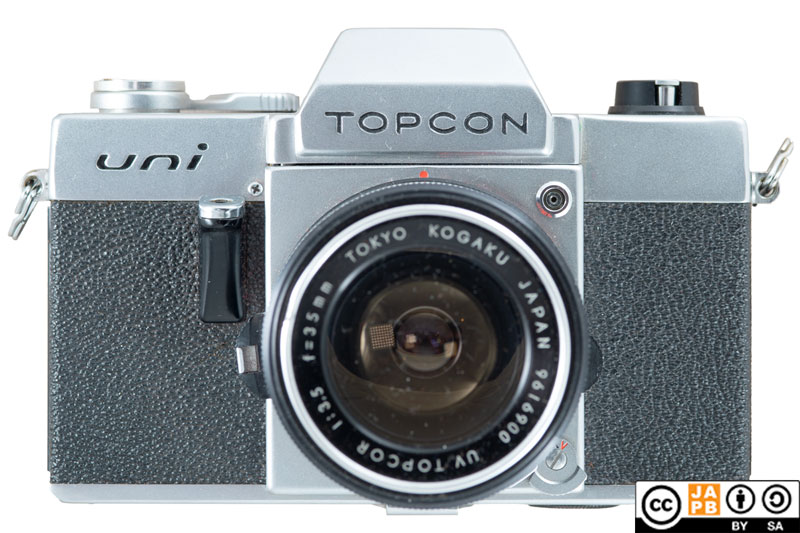
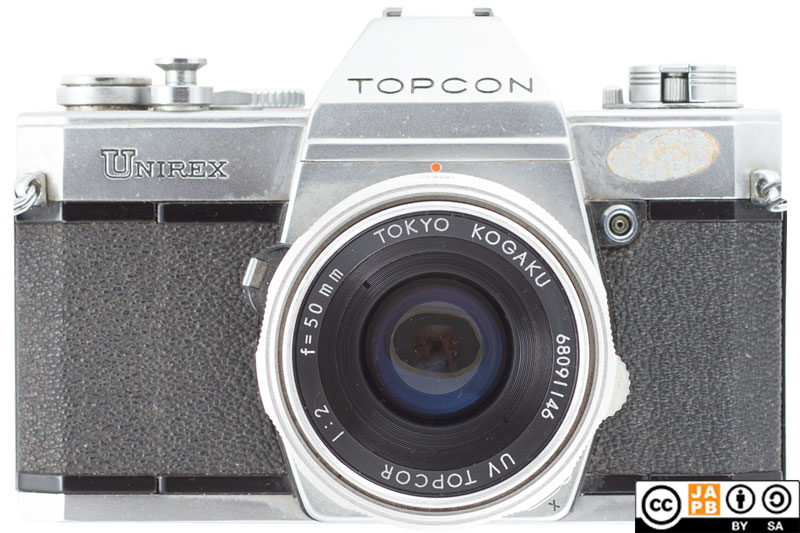
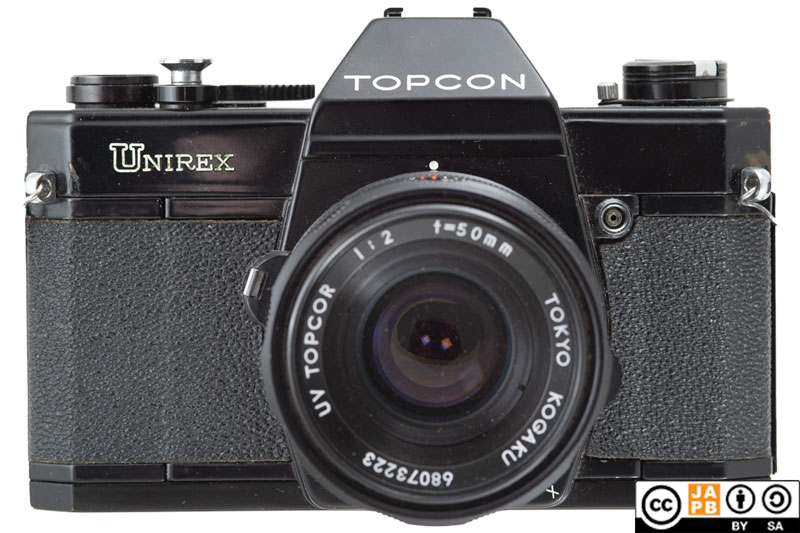
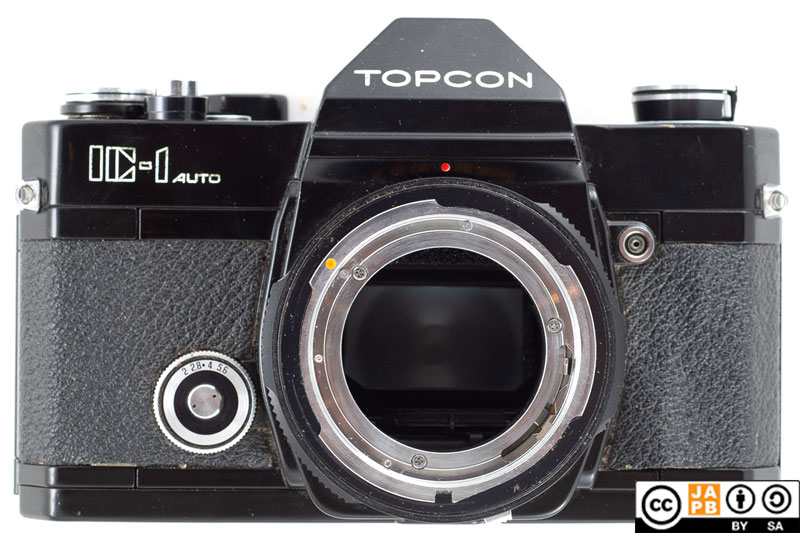
Topcon Uni4 (1964)
If the Wink Mirror S had been an attractive camera, the Topcon Uni did one better by changing the metering (of the exposure automation) from external to through-the-lens, hence making it the first ever interchangeable lens SLR with TTL exposure automation. Also a few more lenses (135/4 and 200/4) were added to the lineup. The camera was a commercial success and cemented Topcon as a force to be reckoned with. In a manner very typical for Topcon, they did not rush to upgrade a product that was selling well, until…
Topcon Unirex (1969) and Unirex EE (1972)
The Unirex was (in technical terms) an incremental update on the Uni, as it added spot metering as an alternative to average metering. Cosmetically it was very different and was designed to appeal to ‘the young public’. With the Unirex, also a 28 mm wide-angle lens was introduced.
The 1972 Unirex EE was not an upgrade, but intended as a budget model, as it omitted the spot metering and was even available with a budget 50 mm f/2.8 lens.
The relative lack of development in the Topcon UV line of cameras is centrally caused by that the leaf shutter held such a central role in the camera – features could only be added if the leaf shutter manufacturer (Seikosha) could be made to embrace them. Seikosha however noticed that most of its other clients had given up on leaf shutters, so instead of being willing to entertain Topcon’s feature requests, Seikosha told Topcon to find another type of shutter or another supplier, hence leading to…
Topcon IC-1 Auto and Topcon New IC-1 Auto (1973 and 1975)
The Topcon IC-1 Auto (IC stands for ‘integrated circuit’) was designed to use the Topcon UV mount (for backwards compatability), but it replaced the Seikosha leaf shutter with a Copal cloth focal plane shutter. Theoretically this move released the subsequent Topcon UV mount cameras from two limitations set by the previous leaf shutters. First, it would have allowed shutter speeds faster than 1/500, but this chance was not acted upon. Secondly, it would now allow the design of lenses with larger rear elements5. This later opportunity was taken and Topcon started selling new lens designs for the Topcon UV mount as HI TOPCOR (not UV TOPCOR) lenses and in 1975 Topcon introduced a new, faster standard prime and the New IC-1 Auto to make use of it.
However, by this time Topcon was already (financially) at the end of its tether. Hence the opportunities of this new line of cameras was not embraced to the extent that they could have been.
Topcon–Exakta mount lens generations
Auto-Topcor lenses
The Auto-Topcor lenses were offered for use with the Topcon R camera, and they use a PAD (pass-through device) to synchronise aperture stop-down with shutter activation. Initially these lenses were offered using semi-automatic aperture (while stop-down was automatic, the photographer would have to prime the aperture mechanism manually), while later most of the same lenses were offered also with a fully automatic aperture6. The entire lineup of Auto-Topcor lenses is summarised below.
| Mainline specifications | Introduced | Aperture mechanism | Optical design | Topcon product code | Serial # start | Number of copies |
|---|---|---|---|---|---|---|
| 3,5 cm f/2.8 | 1957 | semi-automatic | 7e / 5g | 29B | 29xxxx | insuf.data |
| 5,8 cm f/1.8 | 1957 | semi-automatic | 6e / 4g | 28B | 28xxxx | >8000 |
| 10 cm f/2.8 | 1957 | semi-automatic | 5e / 3g | 32B | 32xxxx | insuf.data |
| 13,5 cm f/3.5 | 1958 | semi-automatic | 4e | 10B | 7 | insuf.data |
| 3,5 cm f/2.8 | 1960 | automatic | 7e / 5g | 69B | 69xxxx | insuf.data |
| 5,8 cm f/1.8 | 1960 | automatic | 6e / 4g | 63B | 63xxxx | >1500 |
| 10 cm f/2.8 | 1960 | automatic | 5e / 3g | 68B | 68xxxx | insuf.data |
All Auto-Topcor lenses were mainly black, but came equipped with a chromed front (including filter threads) and a chromed stop-down priming lever8. Even though they are among the first SLR lenses, they already have a very customary control arrangement with the aperture ring (with click stops) at the back, a DOF scale painted on an unmoving surface between aperture ring and focus ring, and a metal, lengthwise ribbed ‘hills-and-valleys’ type focus ring. The one thing these lenses have that later lenses don’t is obviously the PAD-device on an arm that brings it to rest above the Topcon R’s shutter button and (for early Auto-Topcor lenses) the priming lever.
In 1960 Tokyo Kogaku introduced the Topcon R II camera that used another generation of lenses (the F.Auto-Topcor lenses, see below). At the same time, three of the four existing Auto-Topcor lenses were modernised from semi-automatic to fully automatic operation and these new Auto-Topcor lenses remained available for some years. Besides that these fully automatic Auto-Topcor lenses lack the priming lever, they also have different serial numbers from the earlier, semi-automatic variants.
I have not gathered enough serial number data to give any kind of estimate on the number of copies manufactured, except for the 58/1.8 lenses. There are however two reasons to assume that the 35 mm lens was the second most manufactured. Firstly, in a somewhat exceptional move, Topcon offered the Topcon R camera in two types of kits – either with the 58 mm or with the 35 mm lens and if you wanted to buy a second lens, the list price of both lenses was the same. Second, simply based on the number of lenses I have seen, the 35 mm lens is clearly more common than the 100 mm Auto-Topcor. Based on the same judgment (lenses I’ve seen), the Auto-Topcor 135/3.5 mm lens is very rare.
R-Topcor lenses
The R-Topcor lenses were introduced together with the 1957 Topcon R camera. Unlike the line of Auto-Topcor lenses that were also introduced for the Topcon R camera, the R-Topcor lenses were preset aperture lenses, meaning that they are effectively compatible with every generation of Topcon-Exakta cameras as well as Exakta-mount cameras in general.
Topcon’s decision to offer some lenses with semi-automatic apertures and some with preset apertures is partially based on making the most crucial focal lengths (35 mm wide angle; 58 mm normal, 100 mm portrait) available with aperture automation, while keeping the less usual (and longer9) focal lengths in preset mode. The table below lists all known R-Topcor lenses.
| Mainline specifications | Introduced | Aperture mechanism | Optical design | Topcon product code | Serial # start | Number of copies |
|---|---|---|---|---|---|---|
| 28 mm f/2.8 | unknown | preset | unknown | 37B | 37xxxx | only prototypes |
| 50 mm f/2.8 | 1958 | preset | unknown10 | unknown | unknown | only prototypes |
| 90 mm f/3.5 | 1958 | preset | 3e / 3g | 36B | 36xxxx | insuf.data |
| 135 mm f/2 | 1957 | preset | 6e / 4g | 31B | 31xxxx | insuf.data |
| 135 mm f/3.5 | 1960 | preset | 4e / 3g | 30B | 30xxxx | insuf.data |
| 200 mm f/4 | 1960 | preset | 5e / 3g | 28B | 38xxxx | insuf.data |
| 300 mm f/2.8 | 1957 | preset | 5e / 4g | 34B | 34xxxx | insuf.data |
| 300 mm f/5.6 | 1960 | preset | 4e / 4g | 70B | 70xxxx | insuf.data |
For an era where many photo manufacturers offered preset lenses alongside auto aperture lenses, there are two lenses that make the R-Topcor lineup less than ordinary, namely the 135 mm f/2 and the equally impressive 300 mm f/2.8. These two designs more than anything else are proof that when Tokyo Kogaku launched the Topcon R in 1957, they were dead set on not launching an also-ran system.
To help put these two lenses into perspective:
| Company | First production 135 mm f/2 | First production 300 mm f/2.8 |
|---|---|---|
| Topcon | R-Topcor 135/2 (1957) | R-Topcor 300/2.8 (1957) |
| Canon | Canon FDn 135/2 (1980) (+23years) | Canon FD 300/2.8 Fluorite (1974) (+17y) |
| Konica | never (135/2.5 in 1973) | never |
| Leica | never | Leica APO-Telyt-R 1:2.8/280mm (1984) (+27y) |
| Minolta | Minolta MD 135 mm f/2.8 (1981) (+24 y) | Minolta AF 300/2.8 APO (1985) (+28y) |
| Nikon | Nikkor-K 135/2 (1975) (+18y) | Nikkor-F 300 mm f/2.8 (1972) (+15y) |
| Olympus | never | Zuiko AUTO-T 350mm f/2.8 ED-IF (1985) (+28y) |
| Pentax | SMC Pentax-A* 135mm F1.8 (1984) (+27y) | SMC Pentax-A* 300mm F2.8 ED [IF] (1984) (+27y) |
| Zeiss | Carl Zeiss (C/Y) 135 mm f/2 (1975) (+18y) | Carl Zeiss (C/Y) 300 mm f/2.8 (1985) (+28y) |
As you can see from the table above, both the 300/2.8 and 135/2 were truly groundbreaking11 designs and it took key competitors more than a dozen years to catch up.
F.Auto-Topcor lenses
In 1960 Topcon launched the R II camera and with it a new series of lenses to replace the Auto-Topcor lenses offered for the 1957 Topcon R camera. This new series was named F.Auto-Topcor and the preceeding letter ‘F’ was to indicate that these lenses now featured a fully automatic aperture (instead of the previous generation’s semi-automatic apertures.
Whereas the Auto-Topcor lenses facilitated automatic stop-down using a Pass-through device (PAD) resting atop the camera’s shutter release button), this new generation of lenses facilitated automatic aperture stop-down using a lever in the based of the lens, operated by a corresponding lever in the camera body.
But Tokyo Kogaku wanted to future-proof this family of lenses. Hence they also added another feature to allow the lens to communicate its selected aperture to the camera (to enable open-aperture metering). While this feature was not yet supported by any Topcon camera, it did show intent and ambition.
Another clear sign of that intent and ambition was in the quality of these lenses. The build quality was at the highest level that 1960s engineering could achieve, and for the first time Tokyo Kogaku added rubber focus rings to the lenses. Another special F.Auto-Topcor feature was that the lens’ focusing distance could be read through a clear plastic window that also showed a depth-of-field scale.
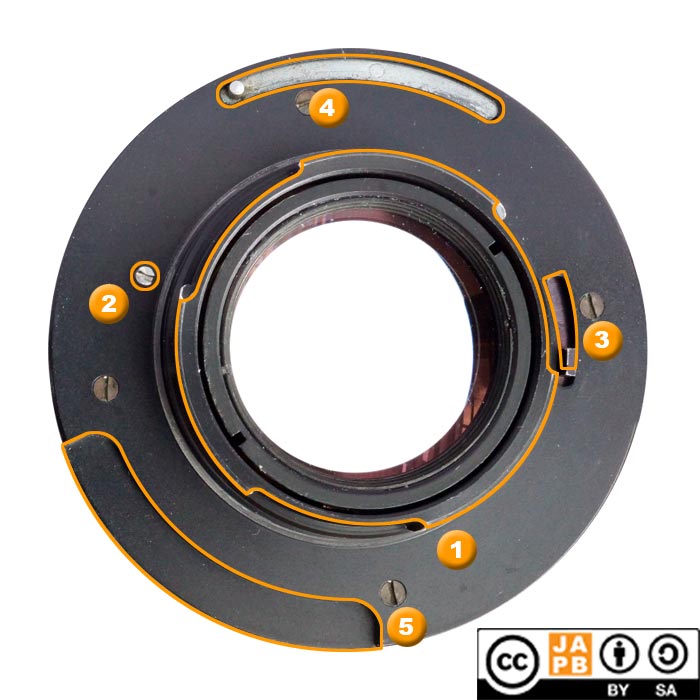
[1] Vanilla Exakta bayonet, with
[2] Exakta-spec locking pin (note the absence of the so called ‘Topcon pin’)
[3] Auto stop-down lever
[4] Aperture communication pin (physically part of the aperture ring).
[5] Cut-out to facilitate mounting on Topcon R camera.
Hence, Tokyo Kogaku already introduced all the elements of the RE.Auto-Topcor lenses (see below) in the earlier F.Auto Topcor lenses, with one cruel twist: Going from the Topcon R II (and the F.Auto-Topcor lenses) to the Topcon RE Super (and the RE.Auto-Topcor lenses), Tokyo Kogaku decided to change the direction of the aperture ring (from 22–16…2.8–1.8 on the F.Auto series to 1.8–2.8…16–22 in the RE.Auto series). As a result of this F.Auto-Topcor lenses cannot be used on any of the Topcon bodies from the RE Super onward while also not offering any level of aperture automation on the original Topcon R.
The F.Auto-Topcor lineup of lenses was practically the same as those on offer 3 years earlier in Auto-Topcor guise, with the obvious modifications (removal of pass-through device, addition of stop-down lever in mount) as well as some cosmetic and ergonomic tweaks (addition of rubber focus rings and a plastic DOF window). While each lens got a new product code, the optical recipes were unchanged.
| Mainline specifications | Introduced | Aperture mechanism | Optical design | Topcon product code | Serial # start | Number of copies |
|---|---|---|---|---|---|---|
| 3,5 cm f/2.8 | 1960 | automatic | 7e / 5g | 74B | 74xxxx | insuf.data |
| 5,8 cm f/1.8 | 1960 | automatic | 6e / 4g | 62B | 28xxxx | insuf.data |
| 10 cm f/2.8 | 1960 | automatic | 5e / 3g | 68B | 32xxxx | insuf.data |
| 13,5 cm f/3.5 | 1961 | automatic | 4e / 3g | 76B | 76xxxx | insuf.data |
In the secondhand market copies of the F.Auto-Topcor lenses are quite rare. Not only were overall production numbers quite modest (maybe 8000 copies of the R II, R III and RS cameras), it also seems like this generation of lenses have suffered increased attrition due to having been orphaned between the original Topcon R and the subsequent and highly successful Topcon RE cameras. As a result of the low number of remaining specimen in the wild, any estimates on production numbers are inherently futile.
RE.Auto-Topcor lenses
Launched together with the 1963 Topcon RE Super, the RE.Auto-Topcor lenses are THE line of Topcon pro/prosumer lenses. The ‘RE’ in the name of the lenses was intended to link these lenses with the camera (the RE Super). In terms of the functionality offered by the lenses, they are very similar to the F.Auto Topcor lenses (see above) in that they use the Exakta bayonet mount, with a lever to facilitate fully automatic aperture stop-down as well as a pin to indicate the lens’ selected aperture – a feature introduced with the F.Auto Topcor lenses but never used. As Tokyo Kogaku chose to reverse the aperture ring’s direction going from the F.Auto series to the RE.Auto series of lenses, this made the F.Auto lenses incompatible with the RE-series of cameras.
The initial lineup of lenses for the RE Super camera largely echoes the lenses that already existed in the F.Auto series with two changes. While the 35/2.8, 58/1.8 and 135/3.5 were fundamentally just given a new housing and launched for the new camera, the rehousing and launch of the 100/2.8 was delayed by a few years. Instead, Tokyo Kogaku chose to use its lens design resources for the 58 mm f/1.4. Given that Tokyo Kogaku was simultaneously busy launching another new line of interchangeable lenses for the Wink Mirror S, the relatively unambitious lens lineup at launch is more understandable.
RE.Auto-Topcor lenses initially used a distinctive colouring scheme with a matte silver/chrome to go with similarly coloured bodies. However, because the photo industry had gotten it into their heads that black meant premium, Topcon also started offering black bodies and black variants of some lenses (starting, notably, with the 58/1.4) in ca. 1966 before extending the black colour alternative to most of the remaining lenses in 1971–1973.
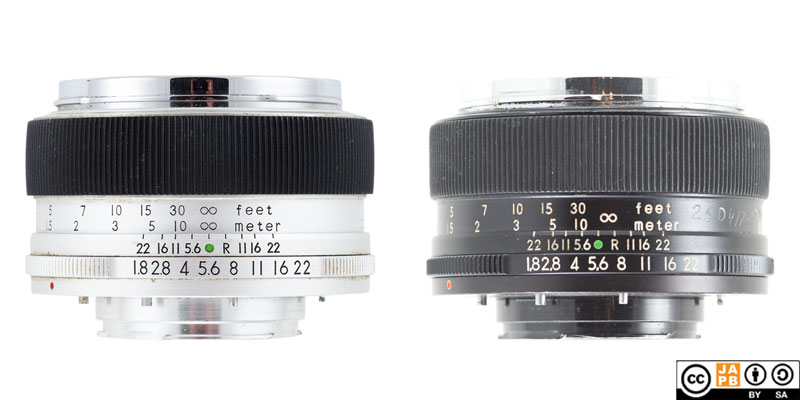
Right: RE.Auto-Topcor 58 mm f/1.8 in black
Because there is both some confusion and outright misinformation about the Lineup of Tokyo Kogaku RE.Auto-Topcor lenses out there, these two tables below try to summarise every RE.Auto-Topcor lens. The first table summarises all serially manufactured lenses including production variants (that mostly are also reflected in serial numbers). The second table focuses on those lenses that left the drawing table, but were never serially manufactured.
Serially manufactured RE.Auto-Topcor lenses (including variants)
| Mainline specifications | Family | Produced | colours | Optical design | Topcon product code | Serial # start | Number of copies12 | Notes |
|---|---|---|---|---|---|---|---|---|
| 20 mm f/4 | RE.Auto | 1969–76 | silver | 8e / 6g | 12344 | 135xxxx | ≈2000 | [data sheet] |
| 2,5 cm f/3.5 25 mm f/3.5 | RE.Auto | 1965–76 | silver | 7e / 7g | 93B | 93xxxx 936xxxx | ≈8000 | [data sheet] |
| 28 mm /2.8 | RE.Auto | 1971–76 | silver black | 7e / 7g | 12346 | 141xxxx | ≈7000 | [data sheet] |
| 30 mm f/3.5 macro | RE.Auto | 1967–76 | silver | 6e / 4g | 124B | 124xxxx | <1000 | |
| 3,5 cm f/2.8 35 mm f/2.8 | RE.Auto | 1963–76 | silver black | 7e / 5g | 74B | 74xxxxx | ≈23000 | [data sheet] [walk-around] |
| 50 mm f/1.4 | RE GN | 1973–78 | black | 7e / 5g | 157B | 157xxxxx | ≈5000 | |
| 50 mm f/1.8 | RE GN | 1973–78 | black | 6e / 5g | 158B | 158xxxxx | ≈6000 | |
| 5,8 cm f/1.4 (I) | RE.Auto | 1963-65 | silver | 7e / 5g | 94B | 94xxxx | ≈4000 | |
| 5,8 cm f/1.4 58 mm f/1.4 (II) | RE.Auto | 1965–77 | silver black | 7e / 5g | 112B | 112xxxxx | ≈35000 | [data sheet] [walk-around] |
| 5,8 cm f/1.8 (I) | RE.Auto | 1963–64 | silver | 6e / 4g | 62B | 28xxxx | ≈500013 | |
| 5,8 cm f/1.8 (II) | RE.Auto | 1964–65 | silver | 6e / 4g | 99B | 99xxxx | ≈10000 | |
| 5,8 cm f/1.8 (III) | RE.Auto | 1965–66 | silver | 6e / 4g | 116B | 1160xxxx | ≈10000 | |
| 5,8 cm f/1.8 (IV) 58 mm f/1.8 (IV) | RE.Auto | 1966–78 | silver black | 6e / 5g | 129B | 116[1–8]xxxx | ≈80000 | [data sheet] |
| 5,8 cm f/3.5 macro | RE.Auto | 1966–78 | silver | 5e / 4g | 101B | 101xxxx | ≈1000 | 14 |
| 5,8 cm f/3.5 macro 58 mm f/3.5 macro | RE.Auto | 1969–78 | silver black | 5e / 4g | 137B | 137xxxx 1370xxxx 1375xxxx | ≈4000 | |
| 85 mm f/1.8 | RE.Auto | 1973–78 | black | 6e / 5g | 133B | 133xxxxx | ≈ 1200 | |
| 10 cm f/2.8 100 mm f/2.8 | RE.Auto | 1965–76 | silver black | 5e / 3g | 75B | 75xxxxx | ≈15000 | [data sheet] [walk-around] |
| 13,5 cm f/3.5 135 mm f/3.5 | RE.Auto | 1963–78 | silver black | 4e / 3g | 76B | 76xxxx 76xxxxx | ≈27000 | [data sheet] |
| 13,5 cm f/4 135 mm f/4 | RE.Auto | 1967–78 | silver | 3e / 3g | 113B | 113xxxx | ≈2500 | |
| 20 cm f/5.6 200 mm f/5.6 | RE.Auto | 1966–78 | silver black | 5e / 4g | 98B | 4 | ≈8000 | [data sheet] |
| 30 cm f/5.6 300 mm f/5.6 | RE.Auto | 1965–78 | black | 4e / 4g | 155B | 155xxxxx | ≈1000 | |
| 500 mm f/5.6 | RE.Auto | 1969–78 | black | 5e / 5g | 111B | 111xxxx | < 500 | |
| 87–205 mm f/4.7 | RE.Auto | 1967–78 | silver black | 13e / 8g | 130B | 130xxxx and 1xxxx | ≈6000 |
RE.Auto-Topcor lenses that never made it into mass production
There are several lenses that Tokyo Kogaku planned for its professional line of cameras that however were never mass produced. Here I have summarised the more believable rumours. In some cases these are believable because some samples were actually produced and have been (rarely) seen at auctions (like the RE GN 35 mm f/1.8) or they might be believable because they were mentioned in the contemporary press (like the 7 mm fisheye which was mentioned with picture in ‘Popular photography’). In other cases the rumours are believable because they are oft-repeated.
| Mainline specifications | Family | Introduced/ Announced | colours | Optical design | Topcon product code | Serial # start | Notes |
|---|---|---|---|---|---|---|---|
| 7 mm f/4 fisheye | RE.Auto | 1969 | silver | 12e / 8g | unknown | N/A | |
| 28 mm f/2 | unclear | unknown | unknown | unknown | unknown | N/A | |
| 28 mm /2.8 | RE GN | 1975 | black | unknown | unknown | N/A | |
| 35 mm f/1.8 | RE GN | 1974 | black | unknown | unknown | 12740002 | 15 |
| 700 mm | unclear | 1969 | unknown | unknown | unknown | N/A | |
| 1000mm | unclear | 1969 | unknown | unknown | unknown | N/A |
RE.Auto-Topcor lenses that were made for the US Navy
In 1965 Topcon famously managed to snag the contract to supply the US navy with cameras and lenses. As a result, you can find some camera bodies (mostly RE Super and Super D bodies) stamped with ‘US NAVY’ on the baseplate, as well as a series of lenses that were custom-made for the navy.
These lenses all share a common characteristic in having a focus lock switch to enable locking focus at infinity (so as to make these cameras and lenses more ergonomic when used from high altitude) while some lenses also had a lever added to the focus ring so as to ease gloved operation.
The contract gave Topcon much-needed kudos, but – at least judging by the number of copies made – was not that big a deal. Also the navy was interested in a limited range of lenses, including (based on documentation and seen samples) those listed below:
| Lens | Name ring reads | Estimated numbers |
|---|---|---|
| 35 mm f/2.8 | RE.Auto-Topcor N 1:2.8 f=35mm | Maybe 1000, probably less |
| 58 mm f/1.8 (Type 129B) | RE.Auto-Topcor N 1:1.8 f=58mm | Maybe 1000, probably less |
| 100 mm f/2.8 | RE.Auto-Topcor N 1:2.8 f=100mm | Maximally a few hundreds |
| 87–205 mm f/4.7 zoom | RE ZOOM AUTO TOPCOR N 1:4.7 f=87~205 mm | Maximally a few hundreds |
RE Topcor lenses
After the 1977 launch of the RE200 camera (And the effective end of Topcon’s bid to compete in the big league) Topcon launched another series of lenses using the Topcon/Exakta bayonet. These lenses were manufactured by Tokyo Kogaku spinoff/subsidiary Cima Kogaku and while they are not bad lenses, they are also not a patch on earlier RE.Auto-Topcor lenses.
| Mainline specifications | Family | Introduced | colours | Optical design | Topcon product code | Serial # start | Notes |
|---|---|---|---|---|---|---|---|
| 28 mm f/2.8 | RE TOPCOR | 1977 | black | 7e / 6g | 701B | 701xxxx | |
| 35 mm f/2.8 | RE TOPCOR | 1977 | black | 6e / 5g | 702B | 702xxxx | [data sheet] |
| 55 mm f/1.7 | RE TOPCOR | 1977 | black | 6e / 4g | 711B | 711xxxxx | [data sheet] |
| 135 mm f/2.8 | RE TOPCOR | 1977 | black | 5e / 5g | 721B | 721xxxx | |
| 200 mm f/3.3 | RE TOPCOR | 1977 | black | 6e / 6g | 722B | 722xxxx | |
| 35-100 mm f/3.5–4.3 | RE TOPCOR | 197816 | black | 11 e / 9g | 731B | 731xxxx |
Topcon UV mount lenses
The Topcon UV mount lenses can be subdivided into two eras: The ‘UV TOPCOR’ lenses starting with the 1963 Wink Mirror S and the ‘HI TOPCOR’ lenses introduced with the IC-1 Auto in 1973. While both UV and HI lenses use the same mount and lens–body communication, the key difference was that the IC-1 Auto allowed for a wider throat diameter due to moving from a Seikosha leaf shutter to a Copal focal plane shutter. However, the basic specifications of the Topcon UV mount remained, hence allowing the use of all UV Topcor lenses on the new IC-1 Auto camera.
While things could have changed given time, all HI TOPCOR lenses, with the notable exception of the HI TOPCOR 55 mm f/1.8, are also usable on pre-1973 Topcon UV cameras.
UV TOPCOR lenses
It is significant to understand that consumer-oriented Topcon UV-line and the pro/prosumer-oriented RE.Auto product lines were virtually simultaneous – from 1963–1978. In this era the UV cameras (from 1963–1973 were built around a Seikosha leaf shutter and were generally considerably more affordable that the RE-series counterparts.
The same was true for the lenses that typically were more affordably designed. Partially that affordability was achieved through somewhat cheaper materials, partially through lower spec lenses (e.g. 35/3.5 instead of 35/2.8; 100/4 instead of 100/2.8), but also through economies of scale17.
Even so, UV Topcor lenses started with a common and distinct cosmetic design philosophy – commonly referred to the ‘black&silver’ design: a silver DOF ring at the rear of the lens; followed by a glossy black focus distance indication ring/focus ring, and topped by a silver filter thread ring.
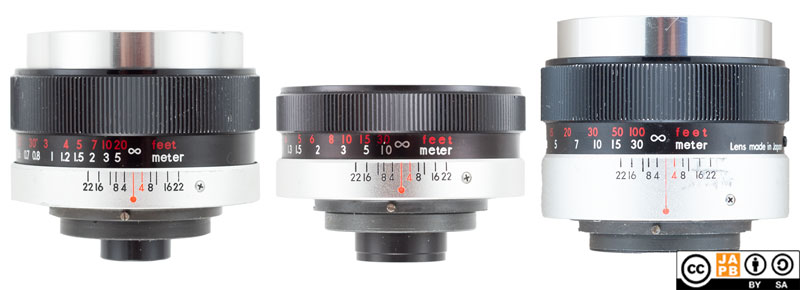
While subsequent introductions (the 135/4 (I), 200/4, 28/4 and 135/4 (II)) gradually modified this look, the combination of silver and black remained clearly apparent.
With the 1969 introduction of the 50 mm f/2 – the new standard prime – this changed as this was a strikingly retro, all-silver design. This however remained a one-off before Topcon turned tails entirely and moved towards an all-matte black design in the subsequent lenses.
| Mainline specifications | Family | Introduced/ announced | colours | Optical design | Topcon product code | Serial # start | Notes |
|---|---|---|---|---|---|---|---|
| 28 mm /4 | UV TOPCOR | 1969 | black&silver18 | 136B | 136xxxxx | [data sheet] | |
| 35 mm f/3.5 | UV TOPCOR | 1963 | black&silver | 6e / 5g | 96B | 96xxxxx | [data sheet] [walk-around] |
| 50 mm f/2 | UV TOPCOR | 1969 | silver black | 68B | 68xxxxxx | [data sheet] | |
| 50 mm f/2.8 | UV TOPCOR | 1972 | black | 4e / 3g | 159B | N/A19 | |
| 53 mm f/2 | UV TOPCOR | 1963 | black&silver | 6e / 4g | 50A | 50xxxx 53xxxx 54xxxxx(x)20 | [data sheet] |
| 100 mm f/4 | UV TOPCOR | 1963 | black&silver | 5e | 97B | 97xxxxx | [data sheet] |
| 135 mm f/4 (I) | UV TOPCOR | 1965 | black&silver | 5e | 110B | 110xxxxx | [data sheet] |
| 135 mm f/4 (II) | UV TOPCOR | 1969 | black&silver | 4e / 3g | 139B | 139xxxxx | [data sheet] |
| 200 mm f/4 | UV TOPCOR | 1967 | black&silver | 6e / 5g | 126B | 126xxxxx | [data sheet] |
| 85–200 mm f/5.6 | UV TOPCOR | 1969 | black | unknown | unknown | unknown | prototype only |
Besides the lenses listed above, there are occasional rumours about a macro lens for the Topcon UV mount, but I’ve never seen even the shadow of one.
HI TOPCOR lenses
Around the time of the introduction of The IC-1 Auto and the HI TOPCOR lenses, Topcon discontinued its earlier serial numbering system (where each 2- or 3 -digit serial number prefix had been linked to a specific product) and instead transitioned to a running numbering scheme with each product having its own running numbering.
While the 50/2 and 50/2.8 HI TOPCOR designs were simple remakes of the earlier UV TOPCOR lenses (with some changes in housing) and the zoom lens was a re-issue of the same RE.Auto-Topcor zoom for the Topcon UV mount, the HI 55/1.8 design was all new.
| Mainline specifications | Family | Introduced/ announced | colours | Optical design | Topcon product code | Notes |
|---|---|---|---|---|---|---|
| 50 mm f/2 | HI TOPCOR | 1973 | black | 6e / 4g | 800B | [data sheet] |
| 50 mm f/2.8 | HI TOPCOR | 1974 | black | 4e / 3g | 803B | [data sheet] |
| 55 mm f/1.8 | HI TOPCOR | 1975 | black | 6e / 4g | 804B | [data sheet] |
| 87–205 mm f/4.7 | HI TOPCOR | 1974 | black | 13e / 8g | 801B | [data sheet] |
Last words
Tokyo Kogaku was active in the high-end camera business for ca 20 years, and was a serious contender for technological leadership for roughly 5 or 6 years: from the 1963 launch of the RE Super and the Wink Mirror S to about 1968/69 when it would have been high time to follow up on their winning products with a next generation of cameras and lenses.
Instead, Topcon generally does not seem to have believed in aggressively improving on winning products. The fact that the 1963 Topcon RE Super, the 1965 Topcon RE-2 and the 1965 Topcon Uni so vastly outsold all the subsequent models was partially due to that the follow-up products were not as revolutionary as the originals, but partially also that Topcon kept milking its cash-cows until the improved follow-on products were comparatively outdated at launch.
Another oddity is that while Topcon’s 1963 winning recipe with the RE Super was based specifically on the deep co-operation between Tokyo Kogaku’s camera engineers and Toshiba’s electrical engineers, it is almost as if Tokyo Kogaku engineers and management were traumatised by this. Instead of seeing the potential in that alliance to aggressively drive the adoption of electronics into cameras, Tokyo Kogaku almost seems to have said ‘this far and no further’. Whatever the reason, none of the Topcon cameras launched in the 15 years after the RE Super offered any electronic features that were in a substantial way beyond what the RE Super had already done.
In discussions regarding ‘why Topcon failed’ one element that is often brought up as a compounding factor (in addition to the slow technological development after 1965) is the company’s mindset. Whereas Topcon was once seen to be a worthy and evenly matched competitor to the likes of Nikon, Nikon was a company that matched its technological prowess with a sales organisation that knew how to aggressively push its wares onto the market. Topcon, on the other hand, likely was too much led by engineering-thinking: believing that a superior product will sell itself and ideas such as ‘if it works, don’t fix it’ (a noble and worthy sentiment, unless you’re in a fast-developing industry). It is clear that Topcon did well in markets where it had a good sales team, but those markets were few and far between, and often those sales teams despaired at the attention and communication they were receiving from Tokyo Kogaku HQ.
Today Topcon cameras and Topcor lenses are again getting more, deserved attention. Mirrorless cameras and the ease of adapting lenses that they offer have led people of all kinds to again have a look at old lenses and increasing numbers are rediscovering Topcon lenses – partially for the often exceptional rendering that they offer, partially for the joy of using such pieces of exquisite workmanship, and partially because many well-maintained Topcon lenses are in such exceptionally good condition that you’d easily think that you might proudly hand them to the next generation.
P.S.
Tokyo Kogaku was sometimes referred to as the ‘Japanese Leica’. It is therefore somewhat ironic that the new Topcon corporation – the company that remained after retreating from the camera business – is today a world leader in surveying equipment where their main competitor is non other than …
wait for it …
Leica Geosystems.
Footnotes
- Several commentators have ascribed Topcon’s lack of commercial success (and subsequent exit from the camera business) to the lack of technological development during the 1963–73 period. I am not sure whether this statement is the whole truth, as the progress from the 1963 RE Super to the 1973 Super DM is not too different from the progress of the Nikon pro flagships (F and F2) in the roughly similar period (1959–1971). I rather suspect that Topcon’s relative lack of commercial success is mostly related to weaknesses in marketing and distribution. ↩︎
- It is not easy to trace the fate of 1970s Japanese companies (at least not without native speakers with connections), but it seems that Cima Kogaku was a Tokyo Kogaku spinoff – a manufacturing facility in Shinshū previously acquired by Tokyo Kogaku – that was spun off in the late 1970s, maybe in the hope that it could (after initial contracts from Tokyo Kogaku) develop into an independent optics manufacturer supplying a wide range of brands. While this venture was not entirely without success (at least Carena, Chinon, Focal , Hanimex, Lentar, Photax and Revuenon used some Cima-manufactured lenses and besides Topcon, Cima Kogaku cameras were also sold under the Carena and Exakta (west) brands), Cima Kogaku and its own Cimko brand were not around for long. ↩︎
- While the Topcon Wink Mirror S was not the fist camera to offer these features (the 1962 Edixa Electronica was narrowly ahead), it was among the first. ↩︎
- In some markets the Topcon Uni was sold as the ‘Topcon Auto 100’ ↩︎
- Leaf shutter cameras with all the lens elements in front of the leaf shutter always have to consider the leaf shutter’s diameter as that affects two factors: The larger the diameter, the brighter lenses it allows, but the slower the fastest shutter speed; the narrower the diameter the darker the lenses and faster the maximum shutter speed. In the case of the Topcon&Seikosha implementation, the compromise limited lenses (effectively) to f/2 and the shutter speed to 1/500 s. ↩︎
- The Topcon R remained available even after the launch of the Topcon R II (and its new F.Auto line of lenses) and at that stage 3/4 Auto-Topcor lenses were upgraded to fully automatic aperture. My feeling from browsing countless ads is that the fully automatic Auto-Topcors are very rare. ↩︎
- Logically, these lenses would have a 6-digit serial number starting ’10’, but as I have never seen a copy in the wild, I won’t commit to promising the fact. ↩︎
- I have also online seen some copies that replaced the chromed lens front with a black-painted front, but it is unclear whether this is an aftermarket modification, a factory batch or a distinct design. ↩︎
- Longer tele lenses also necessitate a longer focus extension (how much the lenses optics are moved away from the camera when focusing towards MFD). Bridging this extension, so that the mechanism at the lens mount could direct the aperture mechanism even when the distance of the aperture mechanism would vary markedly, and to do so reliably, was long seen as a bit of a tricky challenge in lens manufacture. Therefore many lens makers offered their longer lenses initially using preset apertures. ↩︎
- One otherwise respected source indicates a 6 element design, but given that this lens would have been offered as a more economical alternative to the 58/1.8, such an elaborate design for a slow fifty is highly unlikely. ↩︎
- I usually avoid hyperbole, but as both these mainline specifications were decades ahead of the competition, one might replace ‘groundbreaking’ with a more evocative term. ↩︎
- These estimates are a combination of numbers from ‘Topcon Story’, often extended with JAPB research using serial numbers of copies sighted. ↩︎
- This number is based on ‘Topcon Story’. Personally I’ve never sighted a single example. ↩︎
- This lens is just the lens objective with a housing that offers manual aperture control. It was intended to be used with extension rings, variable extension rings or macro bellows. ↩︎
- At least two copies of this lens have been sighted on auctions. ↩︎
- That the 35–100 zoom lens was launched a bit later is supported by that the lens is not mentioned as one of the available lenses in brochures or manuals of either the RE200 or RE300. Also most available copies seem to be for the RM300 and its Pentax K mount. ↩︎
- Until we can gain access to Tokyo Kogaku archival sources, we’ll likely never be able to be sure, but my rough estimate is that the UV-line of cameras outsold the RE-line of cameras by more than 2:1 ↩︎
- Some sources say that there was also an all-silver version of this lens. ↩︎
- The 50/2.8 seems to never have followed the product type serial numbering. ↩︎
- The plethora of serial number ranges is explained by that Topcon initially used the same serial number prefix for the standard (kit) lens as they used for the cameras (50 for the Wink Mirror S; 53 for the Wink Mirror S2 and 54 for the Topcon Uni) ↩︎