Pekka Buttler, 06/2026
Specifications
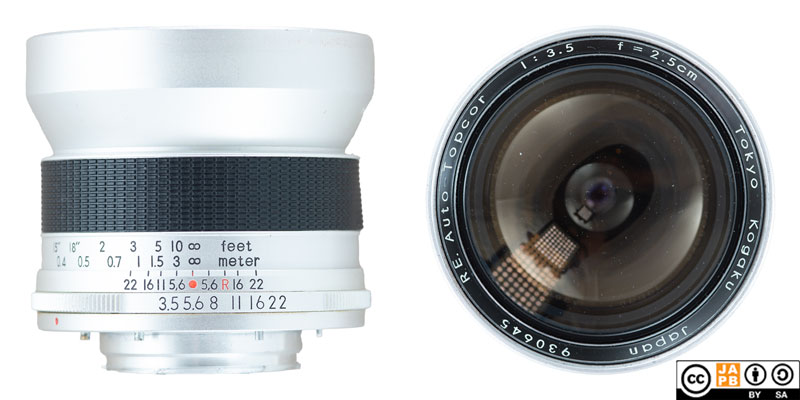
The table below summarizes the lens’ key specifications (measurements based on pictured, last version of the lens):
| Brand: | Tokyo Kogaku (Topcon) | Lens name | RE Auto-Topcor 1:3.5 f=25mm |
| Focal length(s)1 | 25 mm | Angle-of-view2 | 82 ° |
| Maximum Aperture | f/3.5 | In Production | 1965–1978 |
| Lens mount (this lens) | Topcon/Exakta | Generation | RE. Auto-TOPCOR3 |
| Length4 | 53,7 mm | Diameter5 | 65,0 mm |
| Filter ring diameter | N/A | Weight | 294 grams |
| Lens element count | 7 | Lens group count | 7 |
| Aperture blades (S/R/C)6 | 6 S | Focus throw | 300 ° |
| Minimum focusing distance (measured) | 16 cms | Maximum magnification (measured) | 1:2,9 |
| Has manual aperture ring | YES | Has Manual focus ring | YES |
| Aperture mechanism type | auto | Aperture click stops 7 | 3.5••5.6•8•11•16•22 |
Further notes:
• In an era when most lenses were uniformly black (and when even silver rings were going out of fashion), Topcon initially went in the opposite direction in the styling of their Topcon RE. Auto-TOPCOR series of lenses. These lenses were initially matte silver, with black rubber grips giving a contrast. • However, after the 1971 introduction of the Super D, Topcon also started offering most of its lenses in black.
• Originally (1963) Topcon offered no wider lens than the 35/2.8 [data sheet] for its new system, but the 25 mm f/3.5 was introduced in 1965. The pictured lens – with its silver colouring and focal length noted in centimetres – is a relatively early sample.
• This lens’ original rubber focusing ring has been replaced by a plastic traction ring, that – while not being as grippy as the original Topcon rubber rings – does its job nicely.
• The filter threads do not rotate on focusing.
• The lens offers an extremely short minimum focusing distance of 16 centimetres. At that distance the object in focus is barely 5 centimetres from the lens’ front element.
• In 1969 Topcon introduced the even wider 20 mm f/4 and in 1970 the somewhat narrower 28 mm f/2.8 [data sheet], but the 25/3.5 remained in the lineup all the way to the end of Topcon’s professional system
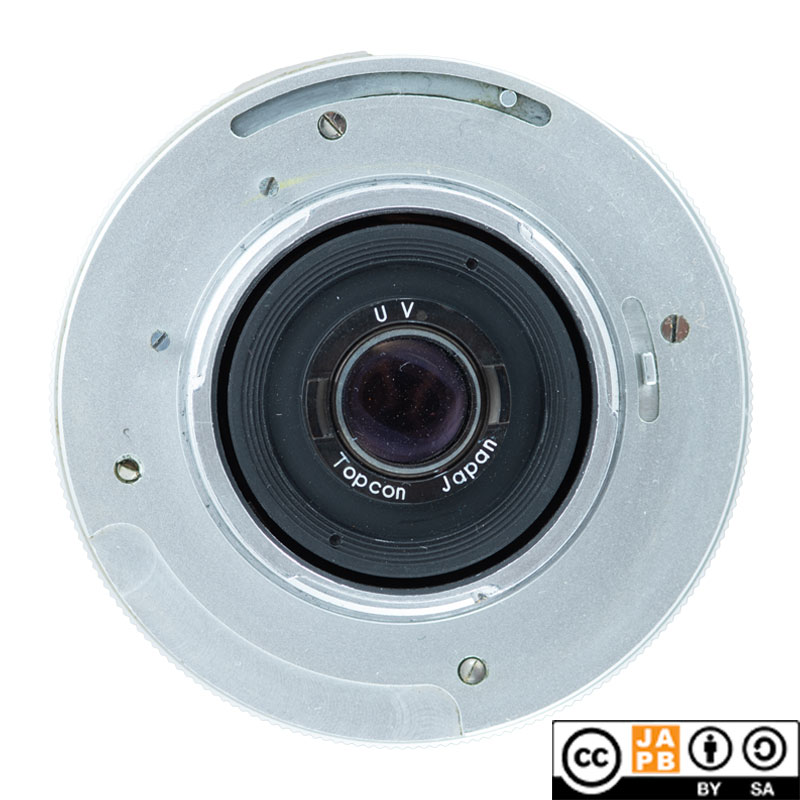
• This lens does not offer a front filter thread. Instead you can either:
a) use a proprietary, bayonet mounted rear filter. Each lens was originally delivered with a set of 10 filters (including UV, Skylight, Flash, Cloudy, Mor&Eve, Flood, as well as Y1, Y2, YG and O2), but today these have often become lost during the decades. Some online comments state that a lens without these cannot deliver full sharpness, but I cannot (yet) support that statement.
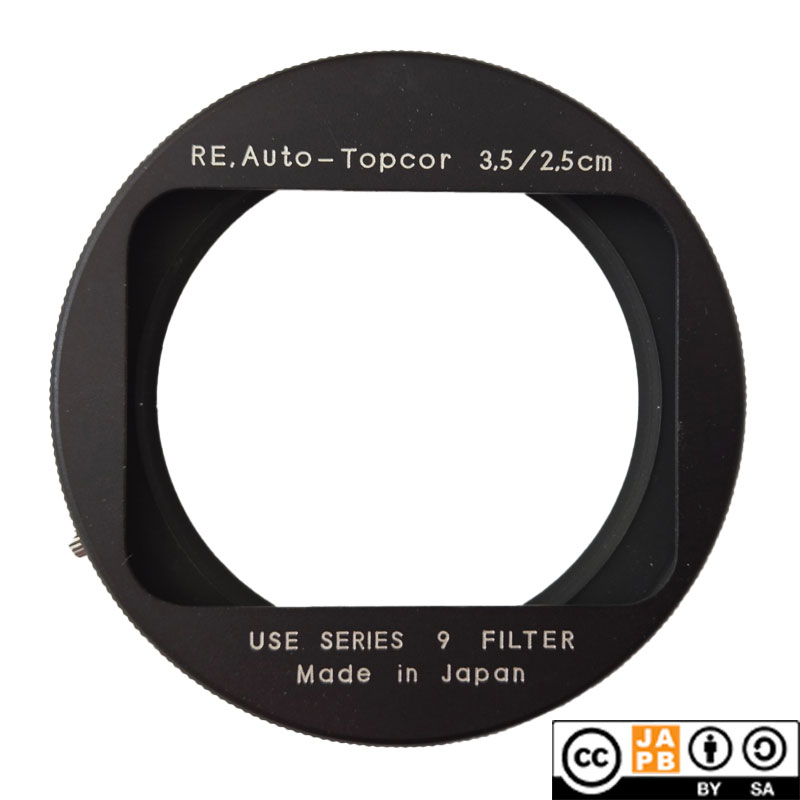
b) Alternatively, each lens was supplied with a clamp-on filter holder for using IX-standard8 front filters.
Versions and variations
The 25 mm f/3.5 Topcon lens is a wide-angle for the Topcon RE system and was introduced in 1965. The following cosmetic/ergonomic variants can be identified (nothing indicates that there would exist any optically significant variations):
| Variant | starting year (ca). | colour | focal length indicated in | has cutout for backwards compatibility9 | approx. serial number range10 |
|---|---|---|---|---|---|
| 1 | 1965 | silver | centimetres | yes | 930001-935191 |
| 3 | 1970 | silver | millimetres | no | 9360001–9367730 |
Most lenses for the Topcon RE system were (after 1972) also made available in black, but with this lens it seems that no black versions were manufactured. While it seems that after the introductions of the 20 mm f/4 (1969) and 28 mm f/2.8 (1971) this lens’ role in the Topcon lens lineup was greatly diminished, it did remain on sale until Topcon effectively left the high-end camera business in 1978.
Also, there seems never to have been a special version of this lens for the US navy.
History of Topcon
Unless you know your camera lore, you might not know that Topcon was once – between 1957 and 1976 – one of the foremost camera companies in the world.
You can read more details in the Topcon company profile.
Adapting
When intending to adapt Topcon/Exakta lenses keep in mind that most Topcon/Exakta lenses have control pins in the lens flange that vanilla Exakta lenses do not have. Hence, there is a theoretical possibility to that some old-time Exakta adapters have been manufactured that do not accommodate these pins. When procuring an adapter, make sure that it explicitly is compatible with Topcon lenses, or visually inspect the adapter regarding whether it makes room for the Topcon control pins.
With that caveat, the following applies to all Topcon/Exakta mount lenses.
This lens cannot be used natively on any current SLR or dSLRs. To use it in its native environment, you will need a Topcon RE Super film body or one of the subsequent Topcon cameras with the Topcon Exakta mount. While these were never produced in immense numbers, they seem to have stood the test of time reasonably well, and can still be found in perfectly serviceable condition.
Thanks to being a fully manual lens (manual aperture, manual focus), the lens can be adapted to all mirrorless cameras using a suitable ‘dumb adapter’. Moreover, due to the popularity of the Exakta mount, special adapters (helicoid adapters, tilt/shift adapters) are readily available.
Using Exakta mount lenses on dSLRs can also be an easy option, depending on the marque of dSLR.
• Canon EF has the shortest flange focal distance among full-frame dSLR’s and Canon’s wide range of dSLRs are able to mount Topcon/Exakta lenses perfectly using a simple adapter ring.
• Minolta / Sony A dSLRs, Pentax K and Nikon F mount dSLRs do not have a short enough flange focal distance to enable reaching infinity focus without an adapter that uses corrective optics.
Footnotes
- Focal length is (unless stated otherwise) given in absolute terms, and not in Full-frame equivalent. For an understanding of whether the lens is wide/tele, see ‘Angle-of-view’. ↩︎
- Picture angle is given in degrees (based on manufacturers’ specs) and concerns the diagonal picture angle. Rule of thumb:
> 90 ° ==> Ultra-wide-angle
70–90 ° ==> Wide-angle
50–70 ° ==> Moderate wide-angle
40–50 ° ==> ‘Standard’ or ‘normal’ lens
20–40 ° ==> Short tele lens
10-20 ° ==> Tele lens
5-10 ° ==> Long tele lens
< 5 ° ==> Ultra-tele lens ↩︎ - See more about Topcon lens generations in Topcon Company profile. ↩︎
- Length is given from the mount flange to the front of lens at infinity. ↩︎
- Diameter excludes protrusions such as rabbit ears or stop-down levers. ↩︎
- S=straight; R=rounded; C=(almost)circular at all apertures. ↩︎
- Numbers equal aperture values on aperture ring; • intermediate click; – no intermediate click. ↩︎
- This filter standard is referred to as both the IX series or series 9 of filters and filters are easily available second hand. ↩︎
- Early Topcon RE lenses included a cutout to enable mounting Topcon RE.Auto lenses on Topcon R family camera bodies. ↩︎
- Serial number ranges are based on a combination of published sources (including ‘Topcon Story’) with the author’s online sleuthwork. Gaps in serial number ranges are due to no samples having been found/seen. ↩︎