Pekka Buttler, 08/2026
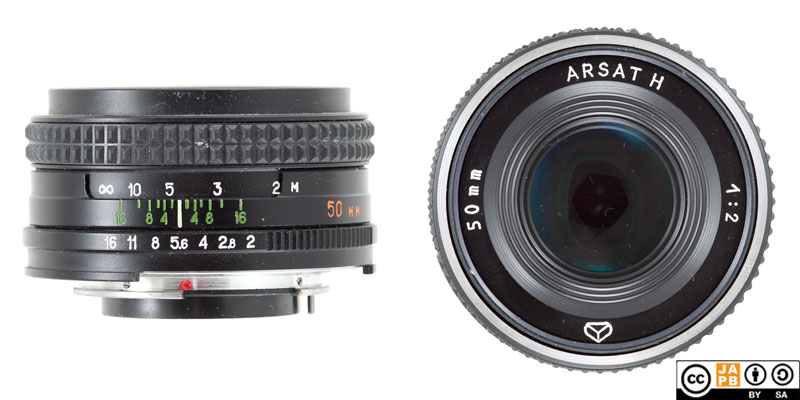
Specifications
The table below summarizes the lens’ key specifications (measurements based on pictured sample):
| Brand: | Arsat | Lens name | H 50 mm 1:2 |
| Focal length(s) 1 | 50 mm | Angle-of-view 2 | 45 ° |
| Maximum Aperture | f/2 | In Production | 3 |
| Lens mount | Nikon F | Subfamily (if applicable) | Ai |
| Length 4 | 31,3 mm | Diameter 5 | 62,6 mm |
| Filter ring diameter | 52 mm | Weight | 213 grams |
| Lens element count | 6 | Lens group count | 4 |
| Aperture blades (S/R/C) 6 | 6 S | Focus throw | 280 ° |
| Minimum focusing distance (measured) | 51 cms | Maximum magnification (measured) | 1:7,8 |
| Has manual aperture ring | YES | Has Manual focus ring | YES |
| Aperture mechanism type | Automatic | Aperture click stops 7 | 2•2.8•4•5.6•8•11-16 |
Further technical notes:
• The Arsat H 50 mm f/2 is the Ukranian (post-Soviet) version of the Helios–81H [data sheet].
• It was sold as the basic nifty fifty with numerous copies of the Kiev-19 and Kiev-19M cameras
• Like many other lenses manufactured at the Arsenal plant in Kiev, this lens uses the Nikon F mount (Ai spec) and can be used on any post-1977 Nikon F mount camera body (whether manufactured by Nikon or Arsenal). (see also: A Soviet Nikon?)
• Whereas the predecessor of this lens (the Helios-81) was designed for use on several systems (including the 1970s Kiev Automat system and the M42 thread mount), the Arsat 50 mm f/2 was only ever manufactured for the Nikon F mount.
A brief genealogy of Nikon SLR lens types
The type of the Nikon F lens mount used by this lens is of the ‘Ai’ (automatic indexing) subtype. A more detailed account is available here, but the development of Nikon’s SLR lenses can be briefly traced as follows:
• 1959–1977: Pre-Ai. Manual focus lenses that use ‘rabbit ears’ to communicate selected aperture with the camera body.
• 1977–1986: Ai and Ai-s. Manual focus lenses that may have ‘rabbit ears’ for backward compatibility, but are designed to communicate selected aperture with the camera body through indentations in base of aperture control ring.
• 1986–today: AF and AF-D. Autofocus lenses that do not have a focusing motor within the lens, but rely on the focus motor within the camera. All AF and AF-D lenses are simultaneously Ai-s lenses (they are Ai-s lenses extended with AF) 8
• 1996–today AF-S and AF-P. Autofocus lenses that have an internal focusing motor and do not rely on the body having a focusing motor.
Adapting
Besides adapting, this lens can be used natively on all current high-end Nikon dSLRs and several earlier medium-to-high-end older Nikon dSLRs9. Likewise, if it still has its rabbit ears, it can be natively used on all Nikon F-mount film cameras ever produced (without the rabbit ears, it is limited to post 1977 bodies).
Thanks to being a fully manual lens (manual aperture, manual focus), the lens can be adapted to all mirrorless cameras using a suitable dumb adapter (and such adapters are easy to find). Moreover, a large range of special adapters (helicoid adapters, tilt/shift adapters, speed boosters) for using Nikon F lenses on most mirrorless systems are available.
Using Nikon F lenses on non-Nikon SLRs and dSLRs is likewise a distinct possibility. Thanks to the relatively generous flange focal distance of the Nikon F mount (46,5 mm), adapter rings for all dSLR mounts are available as well as for a goodly portion of film-era SLR mounts. Such rings may not allow for auto aperture, but even then the lenses can be used in stop-down metering mode.
Footnotes
- Focal length is (unless stated otherwise) given in absolute terms, and not in Full-frame equivalent. For an understanding of whether the lens is wide/tele, see ‘Angle-of-view’. ↩︎
- Picture angle is given in degrees and concerns the diagonal picture angle. Rule of thumb:
> 90 ° ==> Ultra-wide-angle
70–90 ° ==> Wide-angle
50–70 ° ==> Moderate wide-angle
40–50 ° ==> ‘Standard’ or ‘normal’ lens
20–40 ° ==> Short tele lens
10-20 ° ==> Tele lens
5-10 ° ==> Long tele lens
< 5 ° ==> Ultra-tele lens ↩︎ - Absolute data on production years is not easily available, but all the serial numbers of every copy I’ve seen indicate manufacture was heavily weighted towards 1995 and 1996 with the last noted samples dated 1997. ↩︎
- Length is given from the mount flange to the front of lens at infinity. ↩︎
- Diameter excludes protrusions such as rabbit ears or stop-down levers. ↩︎
- S=straight; R=rounded; C=(almost)circular at all apertures. ↩︎
- Numbers equal aperture values on aperture ring; • intermediate click; – no intermediate click. ↩︎
- There is a further sub-class of AF-D lenses called AF-I lenses that are otherwise AF-D lenses (meaning, fully Ai-s compatible), but have an internal focus motor. Only long tele lenses were made in AF-I variants. ↩︎
- As of this writing, the following Nikon dSLRs fully support Aperture priority and manual metered modes on Nikkor Ai lenses: D2, D3, D4, D5, D6, D200, D300, D300s, D500, D600, D610, D700, D750, D780, D800, D800E, D810, D850, D7000, D7100, D7200 ↩︎