Pekka Buttler, 10/2026
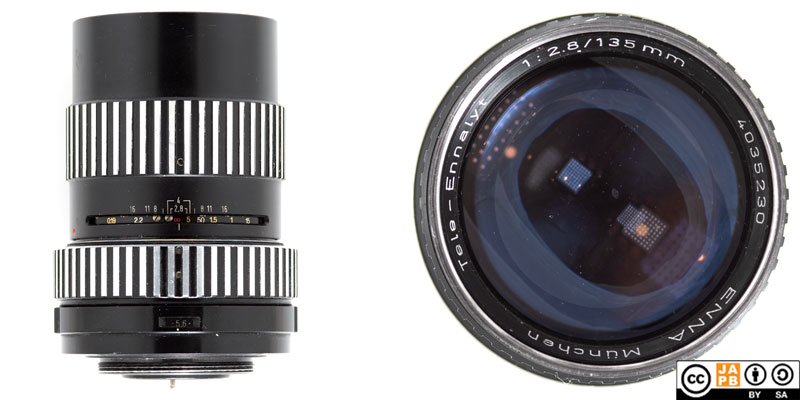
Specifications
The table below summarizes the lens’ key specifications (measurements based on pictured version of the lens):
| Brand: | ENNA München | Lens name | Tele-Ennalyt 1:2.8/135mm |
| Focal length(s)1 | 135 mm | Angle-of-view2 | ≈18 ° |
| Maximum Aperture | f/2.8 | In Production (this version) | 1964–1967 |
| Lens mount (this lens) | Enna Sockel (V2) | Mounts available through sockels | Exakta, M42 (also Alpa and Miranda)3 |
| Length (optical package) Length (with M42 Sockel)4 | 94,6 mm 88,1 mm | Diameter (optical package only) Diameter (with M42 Sockel)5 | 58,2 mm 64,7 mm |
| Filter ring diameter | 52 mm | Weight (optical package only) Weight (with M42 Sockel) | 253 grams 455 grams |
| Lens element count | 5 | Lens group count | unclear |
| Aperture blades (S/R/C)6 | 10 S | Focus throw | 355 ° 7 |
| Minimum focusing distance (measured) | 2,25 m | Maximum magnification (measured) | 1:14,1 |
| Has manual aperture ring | YES (on Sockel) | Has Manual focus ring | YES (on Sockel) |
| Aperture mechanism type | Automatic | Aperture click stops | 2.8•4•5.6•8•11•16 |
Further notes:
• Detailed information on this lens is sparse. For instance, while it being a 5 elements design, trustworthy schematics or specifications are difficult to come by. If you have hard information (such as an Enna Brochure from the 1950s), please be in touch.
• While the earlier Enna Sockel (v1) system had offered both a 135 mm f/3.5 lens [data sheet] as well as (after 1958) a faster 135 mm f/2.8 lens, the second iteration of the Enna Sockel system (v2) only offered a 135/2.8 lens (this lens).
• ‘Tele-Ennalyt’ was used by ENNA München for its longer lenses.
About ENNA Sockel lenses
• Unless you’re familiar with Enna Sockel lenses: Enna Sockel lenses are an early, advanced type of intermediate mount lenses, that are exceptional in that the lens is made up of two parts: The Optical package including the objective and diaphragm mechanism; and the Mechanical package including mount, Semi-automatic aperture control, and focusing helicoid. Read more in the JAPB article on the Enna Sockel.
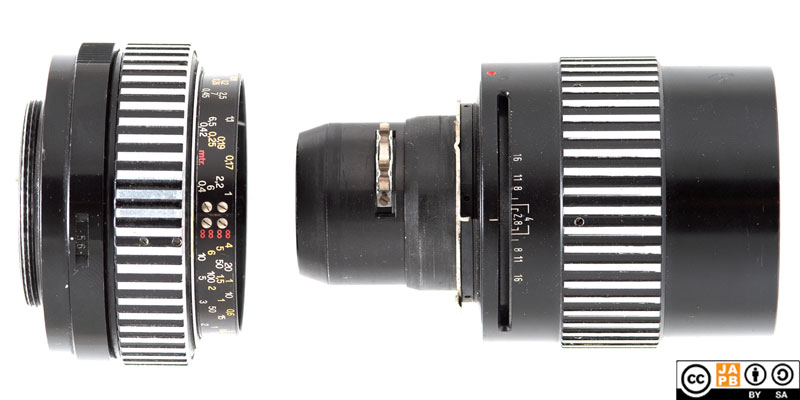
Right: Tele-Ennalyt 135mm f/2.8 optical package
• One characteristic of the ENNA Sockel is that all lenses use the same focusing helicoid. While this is advantageous for the wide-angle lenses that gain extreme close-focusing abilities, longer lenses (like the 135 and 240 mm teles) do pay the price in terms of weak close-focusing abilities.
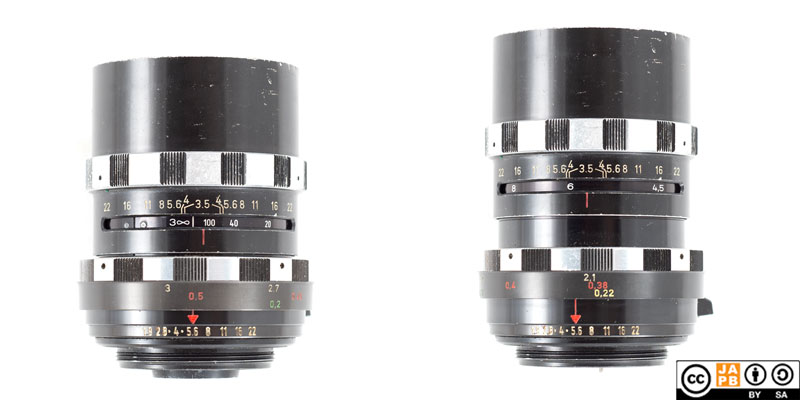
Right: 135 mm f/3.5 Enna Sockel lens at minimum focus distance (2,1 m).
Notice the relatively short focus extension.
Versions and variations
Enna München launched its first 135 mm f/2.8 lens in 1958, after which this basic design was used on both fixed mount lenses (at least for the M42 and Exakta systems) as well as for both the 1st generation and 2nd generation Sockel mounts. Of these, especially the M42 versions had significant staying power, being produced far into the 1970s and even being offered for sale by rebranders (one example is available here on JAPB)
However, I have found nothing to indicate that the 135 mm f/2.8 Enna Sockel (v2) lens would have undergone any significant modification throughout its lifecycle.
History of ENNA München
ENNA München (also: Enna Werk München) is one of the 1950s and 60s most prominent and innovative German optics companies.
You can read more details in the ENNA München company profile.
Adapting the ENNA München Tele-Ennalyt 135 mm f/2.8
Adapting ENNA Sockel lenses
If you have an ENNA Sockel lens without a Sockel (meaning only an Optical package), then the only sensible way for you to adapt that lens is to procure an Enna Sockel of the same generation as your lens that offers a lens mount that you can work with (M42 and Exakta are likely the safest bets).
From then on:
Adapting M42 lenses
If you want to natively mount your M42 lens you need to find a functioning M42 mount film camera. Luckily that should be relatively easy as M42 bodies were produced in their millions and most of them lack features that are especially likely to have deteriorated to the point of making the entire camera inoperable.
Adapting M42 lenses to a mirrorless, full-frame digital camera is a breeze thanks to the lens having full manual controls (aperture ring, focus ring). You simply need a dumb adapter from M42 to your mirrorless system (but choose an M42 adapter with an internal flange, see more in the JAPB article on the M42 mount).
Due to the medium flange focal distance used by the M42 mount (45,46 mm), whether you can adapt this lens to dSLR/SLR mounts depends on which dSLR mount: Canon EF, Four Thirds, Minolta/Sony A and Pentax K can mount m42 lenses using a simple adapter ring. Nikon F on the other hand is not as problem-free, and – to retain anything near infinity focus – the adapter will necessitate corrective optics. In all cases, your camera will work only in stop-down metering.
Adapting Exakta lenses
If you want to use this lens in its native environment, you will need an Exakta-mount film camera body. Exakta bodies were manufactured in large numbers, and many of them are still in good shape. That said, you should take care to procure a workable sample.
Thanks to being a fully manual lens (manual aperture, manual focus), the lens can be adapted to all mirrorless cameras using a suitable adapter. Moreover, the Exakta lenses are so uncomplicated that a simple ‘dumb adapter’ will do the job perfectly. Furthermore, due to the popularity of the Exakta mount, special adapters (helicoid adapters, tilt/shift adapters) are readily available. Alternatively, one can choose to daisy-chain adapters (e.g. Exakta->Canon EF; Canon EF –> mirrorless) which also opens up a wide range of speed boosters .
Adapting Exakta lenses to dSLRs can also be an option, depending on which dSLR.
• Canon EF has the shortest flange focal distance among full-frame dSLR’s and Canon’s wide range of dSLRs are able to mount Exakta lenses perfectly using a simple adapter ring.
• Nikon F, Pentax K and Minolta / Sony A dSLRs need an adapter that uses corrective optics for Exakta lenses (the difference in flange focal distances is not enough to enable reaching infinity focus without corrective optics).
Footnotes
- Focal length is (unless stated otherwise) given in absolute terms, and not in Full-frame equivalent. For an understanding of whether the lens is wide/tele, see ‘Angle-of-view’. ↩︎
- Picture angle is given in degrees (based on manufacturers’ specs) and concerns the diagonal picture angle. Rule of thumb:
> 90 ° ==> Ultra-wide-angle
70–90 ° ==> Wide-angle
50–70 ° ==> Moderate wide-angle
40–50 ° ==> ‘Standard’ or ‘normal’ lens
20–40 ° ==> Short tele lens
10-20 ° ==> Tele lens
5-10 ° ==> Long tele lens
< 5 ° ==> Ultra-tele lens ↩︎ - Sources point to Enna having made second generation Sockel’s also for the Alpa and Miranda systems, but these are so rare as to be practically non-existent. ↩︎
- Length is given from the mount flange to the front of lens at infinity. ↩︎
- Diameter excludes protrusions such as rabbit ears or stop-down levers. ↩︎
- S=straight; R=rounded; C=(almost)circular at all apertures. ↩︎
- Focus throw is a feature of the Sockel, not the lens. As Enna manufactured a range of Sockels and also kept doing minor tweaks, this value need not be accurate for every Sockel. ↩︎