Pekka Buttler, 2/2025 (Updated: 4/2025)
First off: the Enna Sockel is not technically speaking a lens mount. Instead it is a very early intermediate mount. While it likely is not the first intermediate mount, it is the first to facilitate camera-to-lens communication.
Sockel is German and means ‘foundation’1. You can think of it as the foundation you build your lens on.
Enna Sockel specifications and identification :
Mount type: three-prong male bayonet (lens release by overcoming resistance)
Flange focal distance: 70,1 mm (measured)
Film format: 36mm x 24mm (‘Full frame’)
Mount communication: One lever for controlling aperture (Sockel->Lens)
Version 1
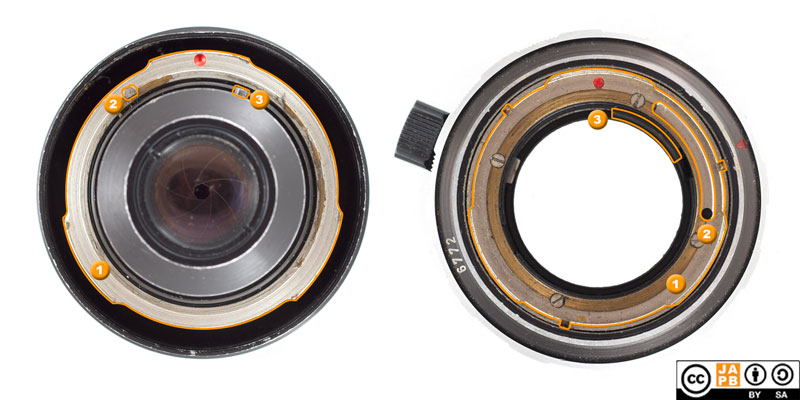
Right: Mechanical package with [1] Three-pronged female bayonet mount, [2]locking pin groove and hole and [3] aperture control lever
Version 2
To be added later
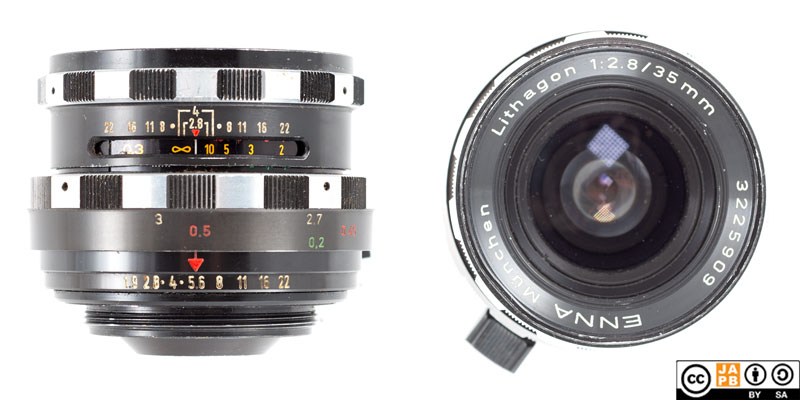
The Enna Sockel is a rather special intermediate mount (compared to other intermediate mounts) in that the Enna Sockel was designed to divide lenses into an optical package including the objective and aperture diaphragm and a mechanical package containing the focusing helicoid and aperture control ring. The logic behind this was that whereas the optical package must be different in different lenses, the mechanics are inherently very similar.
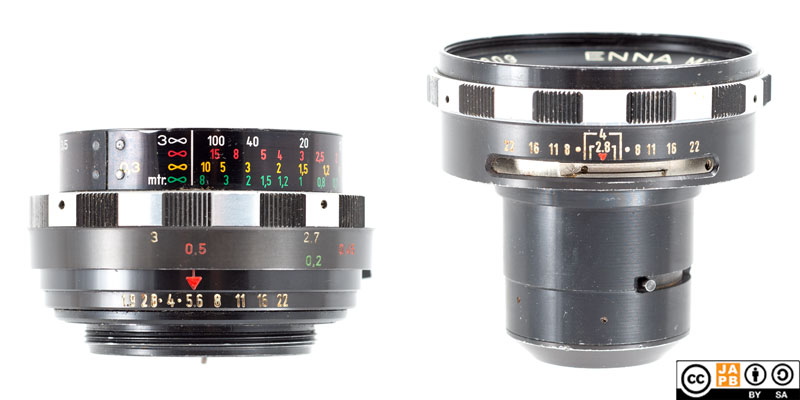
Right: Enna Lithagon 35 mm f/2.8 Optical package.
Hence, any photographer who wanted a standard lens, a wide-angle lens and a portrait lens actually needed just three optical packages and one mechanical package (instead of three of both). Enna’s logic was to avoid duplication and hence offer the user a more cost-effective way to get a range of Enna lenses. The mechanical package even carried distance markings for the four most typical focal lengths (28, 35, 50 and 135). With each of these four focal lengths, the correct distance markings would be revealed by a window in the optical package whereas the other three focal lengths (24, 95 and 240 mm) all had focal lengths marked on the barrel.
One drawback of ENNA’s approach is that all lenses need to work with the same focusing helicoid, and that while that helicoid’s motion range was sufficient (indeed: generous) for wide angle lenses it was unavoidably too little for longer lenses.
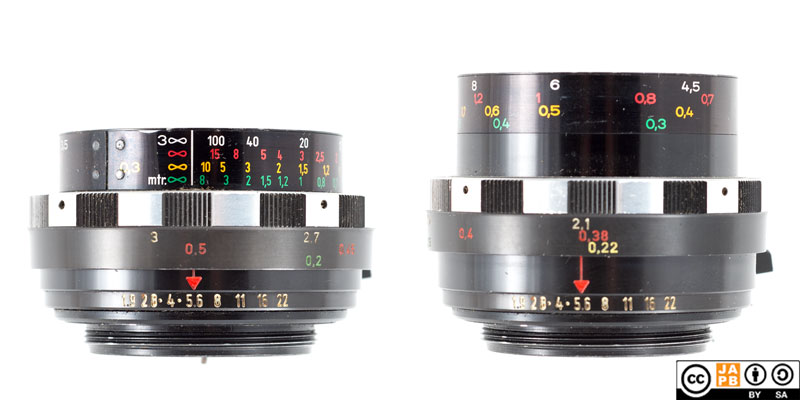
Right: Mechanical package focused at MFD.
| Focal length | Minimum focusing distance (indicated) |
| 24 | ≈ 0,1 m |
| 28 | 0,135 m |
| 35 | 0,2 m |
| 50 | 0,36 m |
| 95 | 1,2 m |
| 135 | 2 m |
| 240 | 5,5 m |
A related drawback was that to achieve even this amount of helicoid movement, the Enna (V1) Sockel lenses utilise a rather extreme focus throw of 520–530 ° (almost 1,5 revolutions). Focusing, while precise, cannot be said to be quick.
As a final quirk, while the Enna Sockel lenses offer two distinct grip rings, care needs to be taken as the front ring is not for focusing, but for disconnecting the optical package (the rear ring controls focus)
Versions 1 and 2
There are two generations of the Enna Sockel.
The first generation (1958–63) facilitated only automatic stop-down, but the aperture had to be opened up and cocked manually (semi-automatic aperture). These versions can be visually identified by that their zebra rings are broad and that they have a lever for cocking the semi-automatic aperture mechanism. (see pictures)
The second generation (1964-67) of the Enna Sockel changed from semi-automatic aperture to fully automatic aperture. This generation carry the narrow zebra rings and a manual-automatic switch.
Sadly, the two generations are incompatible (i.e. you cannot mount a lens from a first generation Sockel lens on a second generation Sockel or vice versa).
| Available in Sockel1 | Available in Sockel2 | |
| Enna Lithagon * 24 mm f/4 | YES | YES [data sheet] |
| Enna (Ultra)Lithagon * 28 mm f/3.5 | YES [data sheet] | YES [data sheet] |
| Enna Super Lithagon 35 mm f/1.9 | YES | |
| Enna Lithagon * 35 mm f/2.8 | YES [data sheet] | YES [data sheet] |
| Enna Ennalyt 50 mm f/1.9 | YES [data sheet] | YES |
| Enna Ennagon 50 mm f/2.8 | YES | |
| Enna (Tele-)Ennalyt 90 mm f/2.8 | YES | |
| Enna (Tele-)Ennalyt 95 mm f/2.8 | YES [data sheet] | |
| Enna Tele-Ennalyt 135 mm f/2.8 | YES [data sheet] | |
| Enna Tele-Ennalyt 135 mm f/3.5 | YES [data sheet] | |
| Enna Tele-Ennalyt 240 mm f/4.5 | YES [data sheet] | YES |
| Sockel to M42 | YES | YES |
| Sockel to Exakta | YES | YES |
| Sockel to Praktina | Maybe | |
| Sockel to Alpa | RARE | |
| Sockel to Miranda | RARE | |
| Sockel to Yashica Pentamatic | Maybe3 |
* Some Sockel2 versions went by the name ‘Ennalyt’
Adapting Enna Sockel -mount lenses:
I can safely say is that if an Enna Sockel lens has landed in your lap (without the Socket-part), then the only sensible way for you to adapt that lens is to procure an Enna Sockel of the same generation as your lens that offers a lens mount that you can work with (M42 and Exakta are likely the safest bets).
Links
• Horst Neuhaus’ site and especially his thorough discussion on the Enna Sockel.
Footnotes:
- Some sources translate Sockel to ‘socket’. While this makes sense it is technically incorrect. ↩︎
- Should you have noticed that this table give a bit shorter numbers than the sockel pictured above the table, the reason is that my two M42 sockels have a slight difference: one has a focus throw of 530 ° and the other (pictured) has a focus throw of 520 ° and as as a result of this also the minimum focusing distances differ a bt. ↩︎
- There are further indications (at least in the form of a dealer price list) that an adapter for some Yashica camera was in the works. ↩︎
- Also there have been seen adapters for the Edixa Model A (which combines an M42 mount with a Exakta-like external triggering mechanism) ↩︎
I have obtained a complete Enna lens set and Sockel for 2ndGen Exakta. Unfortunately, the Sockel is very sticky, slow and in Automatic or Manual the lenses do not adjust. I did insert each correctly for their largest aperture. In Manual turning the ring to choose the Aperture moves nothing in the Sockel. I am not sure what in it actually moves. I was told its a magnet, but without proper documentation its hard to understand. I cannot find a repair manual or exploded diagram for this to work on it. Nor do I know of anyone in the USA who will work on it. The set is in amazing condition and very complete. I would like to use it with my Exakta but as it is now, i cannot.
Greetings William.
Interesting, as I have a set of Enna Sockel 2 lenses (not complete, but a reasonable set nevertheless) that also seems not to be able to adjust the aperture. In my case the Sockel is for the M42 mount and noting seems to move in the sockel when I twist the aperture ring or press the M42 stop-down pin. I plan to take the sockel apart but can only speculate on when I could find the time for that. Feel free to keep me posted if you solve the issue.
Repair is tricky. I (being in the EU) have my established contacts in Finland, Germany and former East Bloc countries (Estonia, Poland, Czech republic), but cannot say that I have any specific insight into the American market, except that I am under the impression that US technicians knowledgeable of mid-century German (non-Leica) gear are so scarce that they can pick and choose their jobs. I hope you can prove me wrong.
Kind regards,
Pekka
Pekka,
Yes, it is a very complete set, with some filters and the very thin original instructions as well. All in their original lens cases. Very clean. Needless to say I am rather pleased to have gotten it at a reasonable price. I believe living in the USA most have no idea what they were looking at and also it not being an M42 even less. You are correct in your assumption that technicians in the USA are lacking in knowledge concerning older European cameras and gear. Yes other than Leica. Those who did know are retiring or have passed on with few taking up the calling. I am learning to CLA my own. I am a novice to be sure and so far focusing on mid century range finders with leaf type shutters. I just obtained a tester for focal plane cameras and am learning about those. I have a very nice Exakta VXb i plan to use these lenses with. I have a few emails out to others who posted about the Enna set and if there is any relevant information I will be sure to contact you. This Sockel has been apart some time in the distant past. There are alignment marks on the back. And from what i have learned the Version 2 uses a small magnet inside to adjust the lens Aperture. It is very gummed up. The Manual/Automatic switch is very stiff. I am assuming there are smalls springs, precise tensions and such within. If I take it apart i will take detailed photos and notes to pass on. I would rather sent it to someone who knows, but if i must than it wont be any worse off than it is now-non working! Thank you very much for your prompt reply! Will
I wish you the best of luck!
Pekka