Pekka Buttler, 06/2026
Specifications
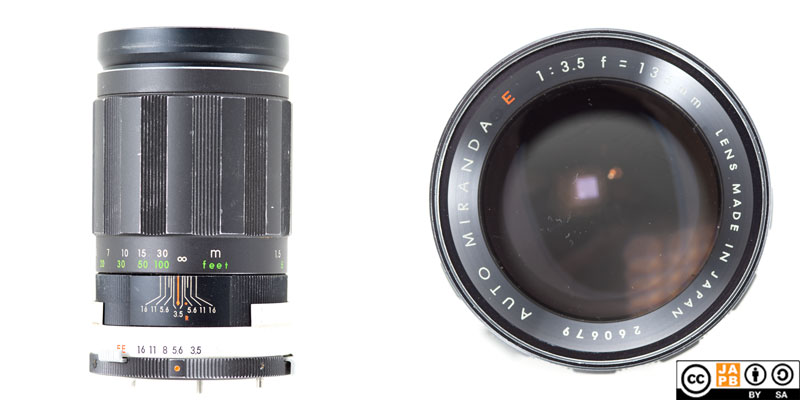
The table below summarises the lens’ key specifications (measurements based on pictured sample):
| Brand: | Miranda | Lens name | E 1:3.5 f=135mm Auto |
| Focal length(s)1 | 135 mm | Angle-of-view2 | 18 ° |
| Maximum Aperture | f/3.5 | In Production | 1972–74 |
| Lens mount (this lens) | Miranda | Mount subtype | E/EC Auto aperture with aperture coupling in mount |
| Length3 | 93,9 mm | Diameter4 | 59,0 mm |
| Filter ring diameter | 52 mm | Weight | 413 grams |
| Lens element count | 4 | Lens group count | 3 |
| Aperture blades (S/R/C)5 | 6 S | Focus throw | 295 ° |
| Minimum focusing distance (measured) | 151 cm | Maximum magnification (measured) | 1:8,9 |
| Has manual aperture ring | YES | Has Manual focus ring | YES |
| Aperture mechanism type | Automatic | Aperture click stops 6 | 3.5-5.6-8-11-16 |
Further notes:
• Miranda traditionally offered two 135 mm tele lenses – one with a f/2.8 maximum aperture and another with a more modest f/3.5 maximum aperture (this lens)
• This lens’ aperture stop-down is handled by a lever at the base of the mount and there is also a lever on the lens (near the mount) that facilitates stop-down for depth-of-field preview.
• To facilitate auto aperture on compatible camera bodies, this lens’ aperture ring can be set to ‘EE’. The ‘EE’ detent is just one (largish) step beyond f/16 on the aperture ring, and to exit the ‘EE’ mode, you need to press a small lever at the side of the aperture ring. This arrangement is sure to annoy photographers who want to use this lens in manual mode and like to manipulate aperture without taking the camera from their eye.
• This lens does not offer an integrated lens hood. While Miranda did offer their own, thread-mounted lens hoods, these are today rare. Luckily, any tele lens hood for 52 mm filter threads will do nicely.
Historical notes:
• Miranda was – in its heyday – an advanced Japanese camera manufacturer. You can read more about Miranda camera in the JAPB company profile on Miranda camera.
• In 1972 Miranda introduced the Auto Sensorex EE camera that introduced a new (for Miranda) way of communicating the lens’ selected aperture to the camera, using a lever in the lens’ base. This led to the redesign of the entire lens catalogue. The new lenses that communicated aperture information on the lens’ mount were launched as the ‘E’ series of lenses.
• Two years later in 1974 Miranda launched the dx-3 camera. With this camera Miranda adopted a new approach where some of those design principles that had governed Miranda design (such as interchangeable viewfinders) were replaced by a more compact (read: smaller) overall design. As part of this push to participate on the market of compact SLRs1 also many of the key lenses were redesigned for compactness and launched as the EC series of lenses and largely discontinued the E series of lenses. For more information on various generations of Miranda lenses, see the Miranda lens compendium.
• Importantly, Miranda was a camera manufacturer and not a lens manufacturer. This means that from early on, Miranda cameras came equipped with various brands of lenses, including some rather prominent manufacturers such as Kowa and Zunow.
• Lenses branded as “Miranda” or “Soligor Miranda” were not manufactured by Miranda, but were sourced from other manufacturers and branded ‘Miranda’. Most often these lenses were sourced from Miranda’s long-time partner (and later: owner) Soligor (Allied Impex Corporation). Hence, the actual manufacturer of “Miranda” lenses is most often impossible to discern with certainty.
Versions/variants
The table below summarises the development of Miranda 135 mm f/3.5 lenses.
For more information on generations of Miranda lenses, see the Miranda lens compendium.
| Mainline spec | Years | Generation | Recipe | MFD | Filter | Length | Diameter | Weight | Notes |
|---|---|---|---|---|---|---|---|---|---|
| 135 mm f/3.5 | 1959 | M/P | unknown | unknown | unknown | unknown | unknown | unknown | |
| 135 mm f/3.5 | 1960–64 | unknown | unknown | unknown | unknown | unknown | unknown | unknown | |
| 135 mm f/3.5 | 1960–64 | M/P | 5 e | unknown | unknown | unknown | unknown | unknown | |
| 135 mm f/3.5 | 1960–64 | unknown | 6 e | unknown | unknown | unknown | unknown | unknown | |
| 135 mm f/3.5 | unknown | PAD | 4e / 4g | 1,8 m | unknown | unknown | unknown | unknown | |
| 135 mm f/3.5 | 1963–68 | F-G-MAT | 4e / 3g | 1,5 m | 46 mm | 95 mm | 58 mm | 411 g | |
| 135 mm f/3.5 | 1968–1972 | F-G-MAT | 4e / 3g | 1,5 m | 46 mm | 94 mm | 60 mm | 410 g | |
| 135 mm f/3.5 | 1966–74 | MEX-REX | 4e / 3g | 1,5 m | 46 mm | 96 mm | 60 mm | 435 g | |
| 135 mm f/3.5 | 1972–76 | E | 4e / 3g | 1,51 m | 52 mm | 94 mm | 59 mm | 413 g | (this lens) |
| 135 mm f/3.5 | 1974–76 | DUAL | 4e / 3g | 1,5 m | 52 mm | 95 mm | unknown | 400 g |
Adapting
This lens cannot be used natively on any current SLR or dSLRs. To use it in its native environment, you will need a Miranda Camera film body. While this lens will mount on any Miranda camera that uses the Miranda mount, its automatic aperture stop-down will work only on Miranda bodies after the Miranda F (launched 1963) and its aperture can be read only by bodies launched after 1972.
Thanks to being a fully manual lens (manual aperture, manual focus), the lens can be adapted to all mirrorless cameras using a suitable adapter. However, Miranda adapters are not as easily available as adapters for many other legacy era camera mounts, nor is there a wide variety of specialist adapters.
Using Miranda lenses on dSLRs is a theoretical possibility. Thanks to the relatively short flange focal distance of the Miranda mount (at 41,5 mm, clearly shorter than that of any full-frame dSLR mount), any adapter will necessitate some corrective optics to achieve infinity focus.
Footnotes
- Focal length is (unless stated otherwise) given in absolute terms, and not in Full-frame equivalent. For an understanding of whether the lens is wide/tele, see ‘Angle-of-view’. ↩︎
- Picture angle is given in degrees and concerns the diagonal picture angle. Rule of thumb:
> 90 ° ==> Ultra-wide-angle
70–90 ° ==> Wide-angle
50–70 ° ==> Moderate wide-angle
40–50 ° ==> ‘Standard’ or ‘normal’ lens
20–40 ° ==> Short tele lens
10-20 ° ==> Tele lens
5-10 ° ==> Long tele lens
< 5 ° ==> Ultra-tele lens ↩︎ - Length is given from the mount flange to the front of lens at its shortest. ↩︎
- Diameter excludes protrusions such as rabbit ears or stop-down levers. ↩︎
- S=straight; R=rounded; C=(almost)circular at all apertures. ↩︎
- Numbers equal aperture values on aperture ring; • intermediate click; – no intermediate click. ↩︎
- A market prominently launched by the Olympus OM-1 a few years earlier. ↩︎