Pekka Buttler, 02/2026
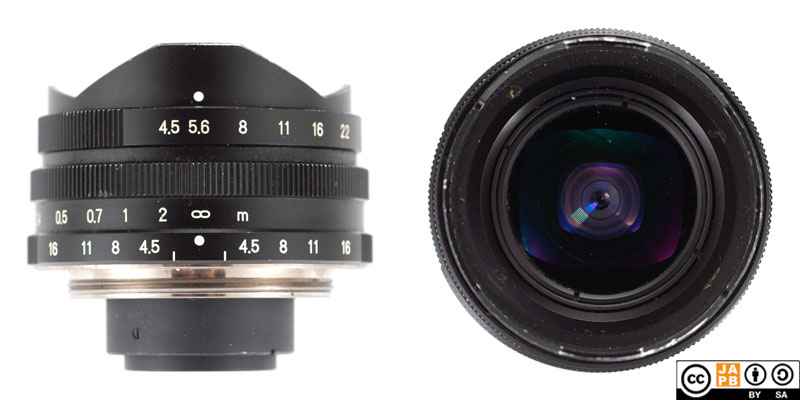
(note: the pictured sample has lost its name ring)
Specifications
The table below summarizes the lens’ key specifications (measurements based on pictured lens):
| Manufacturer: | Cosina (Voigtländer) | Lens name | Super Wide-Heliar 15mmF4.5 ASPHERICAL |
| Focal length(s) 1 | 15 mm | Angle-of-view 2 | 110 ° |
| Maximum Aperture | f/4.5 | In Production | 1999–≈2003 |
| Lens mount (this lens) | Leica thread mount | Other lens mounts | None |
| Length 3 | 30,8 mm | Diameter 4 | 49,7 mm |
| Filter ring diameter | N/A | Weight | 104 grams |
| Lens element count | 8 | Lens group count | 6 |
| Aperture blades (S/R/C) 5 | 10 S | Focus throw | 105 ° |
| Minimum focusing distance (measured) | 32 cm | Maximum magnification | 1:17.5 |
| Has manual aperture ring | YES | Has Manual focus ring | YES |
| Aperture mechanism type | Manual | Aperture click stops | 4.5-5.6•8•11•16•22 |
Further notes:
• The Voigtländer Super Wide-Heliar is not a ‘real’ Voigtländer lens. Instead it is a Cosina-made high-end lens manufactured after Cosina’s acquisition of the Voigtländer name.
• Importantly, while the Voigtländer Super Wide-Heliar has the Leica thread mount’s M39 26TPI mount and a flange focal distance of 28,8 mm it lacks a rangefinder coupling.
• This lens was originally launched together with the (Cosina) Voigtländer BESSA-L scale focusing camera. As such, it was sold together with a 15 mm high eye-point viewfinder.
• Due to the extreme 110 ° Angle-of view, front filters cannot be used and the lens also does not offer rear filters. The lens however has a built in, sturdy (metal) petal-shaped hood that exists as much to protect the bulbous front element as to keep out oblique rays.
• Being an extreme wide-angle, the lens is characterised by extreme depth of field, and at f/16 the entire focusing range (0,3m to infinity) falls within the depth of field.
Versions
The Voigtländer Super Wide-Heliar 15/4.5 exists in three generations:
First generation – LTM lenses
There first generation contains three variants using the LTM mount:
• A black version, introduced 1999 (this lens)
• A silver version, introduced 1999
• A black “100 Jahre Heliar” special edition, introduced 2000.
First generation Nikon F lenses
• Using the fundamentally same optical design, Cosina/Voigtländer also in 2003 made a pancake version of the optically same recipe, for use with the Nikon F mount. This lens, named the Super Wide-HELIAR 15mm F/4.5 Aspherical SL is not only this a pancake lens (it protrudes very little beyond the mount), but it also an invasive lens and can be used only with mirror lock-up (or on mirrorless cameras
Optically all First generation variants are based on the same 8 elements in 6 groups design.
Important note on the first generation variants: These lenses were originally designed for a film camera and they have a tendency to produce considerable vignetting on most digital sensors as well as a severe corner colour cast on some sensors. Before acquiring this lens, I recommend you make sure whether your cameras are among the severely afflicted.
Second generation – for Leica M
In 2009 Cosina Voigtländer launched the same optical design (with minor tweaks) in a housing typical for a Leica M lens. The lens uses a 8 elements in 6 groups design and has a focusing range of 0,5 meters to infinity (0,7m to infinity with meter coupling). While the fundamental design is largely the same as the original first generation, the second generation variants are known to produce milder but still visible corner colour casts.
Third Generation – Leica M, Sony FE and Nikon Z
Having noticed the interest in the Super Wide-Heliar among mirrorless camera users (and having become aware of the corner colour cast issues) Cosina Voigtländer redesigned the Super Wide-Heliar in 2015. The new optical design offers the same angle of view and maximum aperture, but uses a 11 elements in 9 groups design. This lens was first launched for the Leica M mount (2015) and for the Sony FE mount (2016). A Nikon Z mount variant is a recent addition to the lineup. You can find the data sheet of the Sony FE version here.
Other extreme wide-angle lenses from Cosina Voigtländer
In 2000 Cosina Voigtländer extended the lineup with the Ultra Wide-Heliar (12 mm f/5.6) which was modernised in 2010 and again in 2016. Versions of this lens are available in LTM, Nikon F, Leica M and Sony FE mounts.
In 2016 Cosina Voigtländer also launched the Hyper Wide-Heliar 10 mm f/5.6. Leica M and Sony FE mount versions are offered.
Adapting
This chapter will discuss adapting the Leica Thread mount versions of the lens.
To use this lens natively, you will need a Leica thread mount film body. This means either a Leica body from before the 1954 introduction of the Leica M-mount, a Soviet Leica (Zorki or FED) or one of the more modern Japanese LTM rangefinders. You can also use this lens on any Leica M mount body using the LTM-Leica M adapter ring. Importantly, because the lens lacks a rangefinder coupling, you will need to zone focus.
Thanks to being a fully manual lens (manual aperture, manual focus), the lens can be adapted to all mirrorless cameras using a suitable adapter. Moreover, LTM lenses are so uncomplicated that a simple ‘dumb adapter’ will do the job perfectly. However, due to LTM mount’s relatively short flange focal distance, special adapters (helicoid adapters, tilt/shift adapters, speed boosters) are not an option. Be warned though, that some sensors do not work well with the lens (see more above)
Due to the short flange focal distance used by LTM cameras, there is no meaningful way to adapt this lens to any SLR or dSLR.
Footnotes
- Focal length is (unless stated otherwise) given in absolute terms, and not in Full-frame equivalent. For an understanding of whether the lens is wide/tele, see ‘Angle-of-view’. ↩︎
- Picture angle is given in degrees (based on manufacturers’ specs) and concerns the diagonal picture angle. Rule of thumb:
> 90 ° ==> Ultra-wide-angle
70–90 ° ==> Wide-angle
50–70 ° ==> Moderate wide-angle
40–50 ° ==> ‘Standard’ or ‘normal’ lens
20–40 ° ==> Short tele lens
10-20 ° ==> Tele lens
5-10 ° ==> Long tele lens
< 5 ° ==> Ultra-tele lens ↩︎ - Length is given from the mount flange to the front of lens at infinity. ↩︎
- Diameter excludes protrusions such as rabbit ears or stop-down levers. ↩︎
- S=straight; R=rounded; C=(almost)circular at all apertures. ↩︎