Pekka Buttler, 06/2026
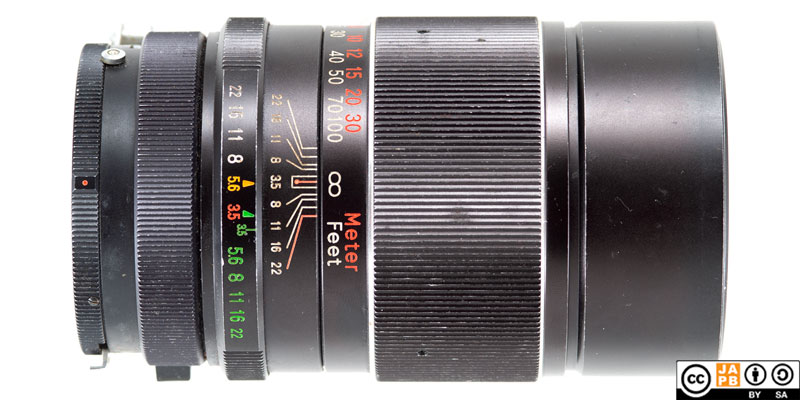
Specifications
The table below summarizes the lens’ key specifications (measurements based on pictured version of the lens):
| Brand: | Vivitar | Lens name | 200mm 1:3.5 AUTO TELEPHOTO |
| Focal length(s)1 | 200 mm | Angle-of-view2 | 12 ° |
| Maximum Aperture | f/3.5 | In Production | ca. 1969–1976 |
| Lens mount (this lens) | Miranda (Automex/Sensorex) | Other lens mounts | multiple3 (T-4) |
| Length4 | 156,1 mm (with Miranda adapter) 145,1 mm (bare T-4 mount) | Diameter54 | 77,9 mm |
| Filter ring diameter | 67 mm | Weight | 848 grams (with Miranda adapter) 767 grams (bare T-4 mount) |
| Lens element count | 4 | Lens group count | 4 |
| Aperture blades (S/R/C)6 | 8 S | Focus throw | 240 ° |
| Minimum focusing distance (measured) | 281 cms | Maximum magnification | 1:12 |
| Has manual aperture ring | YES | Has Manual focus ring | YES |
| Aperture mechanism type | Automatic | Aperture click stops 7 | 3.5-5.6-8-11-16-22 |
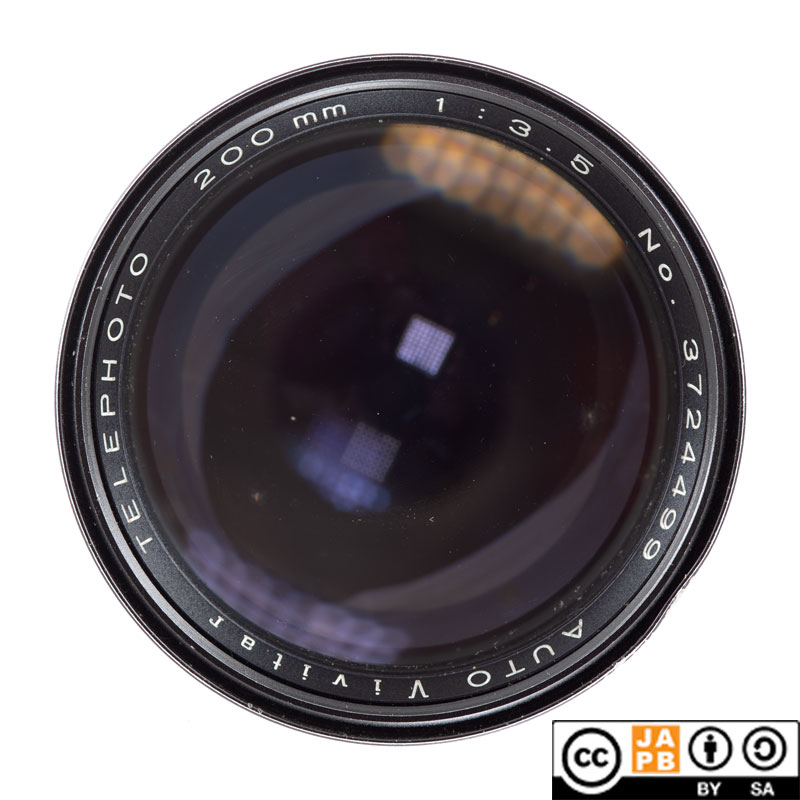
Further notes:
• This lens sports an integrated (pull-out) lens hood and a tripod foot. The tripod foot is 360 ° adjustable and can be locked in any position.
• With a ’37xxx’ serial number prefix, this is a lens originally manufactured by Tokina.
• This lens was designed to use the T-4 interchangeable lens mount and can therefore be used on several 1960s and 70s systems (assuming one has the T-4 adapter).
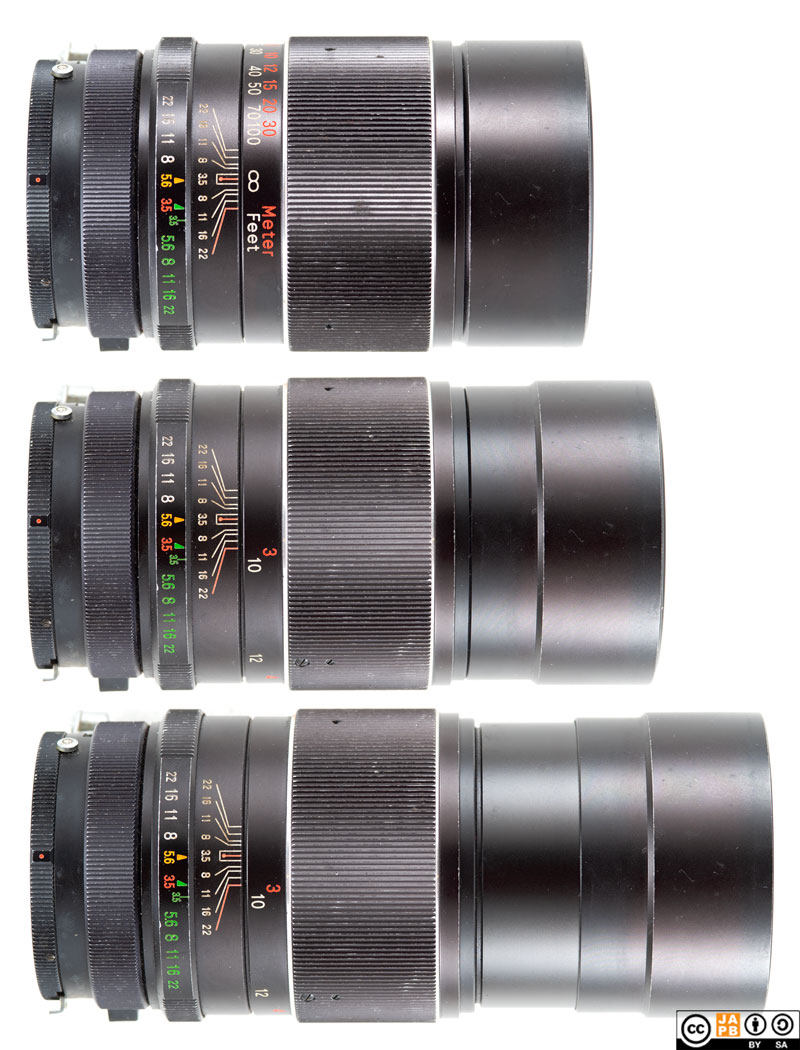
Top: Focused to infinity, hood retracted
Middle: Focused to MFD, hood retracted
Bottom: Focused to MFD, hood extended
Versions and variations
There are several different lenses that Vivitar sold that shared the same mainline specifications, namely a 200 mm focal length and an f/3.5 maximum aperture. While many of these are in no way related to this design, there is one exception: Simultaneously with this lens, Vivitar offered a ‘compact’ version of this lens that had the identical optical recipe but omitted the tripod foot. Whether there were other differences, I am not sure.
Interestingly, this is one of those designs that Tokina originally also offered under its own brand, and the Tokina 200/3.5 (Early T-4) listed on JAPB here is fundamentally the same lens.
History of Vivitar
Vivitar initially was the trade name used by Ponder & Best Inc. until Ponder & Best changed its name to Vivitar Corp. From the 1960s to the early 2000s the company contracted various (mostly Japanese) optical and electronics manufacturers to manufacture photographic gear to be branded as Vivitar.
You can read more details in the Vivitar company profile.
Adapting
n.B! The following applies to all Miranda mount lenses.
This lens cannot be used natively on any current SLR or dSLRs. To use it in its native environment, you will need a Miranda Camera film body. While this lens will mount on any Miranda camera that uses the Miranda mount, its automatic aperture stop-down will work only on Miranda bodies after the Miranda F (launched 1963). For the aperture communication arm to be able to communicate aperture values, this lens needs to be mounted on an Automex or Sensorex series body.
Thanks to being a fully manual lens (manual aperture, manual focus), the lens can be adapted to all mirrorless cameras using a suitable adapter. However, Miranda adapters are not as easily available as adapters for many other legacy era camera mounts, nor is there a wide variety of specialist adapters.
Using Miranda lenses on dSLRs is a theoretical possibility. Thanks to the relatively short flange focal distance of the Miranda mount (at 41,5 mm, clearly shorter than that of any full-frame dSLR mount), any adapter will necessitate some corrective optics to achieve infinity focus.
Footnotes
- Focal length is (unless stated otherwise) given in absolute terms, and not in Full-frame equivalent. For an understanding of whether the lens is wide/tele, see ‘Angle-of-view’. ↩︎
- Picture angle is given in degrees (based on manufacturers’ specs) and concerns the diagonal picture angle. Rule of thumb:
> 90 ° ==> Ultra-wide-angle
70–90 ° ==> Wide-angle
50–70 ° ==> Moderate wide-angle
40–50 ° ==> ‘Standard’ or ‘normal’ lens
20–40 ° ==> Short tele lens
10-20 ° ==> Tele lens
5-10 ° ==> Long tele lens
< 5 ° ==> Ultra-tele lens ↩︎ - Any lens mount for which there is a TX-adapter, including: Canon FD, Contax/Yashica, Konica AR, M42, Minolta SR, Nikon F, Olympus OM and Pentax K ↩︎
- Length is given from the mount flange to the front of lens at infinity. ↩︎
- Diameter excludes protrusions such as rabbit ears or stop-down levers. ↩︎
- S=straight; R=rounded; C=(almost)circular at all apertures. ↩︎
- Numbers equal aperture values on aperture ring; • intermediate click; – no intermediate click. ↩︎