Pekka Buttler, 11/2026
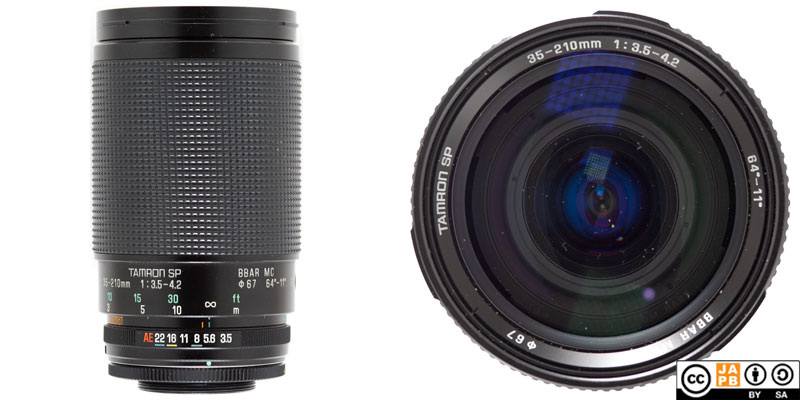
Specifications
The table below summarises the lens’ key specifications (measurements based on pictured sample with M42 adapter):
| Brand: | Tamron | Lens name | SP 35-210mm 1:3.5-4.2 BBAR MC |
| Focal length(s) 1 | 35-210 mm | Angle-of-view 2 | 64°–11° |
| Maximum Aperture | f/3.5–4.2 | In Production | 1983–87 |
| Lens mounts (native) | Tamron Adaptall | Other lens mounts | See article on Adaptall |
| Length 3 | 127,6 mm (with M42 adapter) | Diameter 4 | 73,2 mm |
| Filter ring diameter | 62 mm | Weight | 817 grams (without adapter) 845 grams (with M42 adapter) |
| Lens element count | 16 | Lens group count | 12 |
| Aperture blades (S/R/C) 5 | 8 S | Focus throw | 150 ° |
| Minimum focusing distance (measured) | 158 cms @35mm 158 cms @210 mm | Maximum magnification (measured) | 1:36 @35mm 1:6 @210 mm |
| Has manual aperture ring | YES | Has manual focus ring | YES |
| Aperture mechanism type | Automatic | Aperture click stops (on preset ring) 6 | 3.5••5.6•8•11•16-22 |
Further notes:
• This lens was designed to use the Tamron Adaptall2 intermediate mount
• Tamron has always had its own coding scheme for lens designs. This coding scheme is extremely useful to discern between two (or more) lenses that have the same mainline specifications (focal length and maximum aperture). According to the Tamron coding scheme, this lens is “Model 26A”.
• This lens is a one-ring (push–pull) zoom where the same ring is used for changing focal length (push forward toward 210 mm; pull in towards 35 mm) as well as for focusing.
• The combined focus–zoom ring is very broad and nicely grippy.
• The aperture ring is narrow, but somewhat manageable, assuming that you’re not wearing gloves.
• The lens is (for practical purposes) parfocal, with the minimum focusing distance staying the same (at slightly over 1,5 meters) throughout the zoom range.
• Hence also the lens has a relatively modest MFD at the 35 mm (wide-angle) focal length setting, leading to a maximum magnification ratio of 1:3.6.
• At the tele-end that ≈1,5 MFD is more practical, offering a maximum magnification of 1:6. (In practice the effective focal length at MFD and the 210 setting is close to 190 mm)
• The lens’ filter threads rotate when focusing.
• The lens can be used with a custom bayonet lens hood, which however is very hard to find. Alternatively a 67 mm diameter screw-in hood can also be used, but due to the bog zoom factor, it cannot offer protection beyond the wide end.
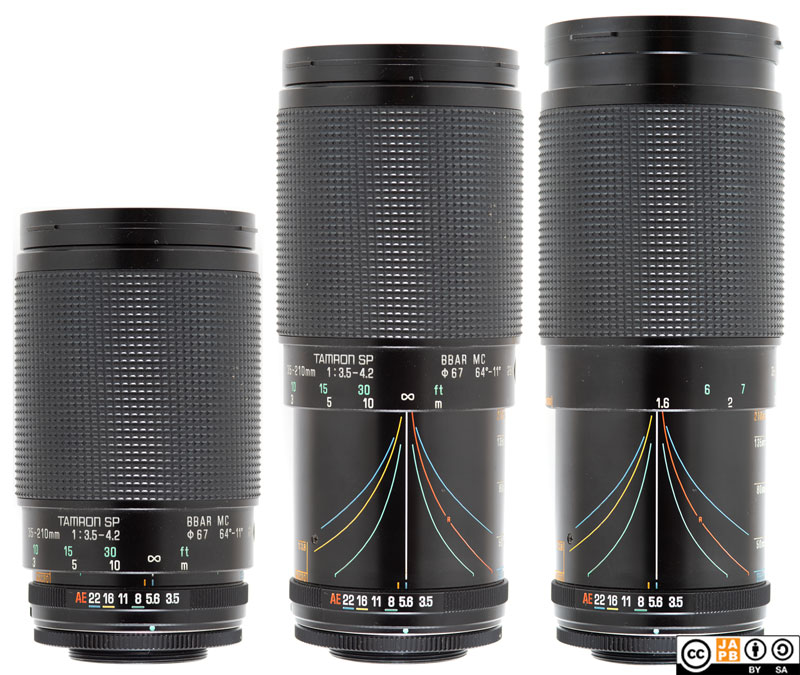
– Zoomed to 35 mm and focused at infinity
– Zoomed to 210 mm and focused at infinity
– Zoomed at 210 mm and focused at 35 mm MFD
Historical notes:
• When Tamron introduced the Adaptall-2 variant of its intermediate mount, they also introduced a ‘premium’ line of more pro-oriented lenses under the ‘SP’ (Superior Performance) acronym.
• Within that SP line, Tamron during 1979–80 introduced a series of zooms, including a 24–48 wide zoom, this 35–80 standard zoom, as well as a 70–210 tele zoom, and the legendary 70–150/2.8 Soft focus zoom. This first generation of SP zooms were characterised by solid image quality, good build quality and limited (2x–3x) zoom ratios.
• In 1983 Tamron extended that lineup of SP Zooms with 4 new zooms. Two of these would extend the traditional zoom ranges towards the wider end (the Tamron SP 28–80/3.5–4.2 and the Tamron SP 28–135/4–4.5) and two more would offer zoom ratios rarely seen budget lenses (at least not without egregious tradeoffs in terms of image quality), namely the 6x zoom ratio Tamron SP 35–210/3.5–4.2 (this lens) and the 5x zoom ratio Tamron SP 60–300/3.8–5.4.
• This lens was discontinued in 1987 in the midst of the turmoil caused by the advent of autofocus technology and was – as such – not replaced by a clear successor lens. It can, however, be seen as the spiritual ancestor of several generations of Tamron “one-for-all” lenses like the 28–200 mm lenses Tamron introduced starting in
Versions and variants
I have not seen any evidence pointing towards more than one variant of this Tamron lens existing.
Adapting
Given that this lens uses an intermediate mount, there are several ways to go, depending on what your intention is
If you intend to adapt your Tamron Adaptall lens to a dSLR…
There are original Tamron Adaptall adapters to both Pentax K and Nikon F (Ai) available. These adapters allow you to use the tamron Adaptall lens as if it was a native (manual focus) lens (including aperture and aperture priority exposure automation). There are also modern adapters available from several adapter manufacturers, but – in general – these adapters are dumb adapters and do not allow aperture control.
If your dSLR is a Canon EF or Sony/Minolta A and Four thirds camera, you can get an aftermarket dumb adapter, but will have to manually control aperture.
To film SLRs?
You’re in luck, because there used to be Adaptall/Adaptall-2 adapters made for pretty much every mainstream SLR system available before the mid-70s, (including at least7: Canon FD*, Contax/Yashica*, Fujica X†, Konica AR*, M42 (several variants8), Mamiya Z°, Minolta SR*, Miranda°, Nikon F° (Pre-Ai and Ai), Olympus OM*, Pentax K (K° and A† versions), Praktica B†, Rollei QBM° and Topcon RE° (Exakta). What you need to do is head to your favourite online classifieds platform and procure an adapter (adapters for dSLR mounts are still available new).
Notes:
* Available both as Adaptall 1 and 2 (with different features)
° Available only as Adaptall 1
† Available only as Adaptall 2
To Mirrorless
If you already have a number of adapters from the typical SLR mounts to your mirrorless camera (e.g. Canon FD / M42 / Nikon F / Olympus OM / Pentax K …) your best choice is to either:
- get an original Tamron adapter from Adaptall to whatever your most favoured SLR era lens mount is or
- get a modern Tamron adapter to mirrorless adapter from one of the contemporary adapter manufacturers (K&F Concept seems to offer dumb adapters for Adaptall to most mirrorless mounts)
Of these, the earlier option is likely to be cheaper and the later less finicky.
History of Tamron
A short history of Tamron can be found as part of the Tamron company profile.
Footnotes
- Focal length is (unless stated otherwise) given in absolute terms, and not in Full-frame equivalent. For an understanding of whether the lens is wide/tele, see ‘Angle-of-view’. ↩︎
- Picture angle is given in degrees and concerns the diagonal picture angle. Rule of thumb:
> 90 ° ==> Ultra-wide-angle
70–90 ° ==> Wide-angle
50–70 ° ==> Moderate wide-angle
40–50 ° ==> ‘Standard’ or ‘normal’ lens
20–40 ° ==> Short tele lens
10-20 ° ==> Tele lens
5-10 ° ==> Long tele lens
< 5 ° ==> Ultra-tele lens ↩︎ - Length is given from the mount flange to the front of lens at infinity. ↩︎
- Diameter excludes protrusions such as rabbit ears or stop-down levers. ↩︎
- S=straight; R=rounded; C=(almost)circular at all apertures. ↩︎
- Numbers equal aperture values on aperture ring; • intermediate click; – no intermediate click. ↩︎
- This list will only contain adapters that we at JAPB have witnessed. ↩︎
- There were both adaptall adapters to vanilla M42 mounts as well as some of the M42 variants (such as Fujica M42, Mamiya M42, Praktica electronic M42). For details, see the JAPB article on the m42 mount. ↩︎