Pekka Buttler, 11/2026
Specifications
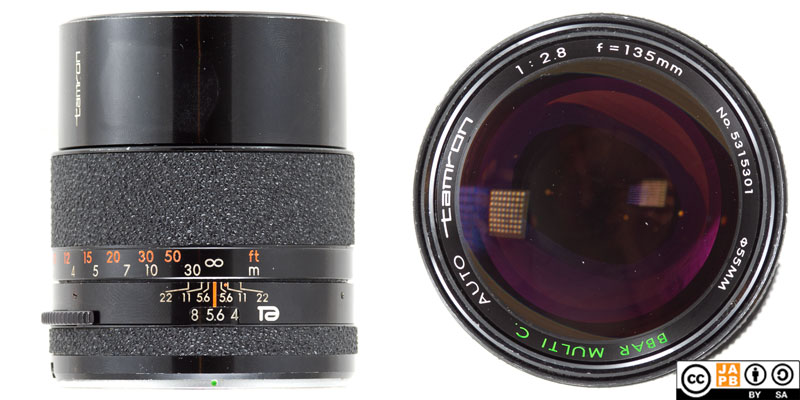
The table below summarises the lens’ key specifications (measurements based on pictured sample with Canon FD adapter):
| Brand: | Tamron | Lens name | 1:2.8 f=135mm BBAR MULTI C. |
| Focal length(s) 1 | 135 mm | Angle-of-view 2 | 18° |
| Maximum Aperture | f/2.8 | In Production | 1976–79 |
| Lens mounts (native) | Tamron Adaptall | Other lens mounts | See article on Adaptall |
| Length 3 | 88,5 mm (with Canon FD adapter) | Diameter 4 | 64,9 mm |
| Filter ring diameter | 55 mm | Weight | 373 grams (without adapter) 448 grams (with Canon FD adapter) |
| Lens element count | 4 | Lens group count | 4 |
| Aperture blades (S/R/C) 5 | 6 S | Focus throw | 180 ° |
| Minimum focusing distance (measured) | 147 cms | Maximum magnification (measured) | 1:8,9 |
| Has manual aperture ring | YES | Has manual focus ring | YES |
| Aperture mechanism type | Automatic | Aperture click stops (on preset ring) 6 | 2.8•4•5.6•8•11•16-22 |
Further notes:
• This lens was designed to use the Tamron Adaptall/Adaptall2 intermediate mount
• Tamron has always had its own coding scheme for lens designs. This coding scheme is extremely useful to discern between two (or more) lenses that have the same mainline specifications (focal length and maximum aperture). According to the Tamron coding scheme, this lens is “Model CT-135”.
• This lens replaced the previous Tamron 135 mm f/2.8 that was made for the Adaptall mount (“Model T-135”).
• In turn, this lens was replaced with the Tamron 135 mm f/2.5 Adaptall-2 version [data sheet]
• The focus ring is sufficiently broad and quite grippy. The aperture ring is so narrow that even having a rubber grip does not make it ergonomic.
• With many lenses from this age of Tamron lenses, the rubber rings have a tendency to stretch and loosen, Luckily this lens does not suffer that malady.
• The lens’ filter threads do not rotate when focusing.
• The lens features an integrated, pull-out lens hood that however is a bit too shallow to offer real protection.
• Next to the aperture ring there is a switch for choosing between manual and automatic aperture.
Versions and variants
There are four variants of the Tamron Adaptall 135 mm f/2.8:
The early (T-135) version has a transparent plastic (perspex) ring covering the focusing scale (and giving DOF preview). This version is available both in a black finish as well as in a light silver finish.
The later (CT-135) version (this lens) lacks the transparent plastic ring and professes to be BBAR multicoated. Also this version is available both in a black finish as well as in a light silver finish.
All four variants share the same optical recipe.
Adapting
Given that this lens uses an intermediate mount, there are several ways to go, depending on what your intention is
If you intend to adapt your Tamron Adaptall lens to a dSLR…
There are original Tamron Adaptall adapters to both Pentax K and Nikon F (Ai) available. These adapters allow you to use the tamron Adaptall lens as if it was a native (manual focus) lens (including aperture and aperture priority exposure automation). There are also modern adapters available from several adapter manufacturers, but – in general – these adapters are dumb adapters and do not allow aperture control.
If your dSLR is a Canon EF or Sony/Minolta A and Four thirds camera, you can get an aftermarket dumb adapter, but will have to manually control aperture.
To film SLRs?
You’re in luck, because there used to be Adaptall/Adaptall-2 adapters made for pretty much every mainstream SLR system available before the mid-70s, (including at least7: Canon FD*, Contax/Yashica*, Fujica X†, Konica AR*, M42 (several variants8), Mamiya Z°, Minolta SR*, Miranda°, Nikon F° (Pre-Ai and Ai), Olympus OM*, Pentax K (K° and A† versions), Praktica B†, Rollei QBM° and Topcon RE° (Exakta). What you need to do is head to your favourite online classifieds platform and procure an adapter (adapters for dSLR mounts are still available new).
Notes:
* Available both as Adaptall 1 and 2 (with different features)
° Available only as Adaptall 1
† Available only as Adaptall 2
To Mirrorless
If you already have a number of adapters from the typical SLR mounts to your mirrorless camera (e.g. Canon FD / M42 / Nikon F / Olympus OM / Pentax K …) your best choice is to either:
- get an original Tamron adapter from Adaptall to whatever your most favoured SLR era lens mount is or
- get a modern Tamron adapter to mirrorless adapter from one of the contemporary adapter manufacturers (K&F Concept seems to offer dumb adapters for Adaptall to most mirrorless mounts)
Of these, the earlier option is likely to be cheaper and the later less finicky.
History of Tamron
A short history of Tamron can be found as part of the Tamron company profile.
Footnotes
- Focal length is (unless stated otherwise) given in absolute terms, and not in Full-frame equivalent. For an understanding of whether the lens is wide/tele, see ‘Angle-of-view’. ↩︎
- Picture angle is given in degrees and concerns the diagonal picture angle. Rule of thumb:
> 90 ° ==> Ultra-wide-angle
70–90 ° ==> Wide-angle
50–70 ° ==> Moderate wide-angle
40–50 ° ==> ‘Standard’ or ‘normal’ lens
20–40 ° ==> Short tele lens
10-20 ° ==> Tele lens
5-10 ° ==> Long tele lens
< 5 ° ==> Ultra-tele lens ↩︎ - Length is given from the mount flange to the front of lens at infinity. ↩︎
- Diameter excludes protrusions such as rabbit ears or stop-down levers. ↩︎
- S=straight; R=rounded; C=(almost)circular at all apertures. ↩︎
- Numbers equal aperture values on aperture ring; • intermediate click; – no intermediate click. ↩︎
- This list will only contain adapters that we at JAPB have witnessed. ↩︎
- There were both adaptall adapters to vanilla M42 mounts as well as some of the M42 variants (such as Fujica M42, Mamiya M42, Praktica electronic M42). For details, see the JAPB article on the m42 mount. ↩︎