Pekka Buttler, 10/2026
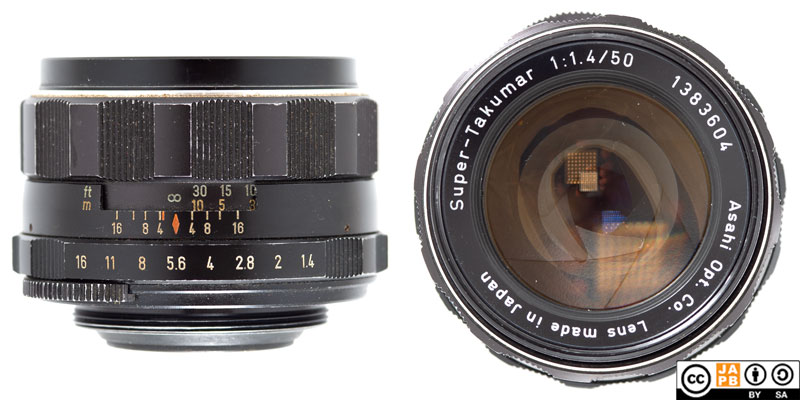
Specifications
The table below summarises the lens’ key specifications (measurements are based on the pictured sample):
| Brand: | Asahi Opt.Co. (Pentax) | Lens name | Super-Takumar 1:1.4/50 |
| Focal length(s)1 | 50 mm | Angle-of-view2 | 47 ° |
| Maximum Aperture | f/1.4 | In Production | 1964–1966 |
| Lens mounts | M42 | Subfamily (if applicable) | –– |
| Length3 | 38,6 mm | Diameter4 | 60,5 mm |
| Filter ring diameter | 49 mm | Weight | 243 grams |
| Lens element count | 8 | Lens group count | 6 |
| Aperture blades (S/R/C)5 | 6 S | Focus throw | 210 ° |
| Minimum focusing distance (measured) | 44 cm | Maximum magnification (measured) | 1:6,9 |
| Has manual aperture ring | YES | Has Manual focus ring | YES |
| Aperture mechanism type | Auto/Manual | Aperture click stops 6 | 1.4-2•2.8•4•5.6•8•11-16 |
Further notes:
• The 8-element 50/1.4 Super Takumar is a legendary lens.
• While it was not the first SLR lens to achieve a maximum aperture of f/1.4 in combination with a 50 mm focal length, it was among the first to do so.
• Importantly, this lens achieved this feat by using a rather complicated 8 element design that included 3 single elements in front of the diaphragm and a cemented triplet (!), and two separate elements behind the diaphragm.
• This ambitious design was intended as a tour-de-force of Asahi optical engineering, and it certainly helped put to rest any lingering thoughts of Japanese optics as “just copying German designs”. However, Asahi lost money on every sample sold, as the costs of that cemented triplet proved to be untenable in the long run.
• Hence, after only two years and roughly 125 000 copies, Asahi replaced this with a more economical, 7-element design. As a result, remaining serviceable 8-element copies are quite sought-after.
Identifying 8-element versions
• Some feel that Asahi tried to surreptitiously replace the costly 8-element version with the more economical 7-element version. Whether this is true or not, what is true is that distinguishing 8- and 7-element versions is not entirely easy, especially if you’re trying to do so without holding the lens in your hand (only based on images).
• Another factor that complicates matters is that today (≈60 years after the original lenses rolled of the production line), repairs might have led to parts from 7- and 8-element versions having been combined. Hence, indicators (below) are rated for how trustworthy they are:
• Radioactivity. The 8-element design is not radioactive, whereas the subsequent 7-element design used Thoriated glass mixtures, meaning that the 7-element Super Takumar 50/1.4 lenses are invariably radioactive.
• IR focus indicator placement. Looking at the lens’ depth-of-field scale, on the 8-element version the red dash indicating the IR focus is within the area defined as depth-of field for f/4, whereas in the 7-element version the IR indicator is just outside the DOF-area of f/4. As the barrel components of 7- and 8-element variants are not easily interchangeable, this is a relatively solid identifying trait.
• Product number under aperture switch. The 8-element version’s product number is ‘358’, but that is not displayed on the underside/rearside of the A/M selector switch. The first version of the 7-element lens (product number ‘37800’) is the first 50/1.4 Takumar to show its product code this way. This is generally a reliable indicator, but cannot be seen from all pictures.
• Rearmost lens placement. The 8-element version has altogether 5 lens elements behind the diaphragm, and hence also the rearmost element protrudes considerably beyond the mount. While this difference is obvious in a side-by side comparison, it might not be discernible without a chance to a side-by-side comparison.
• Serial numbers are shown on the lens’ name ring, and while there are some ‘safe’ serial number ranges (765xxx–1400xxx) there are also serial numbers where 7-element and 8-element version overlap (1400xxx–1733xxx). Moreover, as name rings can be switched around, serial numbers alone do not make a trustworthy indication.
Versions
The table below summarises the major steps in the genealogy of Asahi/Pentax 50 mm f/1.4 lenses.
| Years | Mount | Name / family | Mainline specifications | Optical design | product Number on rear of aperture mode switch | Notes |
| 1964-66 | M42 | Super-Takumar (8-element) | 50 mm f/1.4 | 8e/6g | 358 (not shown) | (this lens) |
| 1965–71 | M42 | Super-Takumar (7-element) | 50 mm f/1.4 | 7e/6g | 378, 37800, 37801, 37802 | |
| 1971–72 | M42 | Super-Multi-Coated Takumar | 50 mm f/1.4 | 7e/6g | 37902 | |
| 1972–75 | M42 | SMC Takumar | 50 mm f/1.4 | 7e/6g | 37908 | [data sheet] |
In 1975 Asahi/Pentax launched its own proprietary bayonet mount – the Pentax K mount – whereafter all Pentax fast fifties were manufactured with a Pentax K mount.
History of Asahi / Pentax
The camera business today known Pentax was founded in 1919 as Asahi Kogaku Kogyo (Asahi Optical Company). Initially the company manufactured lenses for eyeglasses, later diversifying into projection lenses and even later into photographic lenses, supplying lenses for camera makers such as Konishiroku (Konica) and Molta (Minolta) and binoculars.
In 1952 – the year of the Helsinki olympiad – Asahi released the Asahiflex, the first Japanese 35 mm SLR. Together with its SLR cameras, Asahi introduced a line of lenses that carried the name ‘Takumar’, in honour of the founder’s brother.
In 1975 Asahi/Pentax introduced its own bayonet mount – The Pentax K mount – and phased out the production of m42 lenses and cameras. The name Takumar would remain on Pentax lenses until 1979 (and made some sporadic reappearances). The Pentax K mount is still a current mount, but it has several versions/generations. For details, see the JAPB article on the Pentax K mount.
Pentax was among the handful of Japanese camera manufacturers to keep up with the introduction of autofocus SLR cameras, and even survived the shift from film SLRs to digital SLRs (albeit somewhat struggling).
Adapting
If you want to natively mount this lens you need to find a functioning m42 mount film camera. Luckily that should be relatively easy as m42 bodies were produced in their millions and most of them lack features that are especially likely to have deteriorated to the point of making the entire camera inoperable.
Adapting this lens to a mirrorless, full-frame digital camera is a breeze thanks to the lens having full manual controls (aperture ring, focus ring). You simply need a dumb adapter from m42 to your mirrorless system (And set the lens in manual mode to be sure the aperture works as you intend).
Due to the medium flange focal distance used by the m42 mount (45,46 mm), whether you can adapt this lens to dSLR/SLR mounts depends on which dSLR mount: Canon EF, Four Thirds, Minolta/Sony A and Pentax K can mount m42 lenses using a simple adapter ring. Nikon F on the other hand is not as problem-free, and – to retain anything near infinity focus – the adapter will necessitate corrective optics. In all cases, your camera will work only in stop-down metering.
Footnotes
- Focal length is (unless stated otherwise) given in absolute terms, and not in Full-frame equivalent. For an understanding of whether the lens is wide/tele, see ‘Angle-of-view’. ↩︎
- Picture angle is given in degrees (based on manufacturers’ specs) and concerns the diagonal picture angle. Rule of thumb:
> 90 ° ==> Ultra-wide-angle
70–90 ° ==> Wide-angle
50–70 ° ==> Moderate wide-angle
40–50 ° ==> ‘Standard’ or ‘normal’ lens
20–40 ° ==> Short tele lens
10-20 ° ==> Tele lens
5-10 ° ==> Long tele lens
< 5 ° ==> Ultra-tele lens ↩︎ - Length is given from the mount flange to the front of lens at infinity. ↩︎
- Diameter excludes protrusions such as rabbit ears or stop-down levers. ↩︎
- S=straight; R=rounded; C=(almost)circular at all apertures. ↩︎
- Numbers equal aperture values on aperture ring; • intermediate click; – no intermediate click. ↩︎