Pekka Buttler, 11/2026
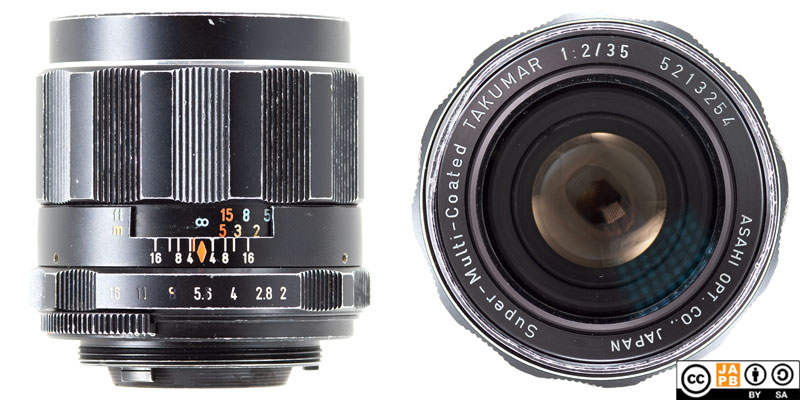
There is also a gallery of images with this lens.
Specifications
The table below summarises the lens’ key specifications (measurements are based on the pictured sample):
| Brand: | Asahi Opt.Co. (Pentax) | Lens name | Super-Multi-Coated Takumar 1:2/35 |
| Focal length(s)1 | 35 mm | Angle-of-view2 | 63 ° |
| Maximum Aperture | f/2 | In Production | 1971–1975 |
| Lens mounts | M42 | Subfamily (if applicable) | –– |
| Length3 | 54,0 mm | Diameter4 | 57,9 mm |
| Filter ring diameter | 49 mm | Weight | 241 grams |
| Lens element count | 8 | Lens group count | 7 |
| Aperture blades (S/R/C)5 | 6 S | Focus throw | 125 ° |
| Minimum focusing distance (measured) | 39,5 cm | Maximum magnification (measured) | 1:8,2 |
| Has manual aperture ring | YES | Has Manual focus ring | YES |
| Aperture mechanism type | Auto/Manual | Aperture click stops 6 | 2-2.8•4•5.6•8•11-16 |
Further notes:
• The 35 mm f/2 Super-Multi-Coated Takumar is a representative of a long line of fast 35 mm focal length lenses from Asahi/Pentax. See more on the genealogy of fast 35 mm primes under ‘versions’
• Importantly, M42 thread mount era Asahi 35/2 lenses come in two distinct iterations: the early 67 mm filter thread versions and the later 49 mm filter thread versions. While the earlier versions are often lionised for their optical qualities, the later are in many ways a more sensible design.
• This lens is from the Super-Multi-Coated generation, meaning that it is not only multicoated, but also supports open aperture metering on compatible Pentax cameras (Spotmatic F, Electro Spotmatic, ES and ES II)
• My copy has seen a fair deal of use, but the optics are flawless.
• This version is widely known to use thoriated glass. Hence it is somewhat radioactive and is liable to – over time – develop a yellow-brown uniform color cast.
Versions
The table below summarises the genealogy of fast 35 mm lenses by Asahi/Pentax (f/2–f/2.3).
| Years | Mount | Name / family | Mainline specs | Optical design | aperture blades | aperture mechanism | filter mm | Notes |
| 1958-63 | vanilla M42 | Auto-Takumar | 35 mm f/2.3 | 6e/5g | 10 | semi-automatic | 62 mm | |
| 1963–67 | vanilla M42 | Super-Takumar (early) | 35 mm f/2 | 8e/7g | 5 | automatic | 67 mm | 7 |
| 1967–71 | vanilla M42 | Super-Takumar (late) | 35 mm f/2 | 8e/7g | 6 | automatic | 49 mm | ☢️ |
| 1971–75 | Pentax-M42 | Super-Multi-Coated Takumar | 35 mm f/2 | 8e/7g | 6 | automatic | 49 mm | (this lens) ☢️ |
| 1975–77 | (K-type Pentax K mount) | SMC-Pentax | 35 mm f/2 | 8e/7g | 6 | automatic | 52 mm | |
| 1977–84 | (K-type Pentax K mount) | Pentax-M | 35 mm f/2 | 7e/7g | 6 | automatic | 49 mm | [data sheet] |
| 1984–89 | (KA-type Pentax K mount) | Pentax-A | 35 mm f/2 | 7e/7g | 6 | automatic | 49 mm | |
| 1999–2019 | (KAF-type Pentax K mount) | smc PENTAX-FA | 35 mm f/2 | 6e/5g | 6 | automatic | 49 mm | |
| 2019– | (KAF-type Pentax K mount) | HD Pentax-FA | 35 mm f/2 | 6e/5g | 6 | automatic | 49 mm |
Asahi/Pentax and the fast 35 mm lens
The SLR, while revolutionary in many ways, initially came with a significant drawback, in that the ‘depth’ of the mirror box necessitated that lenses were designed with a significant back focal distance 8. That back focal distance precluded the use of the kind of wide-angle lenses that were typical on rangefinder cameras, and limited SLR lenses to ranging from standard focal lengths to various degrees of tele. At least until the virtually simultaneous perfection of the retrofocus design by Carl Zeiss Jena and Angenieux in 1949-1950.
While the initial development of the retrofocus lens design happened in the west (U.S., France, Germany), the Japanese optical industry was as adroit as usual in first adopting and later perfecting the technology. In the case of Asahi/Pentax, the major contribution to the art of retrofocus lenses came in the form of the 35 mm f/2.3 Auto-Takumar (1958–1963) – a lens that even today would count as a fast 35 mm lens. In the following decades, Asahi/Pentax always made sure to have a fast 35 mm lens in their lineup.
Adapting
If you want to natively mount this lens you need to find a functioning m42 mount film camera. Luckily that should be relatively easy as m42 bodies were produced in their millions and most of them lack features that are especially likely to have deteriorated to the point of making the entire camera inoperable.
Adapting this lens to a mirrorless, full-frame digital camera is a breeze thanks to the lens having full manual controls (aperture ring, focus ring). You simply need a dumb adapter from m42 to your mirrorless system (And set the lens in manual mode to be sure the aperture works as you intend).
Due to the medium flange focal distance used by the m42 mount (45,46 mm), whether you can adapt this lens to dSLR/SLR mounts depends on which dSLR mount: Canon EF, Four Thirds, Minolta/Sony A and Pentax K can mount m42 lenses using a simple adapter ring. Nikon F on the other hand is not as problem-free, and – to retain anything near infinity focus – the adapter will necessitate corrective optics. In all cases, your camera will work only in stop-down metering.
History of Asahi / Pentax
The camera business today known Pentax was founded in 1919 as Asahi Kogaku Kogyo (Asahi Optical Company). Initially the company manufactured lenses for eyeglasses, later diversifying into projection lenses and even later into photographic lenses, supplying lenses for camera makers such as Konishiroku (Konica) and Molta (Minolta) and binoculars.
In 1952 – the year of the Helsinki olympiad – Asahi released the Asahiflex, the first Japanese 35 mm SLR. Together with its SLR cameras, Asahi introduced a line of lenses that carried the name ‘Takumar’, in honour of the founder’s brother.
In 1975 Asahi/Pentax introduced its own bayonet mount – The Pentax K mount – and phased out the production of m42 lenses and cameras. The name Takumar would remain on Pentax lenses until 1979 (and made some sporadic reappearances). The Pentax K mount is still a current mount, but it has several versions/generations. For details, see the JAPB article on the Pentax K mount.
Pentax was among the handful of Japanese camera manufacturers to keep up with the introduction of autofocus SLR cameras, and even survived the shift from film SLRs to digital SLRs (albeit somewhat struggling).
Footnotes
- Focal length is (unless stated otherwise) given in absolute terms, and not in Full-frame equivalent. For an understanding of whether the lens is wide/tele, see ‘Angle-of-view’. ↩︎
- Picture angle is given in degrees (based on manufacturers’ specs) and concerns the diagonal picture angle. Rule of thumb:
> 90 ° ==> Ultra-wide-angle
70–90 ° ==> Wide-angle
50–70 ° ==> Moderate wide-angle
40–50 ° ==> ‘Standard’ or ‘normal’ lens
20–40 ° ==> Short tele lens
10-20 ° ==> Tele lens
5-10 ° ==> Long tele lens
< 5 ° ==> Ultra-tele lens ↩︎ - Length is given from the mount flange to the front of lens at infinity. ↩︎
- Diameter excludes protrusions such as rabbit ears or stop-down levers. ↩︎
- S=straight; R=rounded; C=(almost)circular at all apertures. ↩︎
- Numbers equal aperture values on aperture ring; • intermediate click; – no intermediate click. ↩︎
- This design is sometimes listed as two separate designs as Asahi Opt. Co seems to have made some minor tweak that resulted in two different product codes (code 368 for 1963–66 and code 43680 for 1966–67) ↩︎
- The ‘back focal distance’ is defined as the distance from the vertex of the rearmost lens to the focal plane (sensor or film). In practical terms, this is the distance from the rear of the lens to the sensor/film. ↩︎