Pekka Buttler, 08/2026
Specifications
The table below summarizes the lens’ key specifications (size and weight measurements reflect pictured lens (in M42 mount)):
| Brand: | Pentacon | Lens name | 3.5/30 |
| Focal length 1 | 30 mm | Angle-of-view 2 | 71 ° |
| Maximum Aperture | f/3.5 | In Production | 1970–1990 |
| Lens mount (this lens) | Exakta | Other lens mounts | M42 |
| Length 3 | 39,3 mm | Diameter 4 | 57,8 mm |
| Filter ring diameter | 49 mm | Weight | 178 grams |
| Lens element count | 5 | Lens group count | 5 |
| Aperture blades (S/R/C) 5 | 10 S | Focus throw | 160 ° |
| Minimum focusing distance (measured) | 32 cms | Maximum magnification (measured) | 1:7,6 |
| Has manual aperture ring | YES | Has Manual focus ring | YES |
| Aperture mechanism type | Preset | Aperture click stops | The aperture setting ring is clickless. The preset ring has clicks at: 3.5-4•5.6•8•11-16-22 |
Further notes:
• The Pentacon 30/3.5 is a new name for an old design. After the State-run merger of Meyer-Optik with Pentacon in 1970, most of the existing Meyer-Optik lens catalog was given a new life under the ‘Pentacon’ brand. The Pentacon 30/3.5 is essentially the same lens as the Meyer-Optik Görlitz Lydith (30/3.5) [data sheet].
• Many have wondered why Meyer-Optik (and later Pentacon) retained the 30 mm f/3.5 in the lens lineup given that they had already introduced the 29 mm f/2.8 Orestegon [data sheet] which was also taken into the Pentacon lineup. The simple reason is that the 30/3.5 was significantly cheaper to manufacture (and sell) and that the 30/3.5 – being a preset lens – offered unrivalled backwards compatibility. Moreover, the Lydith had achieved an ardent following that lasts until today.
• The Pentacon 30 mm f/3.5 was only ever made featuring a preset aperture mechanism. It also remained in small-batch production all the way until German unification.
Versions
The Pentacon 30 mm f/3.5 was introduced for two mounts with different (physical) mounts and different flange focal distances. As a result, there are two structurally distinct versions in existence, which obviously also have slightly differing measurements.
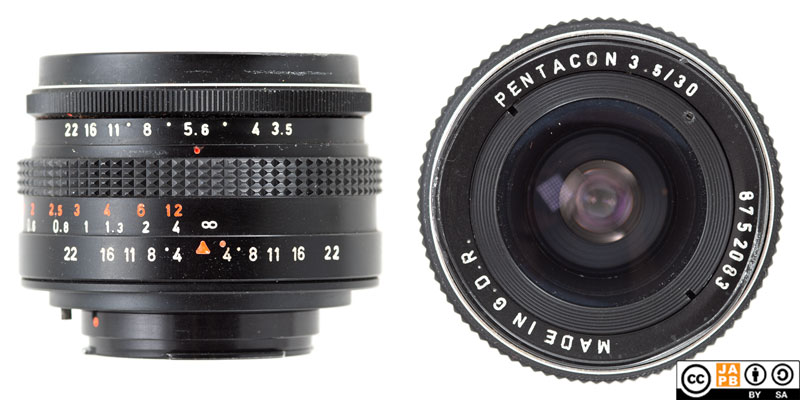
Also, there were at least two different cosmetic variants of the Pentacon 30/3.5, with one version having a narrow scalloped metal focus ring and the other having a metal focus ring made up of small pyramids (see image above).
Moreover, domestic and export versions often had different name rings and at least three different name rings can be encountered.
• there is the above pictured version that highlights the country of origin (G.D.R, German democratic republic)
– there is a very similar name ring that also carries the country of origin, but adds a Pentacon logo before the ‘Pentacon’ brand
– there is a third version that just has “Pentacon 3,5/30” and a serial number (no country of origin).
History of Pentacon
Pentacon – more precisely VEB Pentacon – was an East German state-owned camera and optics combinate that was very influential (also outside the East Bloc) from its inception until the demise of the East German people’s republic.
But Pentacon was not born out of thin air. Therefore any real appreciation of Pentacon – either as a camera maker or as an optics manufacturer – has to start with a back story. Read more in the JAPB company profile on Pentacon …
Adapting
n.B! The following applies this lens in either Exakta or M42 mount.
This lens cannot be used natively on any current SLR or dSLRs. To use it in its native environment, you will need an Exakta or M42-mount film body. Luckily there are a lot of those (especially in M42 mount) available.
Thanks to being a fully manual lens (manual aperture, manual focus), the lens can be adapted to all mirrorless cameras using a suitable adapter. Moreover, both Exakta and M42 lenses are so uncomplicated that a simple ‘dumb adapter’ will do the job perfectly. Moreover, due to the popularity of both mounts, special adapters (helicoid adapters, tilt/shift adapters) are readily available. Alternatively, one can choose to daisy-chain adapters (e.g. M42->Canon EF; Canon EF –> mirrorless) which also opens up a wide range of speed boosters .
Using m42 and Exakta lenses on dSLRs can also be an easy option, depending on which dSLR.
• Canon EF has the shortest flange focal distance among full-frame dSLR’s and Canon’s wide range of dSLRs are able to mount both M42 and Exakta lenses perfectly using a simple adapter ring.
• Minolta / Sony A dSLRs are likewise able to mount M42 lenses using a simple adapter ring, but for Exakta lenses, the difference in flange focal distances is not enough to enable reaching infinity focus without an adapter that uses corrective optics.
• Pentax K dSLRs are likewise able to use M42 lenses using a simple adapter ring, but for Exakta lenses an adapter that uses corrective optics would be needed to allow infinity focus.
• Nikon F dSLRs have a long flange focal distance, meaning that mounting either M42 or Exakta lenses needs an adapter that uses corrective optics to allow anything close to infinity focus.
Footnotes
- Focal length is (unless stated otherwise) given in absolute terms, and not in Full-frame equivalent. For an understanding of whether the lens is wide/tele, see ‘Angle-of-view’. ↩︎
- Picture angle is given in degrees (based on manufacturers’ specs) and concerns the diagonal picture angle. Rule of thumb:
> 90 ° ==> Ultra-wide-angle
70–90 ° ==> Wide-angle
50–70 ° ==> Moderate wide-angle
40–50 ° ==> ‘Standard’ or ‘normal’ lens
20–40 ° ==> Short tele lens
10-20 ° ==> Tele lens
5-10 ° ==> Long tele lens
< 5 ° ==> Ultra-tele lens ↩︎ - Length is given from the mount flange to the front of lens at infinity. ↩︎
- Diameter excludes protrusions such as rabbit ears or stop-down levers. ↩︎
- S=straight; R=rounded; C=(almost)circular at all apertures. ↩︎