Pekka Buttler, 03/2026
Specifications
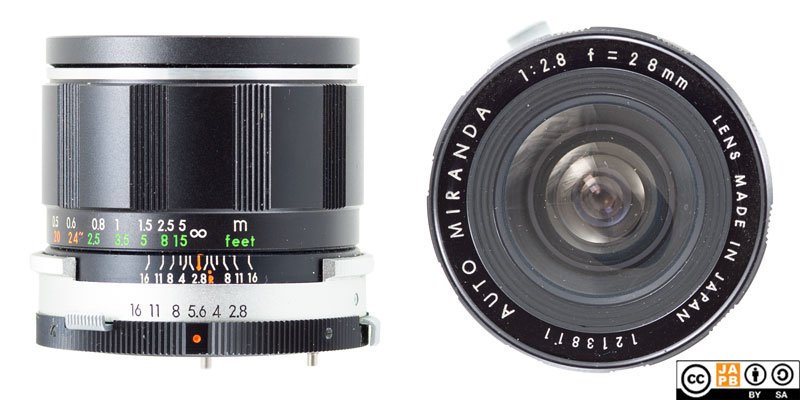
The table below summarises the lens’ key specifications (measurements based on pictured sample):
| Brand: | Miranda | Lens name | 1:2.8 f=28mm Auto |
| Focal length(s)1 | 28 mm | Angle-of-view2 | 74 ° |
| Maximum Aperture | f/2.8 | In Production | 1963–76 (all versions) 1974–76 (this version) |
| Lens mount (this lens) | Miranda | Mount subtype | F-G-MAT Auto aperture but no aperture coupling |
| Length3 | 52,9 mm | Diameter4 | 58,9 mm |
| Filter ring diameter | 52 mm | Weight | 219 grams |
| Lens element count | 8 | Lens group count | 6 |
| Aperture blades (S/R/C)5 | 6 S | Focus throw | 180 ° |
| Minimum focusing distance (indicated) | 25 cms | Maximum magnification (calculated ) | 1:6,8 |
| Has manual aperture ring | YES | Has Manual focus ring | YES |
| Aperture mechanism type | Automatic | Aperture click stops 6 | 2.8-4-5.6-8-11-16 |
Further notes:
• Miranda was – in its heyday – an advanced Japanese camera manufacturer. You can read more about Miranda camera in the JAPB company profile on Miranda camera.
• This is a very late version of Miranda’s venerable 28 mm f/2.8 lens – it belongs to the “Auto Dual” generation of lenses that Miranda started offering in 1974 for backward compatibility. See more on the Miranda lens generations in the Miranda lens compendium.
• Importantly, Miranda was a camera manufacturer and not a lens manufacturer. This mean that from early on, Miranda cameras came equipped with various brands of lenses, including some rather prominent manufacturers such as Kowa and Zunow.
• Lenses branded as “Miranda” or “Soligor Miranda” were not manufactured by Miranda, but were sourced from other manufacturers and branded ‘Miranda’. Most often these lenses were sourced from Miranda’s long-time partner (and later: owner) Soligor (Allied Impex Corporation). Hence, the actual manufacturer of “Miranda” lenses is often impossible to discern with certainty.
Versions/variants
The table below summarises the development of Miranda 28 mm f/2.8 lenses.
For more information on generations of Miranda lenses, see the Miranda lens compendium.
| Mainline spec | Years | Generation | Recipe | MFD | Filter | Length | Diameter | Weight | Notes |
|---|---|---|---|---|---|---|---|---|---|
| 28 mm f/2.8 | 1960–63 | unknown | 8e | unknown | unknown | unknown | unknown | unknown | 7 |
| 28 mm f/2.8 | 1963–74 | F-G-MAT | 8e / 6g | 0,25 m | 46 mm | 58 mm | 59 mm | 230 g | |
| 28 mm f/2.8 | 1963–74 | MEX-REX | 8e / 6g | 0,25 m | 46 mm | 60 mm | 59 mm | 232 g | |
| 28 mm f/2.8 | 1972–74 | E | 8e / 6g | 0,25 m | 52 mm | 54 mm | 59 mm | 243 g | [data sheet] |
| 28 mm f/2.8 | 1974–76 | EC | 7e / 7g | 0,25 m | 49 mm | 40 mm | 60 mm | 205 g | [data sheet] |
| 28 mm f/2.8 | 1974–76 | Dual | 8e / 6g | 0,25 m | 52 mm | 53 mm | 59 mm | 219 g | (this lens) |
Adapting
This lens cannot be used natively on any current SLR or dSLRs. To use it in its native environment, you will need a Miranda Camera film body. While this lens will mount on any Miranda camera that uses the Miranda mount, its automatic aperture stop-down will work only on Miranda bodies after the Miranda F (launched 1963).
Thanks to being a fully manual lens (manual aperture, manual focus), the lens can be adapted to all mirrorless cameras using a suitable adapter. However, Miranda adapters are not as easily available as adapters for many other legacy era camera mounts, nor is there a wide variety of specialist adapters.
Using Miranda lenses on dSLRs is a theoretical possibility. Thanks to the relatively short flange focal distance of the Miranda mount (at 41,5 mm, clearly shorter than that of any full-frame dSLR mount), any adapter will necessitate some corrective optics to achieve infinity focus.
Footnotes
- Focal length is (unless stated otherwise) given in absolute terms, and not in Full-frame equivalent. For an understanding of whether the lens is wide/tele, see ‘Angle-of-view’. ↩︎
- Picture angle is given in degrees and concerns the diagonal picture angle. Rule of thumb:
> 90 ° ==> Ultra-wide-angle
70–90 ° ==> Wide-angle
50–70 ° ==> Moderate wide-angle
40–50 ° ==> ‘Standard’ or ‘normal’ lens
20–40 ° ==> Short tele lens
10-20 ° ==> Tele lens
5-10 ° ==> Long tele lens
< 5 ° ==> Ultra-tele lens ↩︎ - Length is given from the mount flange to the front of lens at its shortest. ↩︎
- Diameter excludes protrusions such as rabbit ears or stop-down levers. ↩︎
- S=straight; R=rounded; C=(almost)circular at all apertures. ↩︎
- Numbers equal aperture values on aperture ring; • intermediate click; – no intermediate click. ↩︎
- Mentioned as a ‘fully automatic’ 8 element 28/2.8 in the 1960 Automex manual. Might be a ‘Soligor-Miranda’ lens. ↩︎