Pekka Buttler, 12/2025
This lens was kindly provided for cataloguing by Vladimir at #photogears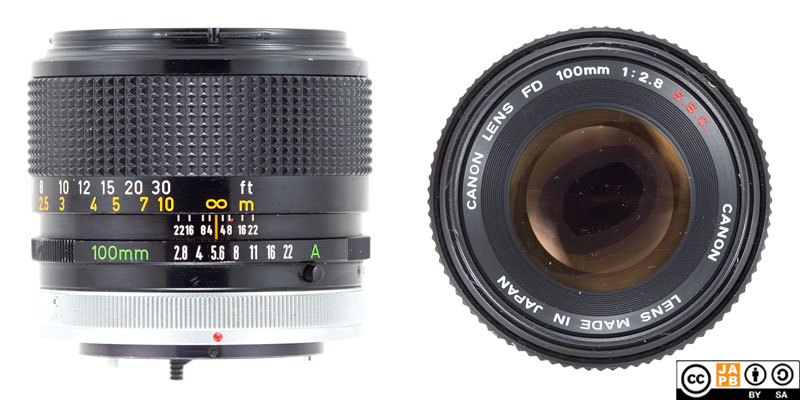
Specifications
The table below summarises the key specifications of the sampled lens.
| Brand: | Canon | Lens name | FD 100 mm 1:2.8 S.S.C. |
| Focal length 1 | 100 mm | Angle-of-view 2 | 24,4 ° |
| Maximum Aperture | f/2.8 | In Production | 1973–79 |
| Lens mount | Canon FD | Subfamily (if applicable) | FD (Black nose) |
| Length 3 | 59,3 mm | Diameter 4 | 66,5 mm |
| Filter ring diameter | 55 mm | Weight | 357 grams |
| Lens element count | 5 | Lens group count | 5 |
| Aperture blades (S/R/C) 5 | 8 S | Focus throw | 210 ° |
| Minimum focusing distance (indicated) | 100 cms | Maximum magnification (indicated) | 1:7,7 |
| Has manual aperture ring | YES | Has Manual focus ring | YES |
| Aperture mechanism type | Automatic | Aperture click stops 6 | 2.8•4•5.6•8•11•16•22 |
Further notes:
• Alike most Canon FD lenses, the lens front sports both a filter ring (55 mm) as well as grooves for mounting a bayonet-type lens hood.
• The BT-55 is the dedicated lens hood for this lens. Shorter variants (BS-55, BW-55A/B) can equally be used but offer less protection against oblique rays.
The history of Canon FD lenses
Feel free to browse the JAPB article on the Canon FD mount for all the details. Below is an outline of the position of the Canon FD mount in Canon’s development trajectory:
• 1959–1963: R-mount. Canon’s first SLR lens mount. Breech lock-type mount with aperture semi-automation (camera is able to stop down lens for taking the shot, but lens needs to be opened up by user action) .
• 1964–1969: FL-mount. Breech-lock type mount, physically similar mount as Canon R-mount, but camera-to-lens communication linkages somewhat different. Cannot communicate selected aperture to body (stop-down-metering only).
• 1970–1978: FD-mount. Breech-lock mount. FD lenses compatible with FL-cameras and vice versa. Manual focus lenses that communicate aperture information to camera, hence opening the door for automatic exposure (both shutter priority and aperture priority possible)
• 1979–1986: new FD-mount (a.k.a. FDn). Bayonet mount, backwards compatible with FL and FD mounts. Otherwise, as FD mount.
• 1987–today: EF-mount. Electronically controlled autofocus lenses that use an internal focusing motor. Compatible with previous mount lenses only using an adapter with optics.
The era of the Canon FD mount can be characterised by a gradual shift towards the ever-increasing use of plastics and lighter materials. In the chronology of this gradual shift:
• Chrome nose FD lenses (1971–1973) are solid metal (often brass), glass and (synthetic) rubber.
• Black nose FD lenses (1973-≈1975) are also metal, glass and rubber, but often 5-10% less heavy than chrome nose lenses.
• Late FD, (≈1975–1979) rubber is replaced by plastic and heavier metals are gradually replaced by lighter alloys
(FDn lenses (1979–1987) typically make extensive use of light alloys as well as, increasingly, plastics while in the EF era (1987 onwards) plastics fully take over)
Canon FD 100 mm f/2.8 lenses
During the ≈15 years of the Canon FD and Canon new FD mounts, Canon’s 100/2.8 underwent several design iterations:
| Year(s) | filter mm | optical design (elements/groups/blades) | weight | notes | |
| Canon FD 100/2.8 chrome nose | 1971–73 | 55 | 5e/5g/8b | 403 g | [data sheet] |
| Canon FD 100/2.8 S.S.C | 1973-79 | 55 | 5e/5g/8b | 357 g | [data sheet] |
| Canon FDn 100/2.8 | 1979-87 | 52 | 5e/5g/6b | 270 g 7 |
Adapting
n.B! The following applies to all Canon FD lenses:
This lens cannot be used natively on any current SLR or dSLRs. To use it in its native environment, you will need a Canon FD-mount film body.
Thanks to being a fully manual lens (manual aperture, manual focus), the lens can be adapted to all mirrorless cameras using a suitable adapter. However, for the adapter to allow the lens to stop down, you will need an adapter that can be set to engage the FD lens’ aperture control lever. Personally, this is my biggest gripe with the FD-mounts as this leads to what I refer to as the four-ring problem:
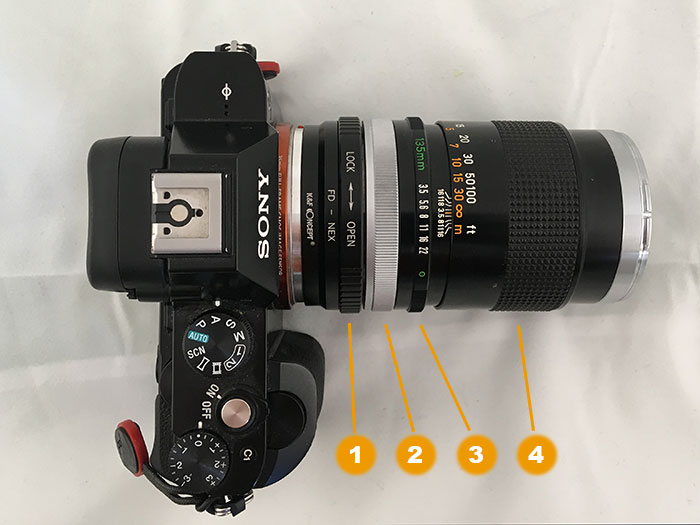
[1] Activation ring for aperture control
[2] Locking ring for breech-lock mount
[3] Aperture ring
[4] Focus ring
Note, that especially the first three rings are very close together.
Moreover, a large range of special adapters (helicoid adapters, tilt/shift adapters, speed boosters) for using Canon FD lenses on most mirrorless systems are available.
Using Canon FD lenses on dSLRs is a possibility, but is not problem free. Thanks to the relatively short flange focal distance of the Canon FD mount (at 42,0 mm, clearly shorter than that of any full-frame dSLR mount), any adapter will necessitate some optics to achieve infinity focus.
Footnotes
- Focal length is (unless stated otherwise) given in absolute terms, and not in Full-frame equivalent. For an understanding of whether the lens is wide/tele, see ‘Angle-of-view’. ↩︎
- Picture angle is given in degrees and concerns the diagonal picture angle. Rule of thumb:
> 90 ° ==> Ultra-wide-angle
70–90 ° ==> Wide-angle
50–70 ° ==> Moderate wide-angle
40–50 ° ==> ‘Standard’ or ‘normal’ lens
20–40 ° ==> Short tele lens
10-20 ° ==> Tele lens
5-10 ° ==> Long tele lens
< 5 ° ==> Ultra-tele lens ↩︎ - Length is given from the mount flange to the front of lens at infinity. ↩︎
- Diameter excludes protrusions such as rabbit ears or stop-down levers. ↩︎
- S=straight; R=rounded; C=(almost)circular at all apertures. ↩︎
- Numbers equal aperture values on aperture ring; • intermediate click; – no intermediate click. ↩︎
- Weight based on Canon camera museum. All other weights measured. ↩︎