Pekka Buttler, 10/2026
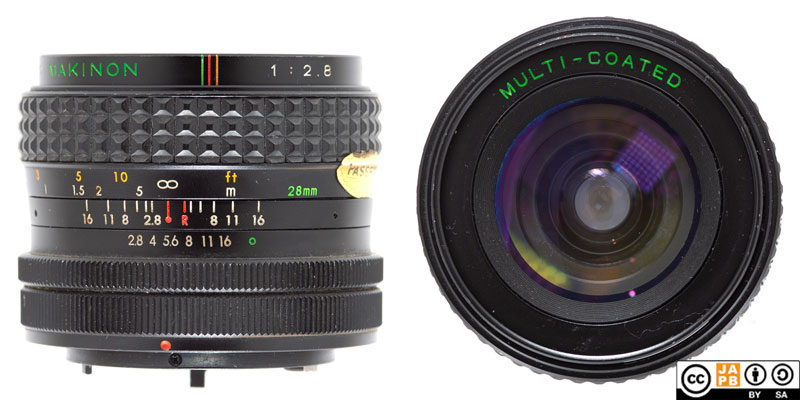
Specifications
The table below summarises the key specifications of the sampled lens.
| Brand: | Makinon | Lens name | Auto 1:2.8 f=28mm |
| Focal length 1 | 28 mm | Angle-of-view 2 | 74 ° |
| Maximum Aperture | f/2.8 | In Production | ≈1975–1983 |
| Lens mount | Canon FD | Other lens mounts | Contax/Yashica, Konica AR, M42, Minolta SR, Nikon F, Olympus OM, Pentax K, Rollei QBM |
| Length 3 | 50,4 mm | Diameter 4 | 63,9 mm |
| Filter ring diameter | 55 mm | Weight | 259 grams |
| Lens element count | 6 | Lens group count | 6 |
| Aperture blades (S/R/C) 5 | 8 S | Focus throw | 230 ° |
| Minimum focusing distance (indicated) | 27 cms | Maximum magnification (indicated) | 1:7,0 |
| Has manual aperture ring | YES | Has Manual focus ring | YES |
| Aperture mechanism type | Automatic | Aperture click stops 6 | 2.8-4-5.6-8-11-16 |
Further notes:
• The Makinon 28 mm f/2.8 lens was – once upon a time – a very popular lens and copies are even today easily and affordably available.
• There are altogether three different variants of this lens (see more below)
Versions
First off, the Makinon 28 mm f/2.8 was offered for at least 9 different lens mounts, so the measurements given above do vary somewhat from mount to mount – especially the length and weight measurements are quite mount-dependent.
Secondly, the Makinon 28 mm f/2.8 lens sold very well and Makina Optical launched at least three variants of the lens:
Variant A sports a 55 mm filter thread and a rubber focus ring made up of three rows of pyramid shapes – like the pictured lens. Among these lenses, the earliest variants have a silver band on both sides of the rubber focus ring.
Variant B has been ergonomically redesigned and now sports a narrower, 52 mm filter thread. Also the Focus ring has become a bit narrower, now only having two rows of pyramids.
Variant C shares the overall design and the 52 mm filter thread with Variant B, but the Focus ring now sports four rows of lengthwise rectangles.
Introduction to Makinon
Makinon was the lens brand of Makina Optical of Japan. Makina Optical was founded in 1967 and focused on lens manufacture from day one: First Makina Optical focused on selling lenses to other retailers under their brands, but in 1974/5 Makina Optical started selling lenses under their own Makinon brand. See more details in the Company profile of Makina Optical
Adapting
n.B! The following applies to the Makinon 28 mm f/2.8 using an Canon FD mount (as well as all Canon FD lenses):
This lens cannot be used natively on any current SLR or dSLRs. To use it in its native environment, you will need a Canon FD-mount film body. These were manufactured in their millions and fully working samples are relatively easy to find.
Thanks to being a fully manual lens (manual aperture, manual focus), the lens can be adapted to all mirrorless cameras using a suitable adapter. However, for the adapter to allow the lens to stop down, you will need an adapter that can be set to engage the FD lens’ aperture control lever. Personally, this is my biggest gripe with the FD-mounts as this leads to what I refer to as the four-ring problem:
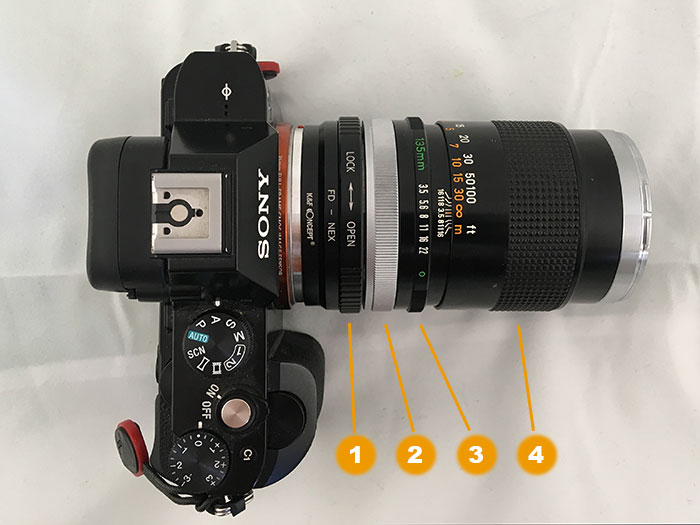
[1] Activation ring for aperture control
[2] Locking ring for breech-lock mount
[3] Aperture ring
[4] Focus ring
Note, that especially the first three rings are very close together.
Moreover, a large range of special adapters (helicoid adapters, tilt/shift adapters, speed boosters) for using Canon FD lenses on most mirrorless systems are available.
Using Canon FD lenses on dSLRs is a possibility, but is not problem free. Thanks to the relatively short flange focal distance of the Canon FD mount (at 42,0 mm, clearly shorter than that of any full-frame dSLR mount), any adapter will necessitate some optics to achieve infinity focus.
Footnotes
- Focal length is (unless stated otherwise) given in absolute terms, and not in Full-frame equivalent. For an understanding of whether the lens is wide/tele, see ‘Angle-of-view’. ↩︎
- Picture angle is given in degrees and concerns the diagonal picture angle. Rule of thumb:
> 90 ° ==> Ultra-wide-angle
70–90 ° ==> Wide-angle
50–70 ° ==> Moderate wide-angle
40–50 ° ==> ‘Standard’ or ‘normal’ lens
20–40 ° ==> Short tele lens
10-20 ° ==> Tele lens
5-10 ° ==> Long tele lens
< 5 ° ==> Ultra-tele lens ↩︎ - Length is given from the mount flange to the front of lens at infinity. ↩︎
- Diameter excludes protrusions such as rabbit ears or stop-down levers. ↩︎
- S=straight; R=rounded; C=(almost)circular at all apertures. ↩︎
- Numbers equal aperture values on aperture ring; • intermediate click; – no intermediate click. ↩︎