Prelude
Scene I: The photography explosion
Photography was pretty much invented starting in the 1820s, but for a long time photography and printmaking was an involved affair requiring large and barely mobile cameras, finicky chemistry and that the whole process lacked standardisation. In the early decades of photography, pretty much every photographer had their own way of plying their trade and mastering chemistry was at least as important as mastering composition. While the next 100 years led to a gradual standardisation of films, chemistries, etc., photography remained an involved, almost arcane field.
The late 1920s to early 1930s changed all that. Not only was it that the basic concept of medium format film cameras had become mature, but also the nascent concept of using the more cost-effective cine film (135-format film) (except turned 90 °) in rangefinder cameras – pioneered by Leica and copied by the Contax – would lead to a veritable explosion in the use of still cameras during the coming years.
Scene II: The entry of the SLR
But rangefinder cameras were not the only way to use cine film in a still camera. Ihagee of Dresden had since 1933 been making SLR type cameras for 127-format roll film and in 1936 Ihagee introduced the Kine Exakta – a camera for using cine film in an SLR. The SLR concept was radically different. No longer would you have one light path that you would use for composing (and focusing) and another light path for actually taking the shot (like you would have in viewfinders, rangefinders and TLRs). Instead, the same light path would serve both purposes. This not only made the process more visceral, it opened up a range of possibilities for using small format film that were too clunky to be practicable without the integrated light path: varying focusing screens and tilt/shift lenses.

Granted, compared to the relatively more mature technologies, SLR cameras still had a number of challenges to deal with, but many believed those would be solved in short order. After Carl Zeiss Jena also managed to in 1936 design a bright standard lens (the 58 mm f/2 Biotar [data sheet]) for the Kine Exakta, it seemed there were three German cameras – the Kine Exakta, the Contax and the Leica – ready to take over the world.
Scene III: Another type of explosion entirely
Sadly, a man in a moustache also had plans for taking over the world and got to try his plans first. As a result, the more peaceful, photographic takeovers were set back by a dozen or so years.
As a result of those ambitions, most of the German camera industry spent the first part of the 1940s feverishly manufacturing military cameras and optics and the second half of the 1940s trying to put their manufacturing operation back together again – a task hindered by a combination of having been at the receiving end of the (to date) biggest ever bombing campaign in combination with various victor nations picking through the wreckage looking for spoils.

Fast lenses
We refer to a lens as ‘fast’ if it lets in so much light that it allows for shorter, i.e. ‘faster’ shutter speeds.
Today many photographers have a soft spot for fast lenses. Whether they’re looking for a lens that allows stronger subject separation, or whether they’re interested in low-light photography, the interest in fast lenses is understandable. Back in the 1950s (and before) there was an altogether more pressing reason to want fast lenses: slow films.
While we today consider ISO100 to be “base ISO” in the 1950s ISO100 1was pretty much at the upper end of the range of normal film sensitivities. ISO200 was a fast film and ISO640 and above was to be considered adventurous. If you wanted your result to be crisp and lack obvious grain, you did not venture beyond ISO50. Today’s preference for fast lenses used to be a necessity. Hence, it is more than understandable that the availability of fast lenses was a key selling argument for any camera system.
Pre-war developments
In offering fast lenses the rangefinder cameras took an early lead. The Carl Zeiss Sonnar for the Contax Rangefinder reached f/1.5 already in 1932 and a f/1.5 standard lens2 was also available for the Leica system in the mid 30s. Simultaneously German 1930s patent data indicate that even f/1.2 designs were on the drawing board but were never brought into serial production.
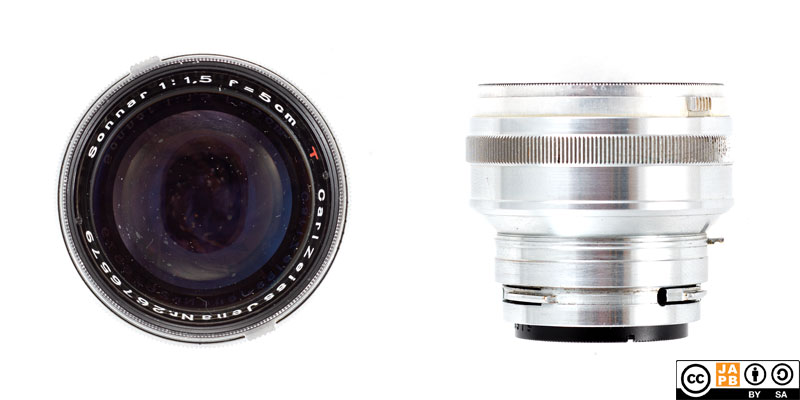
But making fast lenses for a rangefinder camera is an altogether easier affair than for an SLR. One key characteristic of the SLR is that it needs to make space not only for a focal plane shutter but also for a swinging mirror – the key mechanism that allows the same lens to serve both composition (when the mirror is down) and photography (when the mirror is up). This unavoidably leads to that the distance between the rear of a lens and the film plane – known as the back focus distance – is significantly longer.
That longer back focus distance is a not a problem for longer focal length lenses (that natively have a long back focus distance), but it becomes a limitation for standard lenses and it also was the reason why early SLRs did not offer any wide-angle lenses3.
After the war
While Germany – first as the German ‘Reich’, then as the ‘Weimar Republic’, then as the ‘Third Reich’ – had dominated the world of photographic machines and optics in the pre-WWII years, it is a quirk of history that in the coming decades Germany would be forced accept that they had lost the lead to another of the losing nations of the second world war: Japan.
Hence it came that while the German lens industry had not dared go beyond f/1.5 in the rangefinder lenses, the reconstructed Japanese optics industry felt that if they could not beat the German camera industry in terms of reputation, they would have to focus on features and quality (and price). Hence while the German industry had not dared go beyond f/1.5 in production rangefinder lenses, Japanese manufacturers did not dare not to: Nippon Kogaku (Nikon) launched a 50/1.4 in 1950 (scarce 5 years after the war), soon to be bested by the Sonnar-derived Zunow 50 mm f/1.1 (in 1953), to then be matched by the gaussian-type Nippon Kogaku 50 mm f/1.1 in 1956, only for everyone to be stunned into stupefaction by the 1961 Canon 50 mm f/0.95. By the start of the 1950s it was clear that Japan had taken the lead in the development of fast rangefinder lenses, and by the end of the 50s, the same would come to pass in SLR lenses.
The birth of the fast SLR lens
As noted, the SLR design struggles due to the space demands of the SLR mirror box, meaning that lenses generally need to be designed for a considerable back focal distance. In combination with 1930s technology (glasses, coatings and computations), that back focal distance initially led to an insidious conundrum, meaning that you could have
• wide-ish standard lenses (45–50 mm full-frame equivalent),
• bright-ish lenses (f/2 or faster), or
• well-corrected lenses.
While you could choose any one of these, combining 2 or even 3 of the criteria meant that you would have to accept considerable trade-offs. Hence, given the 1930s technology, the Zeiss Biotar with its 58 mm (narrow standard) focal length, f/2 maximum aperture and high level of correction was really the best the industry could – in those days – do.
While many scientific developments took place during the war-years, those could be brought to bear on consumer optics only after the war. Armed with hard-earned new knowledge, optical engineers set out to improve on the prewar designs. Not only did they now have more modern coatings that could allow lenses with more air-glass interfaces, they also now had access to new types of optical glasses as well as more advanced manufacturing knowledge. Moreover, as the guns had gone silent, nations again focused on other ways of gaining prestige.
The emphasis moves from Sonnars to Gaussians; from Germans to Japanese.
As noted, the initial postwar push towards brighter and brighter lenses happened in the area of rangefinder lenses. Here the prewar f/1.5 record set by Carl Zeiss was quickly broken and then smashed by Japanese innovators like Nikon, Zunow and Canon. Importantly, while the initial attempts to beat the previous Zeiss’ record were based on the Sonnar design (the same that Zeiss had used), Nikon’s 1956 f/1.1 design had already switched from the Sonnar to the using a 9-element gaussian design. While a standard-type (ca 45° angle-of-view) Sonnar lens needed a short-ish back focal distance, a similar-angle double-gauss design could accommodate a significantly longer back focal distance. Hence, Nikon had in their hands a design that could more theoretically be modified into a fast SLR lens.
Nikon’s 50 mm f/1.1 rangefinder lens laid part of the groundwork for Nikon managing to be the first company to launch and bring to market a f/1.4 standard SLR lens4. While Nikon managed to get there first, but they were not alone for long. In fact, within two years Carl Zeiss (west) had launched its 55 mm f/1.4 Planar, Konishiroku (Konica) had launched a 52 mm f/1.4 (which was unusually wide for its era and speed), Minolta had launched its 58 mm f/1.4 and Taisei Kogaku (Tamron) had managed to launch its 58 mm f/1.2 (one-upping the speed game by a notch).

The next few years would see some more 55–58 mm f/1.2–f/1.4 lenses being introduced. See table below for further details.
| Year5 | Manufacturer | Model | Notes |
|---|---|---|---|
| 1959/19606 | Nippon Kogaku (Nikon) | NIKKOR-S Auto 5,8 cm f/1.4 | |
| 1959/19617 | Carl Zeiss (West) | Carl Zeiss Planar 55mm f/1.4 (for Contarex) | |
| 1960 | Konishiroku (Konica) | Konishiroku Hexanon 52mm F/1.4 | [data sheet of 1962 version] |
| 1960 | Taisei Kogaku (Tamron) | Tamron 58/1.2 (aka Taika Harigon 58/1.2) | |
| 1961 | Minolta | Minolta Auto ROKKOR-PF 58mm F/1.4 | [data sheet] |
| 1962 | Canon | Canon Super-Canomatic R 58mm F/1.2 | |
| 1963 | Tokyo Kogaku (Topcon) | Topcon RE. Topcor 58 mm f/1.4 | |
| 1966 | Tomioka | Tomioka 55 mm f/1.4 | Sold under many brands. Several copies detailed on JAPB [1] [2] |
| 1966/19678 | Carl Zeiss Jena (East) | Pancolar 55 mm f/1.4 |
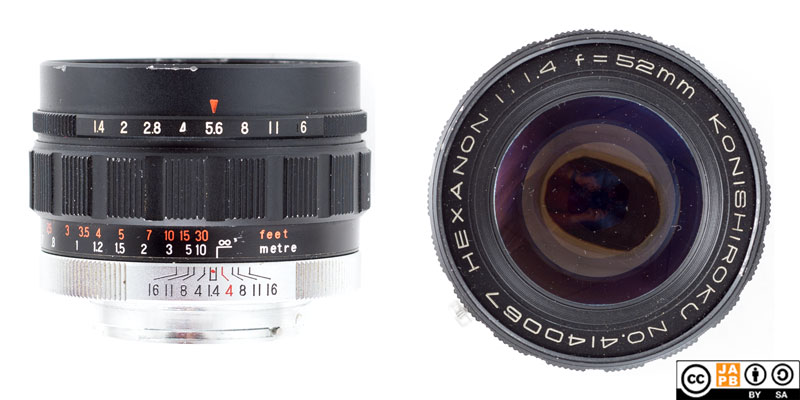
A second wave of fast fifties.
One important aspect of the first wave of fast standard SLR lenses was that all these lenses (except the Konishiroku 52 mm f/1.4) were in the 55 to 58 mm focal length range, which meant that they were roughly 10–15% narrower than the slow 50 mm lenses (like the f/3.5 Tessars) that photographers had already gotten used to.

The second wave of fast fifties started in 1962 with most (if not all) major lens manufacturers designing and marketing 50 mm versions to replace their previous 55–58 mm fast lenses. Nikon was again the vanguard with its Nikkor-S 50 mm f/1.4 [data sheet], followed closely by Asahi/Pentax with the Super-Takumar 50 mm f/1.4 (8-element) [data sheet] and the Canon FL 50 mm f/1.4.
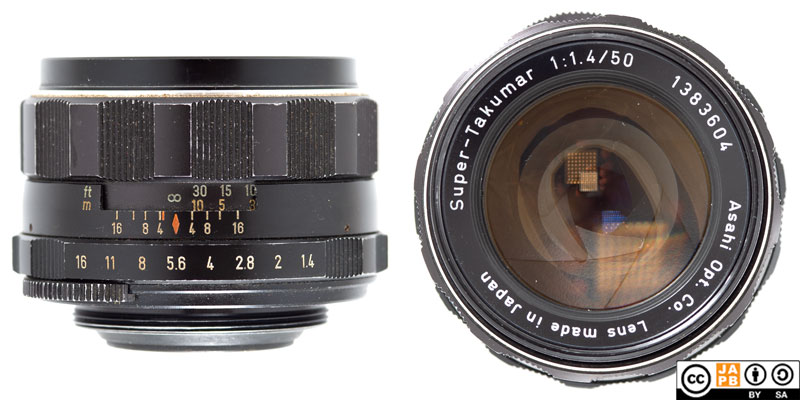
While by the end of the 1960s pretty much every major lens manufacturer was offering a 50 mm f/1.4 lens, that did not yet mean that the technology was fully mature. Compared to modern fast fifties, these late 60s fast fifties were still prone to significant aberrations when used wide open. Subsequent development in coatings, manufacturing techniques and computer-aided design would see gradual improvements in wide-open performance as well as corner resolution.

| Lens manufacturer | First wave (f/1.4 with focal length > 50 mm) | Second wave (f/1.4 50 mm) |
|---|---|---|
| Nikon | NIKKOR-S Auto 5.8cm f/1.4 (Nikon F, 1959) | NIKKOR-S Auto 5.8cm f/1.4 (Nikon F, 1962) [data sheet] |
| Carl Zeiss (west) | Carl Zeiss Planar 55 mm f/1.4 (Contarex, 1959) | Carl Zeiss Planar 1,4/50 HFT (QBM, 1972) [gallery] |
| Konica | Konishiroku Hexanon 52mm F/1.4 (Konica F, 1960) [data sheet] | Konica Hexanon AR 50 mm f/1.4 (Konica AR, 1973) [data sheet] |
| Taisei Kogaku | Taika Harigon 58/1.2 (Exakta, 1960) | None. |
| Minolta | Minolta Auto Rokkor-PF 58 mm f/1.4 (Minolta SR, 1961) [data sheet] | Minolta MC Rokkor-PG 50 mm f/1.4 (Minolta SR, 1973) [data sheet] |
| Canon | Canon Super-Canomatic R 58mm F/1.2 (Canon R, 1962) | Canon FL 50 mm f/1.4 (Canon FL, 1965) [data sheet] |
| Asahi/Pentax | None. | Super-Takumar 50 mm f/1.4 (8-element) (M42, 1964) [data sheet] |
| Topcon | Topcon RE. Topcor 58 mm f/1.4 (Topcon-Exakta, 1963) [data sheet] | Topcon RE GN 50 mm f/1.4 (Topcon-Exakta, 1973) |
| Carl Zeiss Jena | CZJ Pancolar 55 mm f/1.4 (M42, 1967) | CZJ Prakticar 50 mm f/1.4 (Praktica B, 1980) [data sheet] |
| Yashica | None. | Yashica YASHINON-DX 50 mm f/1.4 (M42, 1966) |
| Miranda | None. | Miranda 50 mm f/1.4 (Miranda, 1966) [data sheet] |
| Leica | None. | Leica Summilux-R 50/1.4 (Leica-R, 1969) |
Footnotes
- Actually, in the 1950s the ISO scale was not yet used, but as you’re likely not into DIN or GOST speeds, I’m here translating into modern values. ↩︎
- This is the “Leitz Xenon, designed by Schneider and its star designer A.W. Tronnier. The exact date of introduction though is a bit unclear as this was a time when Tronnier was being extremely proflific. ↩︎
- Until the 1949 invention of the retrofocus-type wide-angle lens, the widest lens anyone had seen on an SLR was a Carl Zeiss 40 mm f/4.5 [data sheet] lens derived from stretching the Tessar design to its limits. ↩︎
- Note please: If you ask Nikon, they were the first to launch an f/1.4 SLR lens; if you ask Carl Zeiss, they claim that they were first. While it seems that both were relatively simultaneous in the introduction of their respective f/1.4 designs, I here ‘hand’ the win to Nikon as they managed to get their f/1.4 to market earlier ( ↩︎
- In all cases, the accurate year data can bot be guaranteed, exacerbated by the fact that documents variously use date of patenting, date of launch or introduction and date of release to market. ↩︎
- Introduced 1959, sold starting march 1960 ↩︎
- Patented 1959, sold starting 1961 ↩︎
- Introduced 1966, manufacturing started 1967. ↩︎