Pekka Buttler, 02/2026
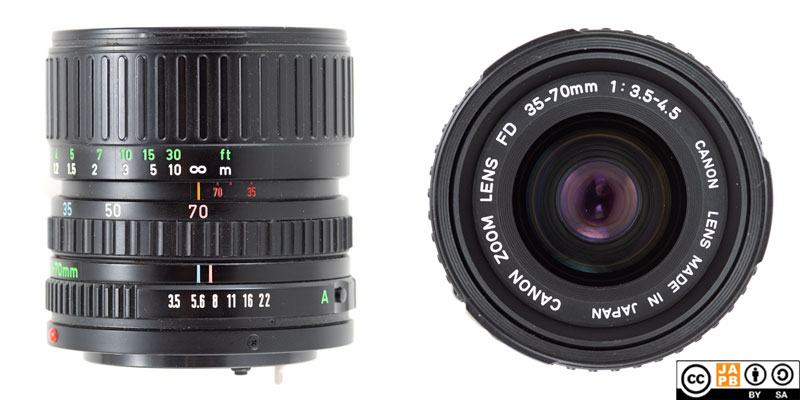
Specifications
The table below summarises the lens’ key specifications (measurements based on pictured sample):
| Brand: | Canon | Lens name | Zoom Lens FD 35-70 mm 1:3.5–4.5 |
| Focal length(s)1 | 35-70 mm | Angle-of-view2 | 75°–43° |
| Maximum Aperture | f/3.5–4.5 | In Production | 1983–1987 |
| Lens mount | Canon FDn | Subfamily (if applicable) | N/A |
| Length3 | 63,2 mm | Diameter4 | 62,8 mm |
| Filter ring diameter | 52 mm | Weight | 197 grams |
| Lens element count | 9 | Lens group count | 8 |
| Aperture blades (S/R/C)5 | 5 S | Focus throw | 180 ° (to beginning of macro range) 270 ° (to MFD |
| Minimum focusing distance (measured) | 40 cm (@35mm) 38 cm (@70mm) | Maximum magnification (measured) | 1:9,9 (@35mm) 1:4,8 (@70mm) |
| Has manual aperture ring | YES | Has Manual focus ring | YES |
| Aperture mechanism type | Automatic | Aperture click stops 6 | 3.5•5.6•8•11•16•22 |
Further notes:
• This is a relatively late addition to the Canon FDn lens lineup. It was introduced in 1983 around the same time as the Canon FDn 28-55/3.5–4.5 [data sheet]. These two lenses (the 28–55 and 35–70 share the same maximum apertures, build quality, and general price point.
• This lens was Canon’s entry-level standard zoom and it was launched to replace its predecessor – the Canon FDn 35–70 mm f/4 [data sheet]. Compared with its predecessor it was one third lighter, one third cheaper, shared the general build quality and design philosophy but did not offer a constant max aperture.
• This lens is a two-ring zoom lens, with the rearmost ring controlling the zoom (focal length) and the frontmost ring controlling focusing distance.
• The lens uses an internal zooming approach, meaning that the lens’ overall length does not change when zooming.
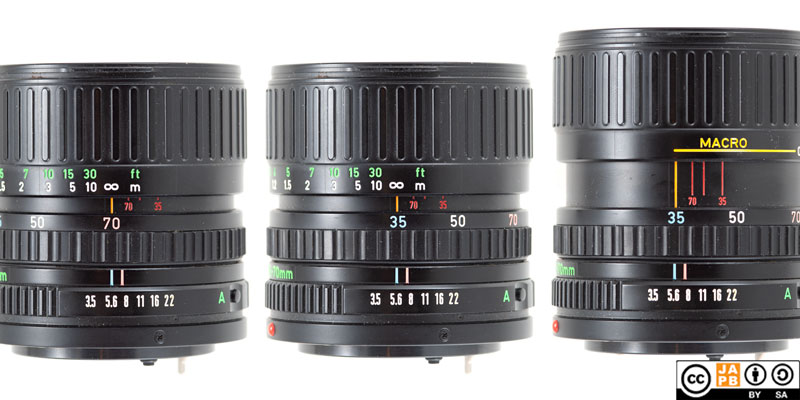
Middle: Canon FDn 35–70 mm f/3.5–4.5 zoomed at 35 mm and focused at infinity
Right: Canon FDn 35–70 mm f/3.5–4.5 zoomed at 35 mm and focused at MFD
• On the other hand the lens’ length does change when focusing and the filter threads rotate in tandem with the focus ring.
• The lens is not – strictly speaking – parfocal, but close enough that when stopped down to medium apertures (f/8) you can zoom without needing to refocus.
• As a minor ace up its sleeve, the lens has a short minimum focusing distance which produces a rather good maximum magnification (if this was a Sigma lens, they shamelessly would’ve called it ‘macro’).
• Even though a this was a budget lens, it still sported a bayonet attachment for a lens hood.
History of Canon FDn lenses
Feel free to browse the JAPB article on the Canon FDn mount for all the details. Below is an outline of the position of the Canon FD mount in Canon’s development trajectory:
• 1959–1963: R-mount. Canon’s first SLR lens mount. Breech lock-type mount with aperture semi-automation (camera is able to stop down lens for taking the shot, but lens needs to be opened up by user action) .
• 1964–1969: FL-mount. Breech-lock type mount, physically similar mount as Canon R-mount, but camera-to-lens communication linkages somewhat different. Cannot communicate selected aperture to body (stop-down-metering only).
• 1970–1978: FD-mount. Breech-lock mount. FD lenses compatible with FL-cameras and vice versa. Manual focus lenses that communicate aperture information to camera, hence opening the door for automatic exposure (both shutter priority and aperture priority possible)
• 1979–1986: new FD-mount (a.k.a. FDn). Bayonet mount, backwards compatible with FL and FD mounts. Otherwise, as FD mount.
• 1987–today: EF-mount. Electronically controlled autofocus lenses that use an internal focusing motor. Compatible with previous mount lenses only using an adapter with optics.
The era of the Canon FD and FDn mounts can be characterised by a gradual shift towards the ever-increasing use of plastics and lighter materials. In the chronology of this gradual shift:
• Chrome nose FD lenses (1971–1973) are solid metal (often brass), glass and (synthetic) rubber.
• Black nose FD lenses (1973-≈1975) are also metal, glass and rubber, but often 5-10% less heavy than chrome nose lenses.
• Late FD, (≈1975–1979) rubber is replaced by plastic and heavier metals are gradually replaced by lighter alloys
• With FDn lenses (1979–1987) this trend came to its natural conclusion as these lenses typically make extensive use of light alloys as well as, increasingly, plastics.
(In the EF era (1987 onwards) plastics fully take over)
A final, noteworthy aspect pertains to the S.C. and S.S.C. monikers found on some generations (Black nose and Late FD) Canon lenses: by the time of the introduction of the FDn mount Canon decided to do away with these markings. Hence, while FDn versions no longer sported the S.C. or S.S.C monikers, their coatings are always at least as good as that of their direct predecessor in the Canon FD line.
Related versions
In terms of optical designs, this lens has no clear predecessors or successors.
In terms of position in the product lineup, this lens replaced the 1979 Canon FDn 28–50/3.5 and was in turn replaced in 1987 by the Canon EF 28–70/3.5–4.5
Adapting
This lens cannot be used natively on any current SLR or dSLRs. To use it in its native environment, you will need a Canon FD or FL-mount film body.
Thanks to being a fully manual lens (manual aperture, manual focus), the lens can be adapted to all mirrorless cameras using a suitable adapter. However, for the adapter to allow the lens to stop down, you will need an adapter that can be set to engage the FD lens’ aperture control lever.
Moreover, a large range of special adapters (helicoid adapters, tilt/shift adapters, speed boosters) for using Canon FD lenses on most mirrorless systems are available.
Using Canon FD lenses on dSLRs is a possibility, but is not problem free. Thanks to the relatively short flange focal distance of the Canon FD mount (at 42,0 mm, clearly shorter than that of any full-frame dSLR mount), any adapter will necessitate some corrective optics to achieve infinity focus.
Footnotes
- Focal length is (unless stated otherwise) given in absolute terms, and not in Full-frame equivalent. For an understanding of whether the lens is wide/tele, see ‘Angle-of-view’. ↩︎
- Picture angle is given in degrees and concerns the diagonal picture angle. Rule of thumb:
> 90 ° ==> Ultra-wide-angle
70–90 ° ==> Wide-angle
50–70 ° ==> Moderate wide-angle
40–50 ° ==> ‘Standard’ or ‘normal’ lens
20–40 ° ==> Short tele lens
10-20 ° ==> Tele lens
5-10 ° ==> Long tele lens
< 5 ° ==> Ultra-tele lens ↩︎ - Length is given from the mount flange to the front of lens at its shortest. ↩︎
- Diameter excludes protrusions such as rabbit ears or stop-down levers. ↩︎
- S=straight; R=rounded; C=(almost)circular at all apertures. ↩︎
- Numbers equal aperture values on aperture ring; • intermediate click; – no intermediate click. ↩︎