Pekka Buttler, 08/2022 (corrected 08/2024)
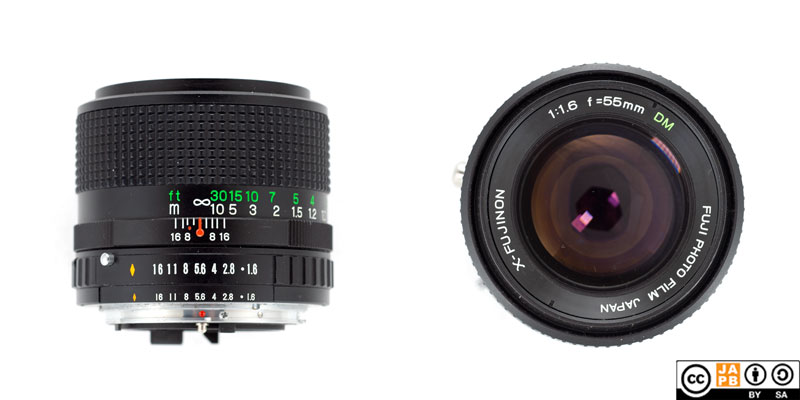
Specifications
The table below summarizes the lens’ key specifications:
| Brand: | Fuji Photo Film | Lens name | X-Fujinon 1:1.6 f=55mm DM |
| Focal length 1 | 55 mm | Angle-of-view 2 | 42°10′ |
| Maximum Aperture | f/1.6 | In Production | 1979– ≈ 1981 |
| Lens mount | Fujica X | Subfamily (if applicable) | –– |
| Length 3 | 50,6 mm | Diameter 4 | 61,4 mm |
| Filter ring diameter | 49 mm | Weight | 240 grams |
| Lens element count | 5 | Lens group count | 4 |
| Aperture blades (S/R/C) 5 | 6 R | Focus throw | ≈185 ° |
| Minimum focusing distance | 45 cm | Maximum magnification | 1:6,0 |
| Has manual aperture ring | YES | Has Manual focus ring | YES |
| Aperture mechanism type | Automatic | Aperture click stops 6 | 1.6•2.8-4-5.6-8-11-16 |
Further notes:
• While the lens name ring does not say it, by this time all but the most pedestrian Fuji Photo Film lenses sported Fuji’s proprietary coating technology referred to as ‘Electron Beam Coating’ or – in short – EBC.
• Besides aperture ring and focus ring, this lens has a button to control the aperture ring’s auto setting (indicated by the yellow diamond). To enter or exit the auto setting, that button has to be pressed.
• The ‘DM’ in the lens’ name stands for “Dial Mode” and means that the lens can be used (on a Fujica X body) in program and shutter priority mode, once the aperture ring’s auto setting is engaged.
History
Fuji Photo Film (nowadays: Fujifilm) was among the last major manufacturers to abandon the M42 thread mount for a proprietary lens mount. The Fujica STX-1 camera (introduced 1979) introduced a new lens mount (typically referred to as the Fujica X mount, not to be mistaken for the modern FujiX mount) and a series of new lenses.
Many (if not most) of the lenses initially introduced for the Fujica X -mount were simply old (and venerable) Fuji Photo Film designs from the m42 lens crammed into a new housing with a new mount.
Interestingly, this lens is not among those (even though there was a 55 mm f/1.6 lens with a 5 elements in 4 groups construction in Fuji’s M42 lens lineup). The table below summarises the commonalities and differences (please also note the discussion in the comments):
| Mount | M42 | Fujica-X |
| Name (on ring) | Fujinon 1:1.6 f=55mm | X-Fujinon 1:1.6 f=55mm DM |
| Focal length | 55mm | 55mm |
| Maximum aperture | f/1.6 | f/1.6 |
| Elements and groups | 5 elements 4 groups | 5 elements 4 groups |
| element order (◊ is aperture) | single-single-◊-doublet-single | single-doublet-◊-single-single |
| Diameter | 61,5 mm | 61,4 mm |
| Length | 38,1 mm | 50,6 mm |
| Weight | 180 grams | 240 grams |
| Minimum focus distance | 60 cm | 45 cm |
Fuji has long been known for its high quality lenses – both in SLR’s compacts and medium and large format lenses – and it would have been interesting to see what Fuji Photo Film’s lineup of Fujica X lenses would have developed into. Alas, in the mid-1980s, Fuji Photo Film decided to withdraw from SLR manufacture and focused instead on both compacts and larger film formats. Whether that withdrawal was caused by disappointing sales of the Fujica X line, or due to the advent of autofocus SLR’s, I can only speculate.
Adapting
The only cameras able to natively mount Fujica X lenses are the Fujica STX and AX lines of manual focus, film SLRs. Should you want to use this lens on film, you can count yourself lucky that the AX and STX lines of Fujica’s generally seem to have well designed and manufactured, hence making compatible film bodies readily available for a pittance.
Adapting this lens to a mirrorless, full-frame digital camera is a breeze thanks to the lens having full manual controls (aperture ring, focus ring). However, due to the method of aperture control used the Fujica X lenses, the adapter will need a control ring to allow stopping down the lens (and you will need to remember to engage that ring). However, thanks to the relative scarcity of Fujica X lenses (caused, in part, by the shortish production run), Fujica X adapters are not quite as readily available as for more common, film-era mounts. Hence, while regular adapters are not difficult to come by, specialised adapters (such as speed boosters or tilt/shift adapters) are not easy to obtain.

Due to the shortish flange focal distance used by the Fujica X mount (43,5 mm), adapting this lens to dSLR/SLR mounts is not as problem-free, and – to retain anything near infinity focus – the adapter will necessitate corrective optics. Even so, adapters to many dSLR mounts are available.
Footnotes
- Focal length is (unless stated otherwise) given in absolute terms, and not in Full-frame equivalent. For an understanding of whether the lens is wide/tele, see ‘Angle-of-view’. ↩︎
- Picture angle is given in degrees and concerns the diagonal picture angle. Rule of thumb:
> 90 ° ==> Ultra-wide-angle
70–90 ° ==> Wide-angle
50–70 ° ==> Moderate wide-angle
40–50 ° ==> ‘Standard’ or ‘normal’ lens
20–40 ° ==> Short tele lens
10-20 ° ==> Tele lens
5-10 ° ==> Long tele lens
< 5 ° ==> Ultra-tele lens ↩︎ - Length is given from the mount flange to the front of lens at infinity ↩︎
- Diameter excludes protrusions such as rabbit ears or stop-down levers ↩︎
- S=straight; R=rounded; C=(almost)circular at all apertures. ↩︎
- Numbers equal aperture values on aperture ring; • intermediate click; – no intermediate click.a ↩︎
Dear Mr. Buttler,
On more sites including your site I see that the Fujica X-Fujinon DM EBC 55mm 1.6 is described as a Xenotar type 5 elements 4 groups design. Not a reversed Xenotar like the M42 should be according all these sites. Your page uses the following notation:
Elements and groups 5 elements 4 groups 5 elements 4 groups
Element order (◊ is aperture) single-single-◊-doublet-single single-doublet-◊-single-single
I am not familiar with the M42 version but based on two X-Fujinon DM EBC 55mm 1.6 lenses and one X-Fujinon DM 55mm 1.6 lens that I cleaned etc. I am certain that the X-Fujinon versions are (also) reversed Xenotar types and have 5 elements and 5 groups.
So no doublet in front or rear cells. The separation between what could be seen as a doublet is 0.30mm in the center and zero at the edges. In a normal cemented doublet the separation distance should be uniform and at most 0.013mm wide. Either FujiFilm considered that still a doublet or something went wrong with the specification check somewhere. As written I have no experience with the M42 version so I can not judge whether it is more alike the X-Fujinon version or different on the aspects I mentioned. Users write that the bokeh differs between the two types so there will be some difference.
There is a thread on this subject: https://www.dpreview.com/forums/threads/x-fujinon-55mm-1-6-dm-ebc-optical-diagram-transferred-from-another-thread.4743157/
Dear Mr. Dinkla
Thank you very much for this piece of valuable information. I personally have only held a copy of the M42 55/1.6 in my hands (not had a chance to play with it or take it apart), so I too am forced to only go on secondary sources about it.
So can you confirm that the X-Fujinon version of the 55/1.6 corresponds to the structure given in the lens diagram for the M42 version (visible at: https://lens-db.com/wp-content/uploads/2012/12/F55F16M42.jpg)?
Kindly,
Dear Mr. Butler,
I have some doubts whether that M42 lens diagram is in itself correct for that lens type but at least it shows a reversed Xenotar type lens diagram. If you close the aperture and observe 4 clear reflections at the front side and 4 clear reflections at the rear side plus possibly a faint one as well then it could be a reversed Xenotar type.
The URL I added, guides you to a discussion where I also added a lens diagram based on my measurements of the X-Fujinon DM 55mm 1.6 elements as far as I could separate them. That lens diagram certainly is not like the M42 one shown here but is also a reversed Xenotar type though without a cemented doublet. So a 5 elements 5 groups design.
Kind regards, Ernst