Pekka Buttler, 12/2025
This lens was kindly provided for cataloguing by Vladimir at #photogears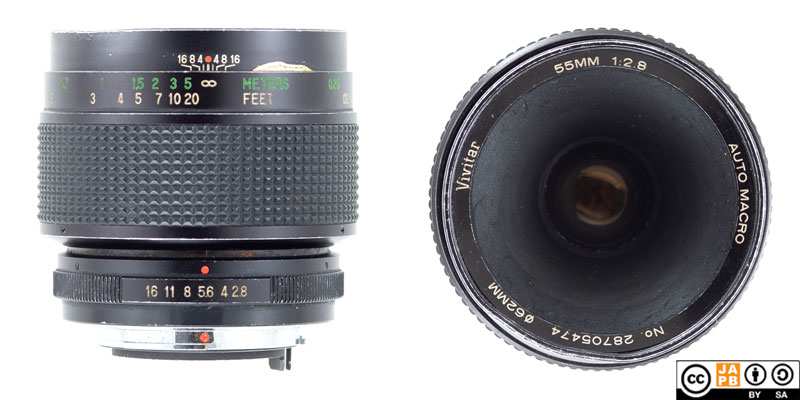
Specifications
The table below summarizes the lens’ key specifications (measurements based on pictured, last version of the lens):
| Brand: | Vivitar | Lens name | 55mm 1:2.8 auto telephoto macro |
| Focal length(s)1 | 55 mm | Angle-of-view2 | 43 ° |
| Maximum Aperture | f/2.8 | In Production | unclear3 |
| Lens mount (this lens) | Pentax K | Other lens mounts | multiple4 |
| Length5 | 70,6 mm | Diameter6 | 63,5 mm |
| Filter ring diameter | 62 mm | Weight | 338 grams |
| Lens element count | 5 | Lens group count | 4 |
| Aperture blades (S/R/C)7 | 6 S | Focus throw | 690 ° |
| Minimum focusing distance | 21 cms | Maximum magnification | 1:1 |
| Has manual aperture ring | YES | Has Manual focus ring | YES |
| Aperture mechanism type | Auto | Aperture click stops 8 | 2.8•4•5.6•8•11•16•22 |
Further notes:
• This lens is an abnormal legacy macro lens in that it reaches 1:1 magnification without using an extension ring to reach beyond 1:2.
• It achieves this 1:1 maximum magnification using a rather extreme extension facilitated by a two-sided helicoid, driven by a focus throw that (at almost 2 full revolutions) is almost absurd. While the focus throw does facilitate very precise fine-tuning of focus, changing focus between macro range and portrait range leads to an almost Dervish’s dance.
• The lens was originally manufactured by Komine.
• There are other similar era lenses that feature the same specifications (55 mm f/2.8, 1:1 macro with two-sided helicoid) sold under the names of other obvious rebranders (e.g. Rokunar V-HQ 55mm f/2.8; Elicar V-HQ Macro 55 mm f/2.8) that might be related designs.
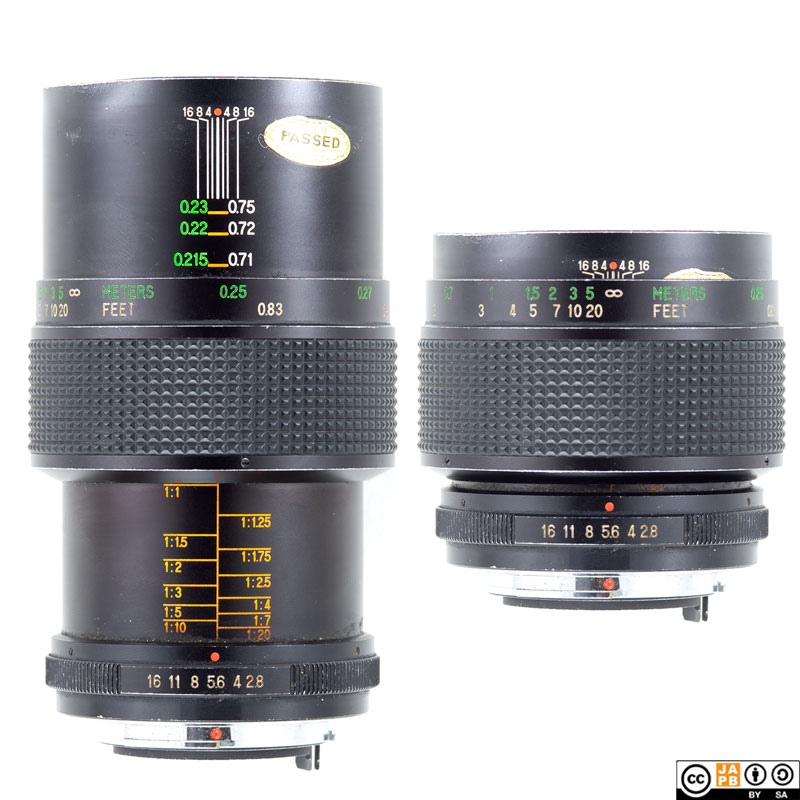
Bottom: Vivitar 55 mm f/2.8 Macro focused at infinity
The two-sided focusing helicoid is clearly apparent.
Versions and variations
Nothing points to there being more than one Vivitar 55 mm f/2.8 macro lens, albeit that lens was manufactured in several different mounts (and thus in somewhat differing dimensions and weights).
However, there may be some confusion as this was not the only tele macro lens offered by Vivitar during the roughly same era
History of Vivitar
Vivitar initially was the trade name used by Ponder & Best Inc. until Ponder & Best changed its name to Vivitar Corp. From the 1960s to the early 2000s the company contracted various (mostly Japanese) optical and electronics manufacturers to manufacture photographic gear to be branded as Vivitar.
You can read more details in the Vivitar company profile.
Adapting
n.B! The following applies to all non-electronic Pentax K mount lenses.
If you want to natively mount this lens you need to find a functioning Pentax K mount SLR (or a dSLR) camera. Luckily that should be relatively easy as Pentax K film bodies were produced in their millions and most of them – especially those manufactured by Pentax – have a good reliability record. Alternatively, you can use this lens natively on any Pentax dSLR.
Adapting this lens to a mirrorless, full-frame digital camera is a breeze thanks to the lens having full manual controls (aperture ring, focus ring). You simply need a dumb adapter from Pentax K to your mirrorless system.
Due to the medium flange focal distance used by the m42 mount (45,46 mm), whether you can adapt this lens to other than Pentax’ dSLR mounts depends on which dSLR mount: Canon EF, and Four Thirds can mount Pentax K lenses using a simple adapter ring. Minolta/Sony A and Nikon F on the other hand are not as problem-free, and – to retain anything near infinity focus – the adapter will necessitate corrective optics. In all cases, your camera will work only in stop-down metering.
Footnotes
- Focal length is (unless stated otherwise) given in absolute terms, and not in Full-frame equivalent. For an understanding of whether the lens is wide/tele, see ‘Angle-of-view’. ↩︎
- Picture angle is given in degrees (based on manufacturers’ specs) and concerns the diagonal picture angle. Rule of thumb:
> 90 ° ==> Ultra-wide-angle
70–90 ° ==> Wide-angle
50–70 ° ==> Moderate wide-angle
40–50 ° ==> ‘Standard’ or ‘normal’ lens
20–40 ° ==> Short tele lens
10-20 ° ==> Tele lens
5-10 ° ==> Long tele lens
< 5 ° ==> Ultra-tele lens ↩︎ - Existing information is conflicting, production likely 1970s and 80s.. ↩︎
- Including: Canon FD, Contax/Yashica, Konica AR, M42, Minolta SR, Nikon F, Olympus OM and Pentax K ↩︎
- Length is given from the mount flange to the front of lens at infinity. ↩︎
- Diameter excludes protrusions such as rabbit ears or stop-down levers. ↩︎
- S=straight; R=rounded; C=(almost)circular at all apertures. ↩︎
- Numbers equal aperture values on aperture ring; • intermediate click; – no intermediate click. ↩︎