Pekka Buttler, 11/2026
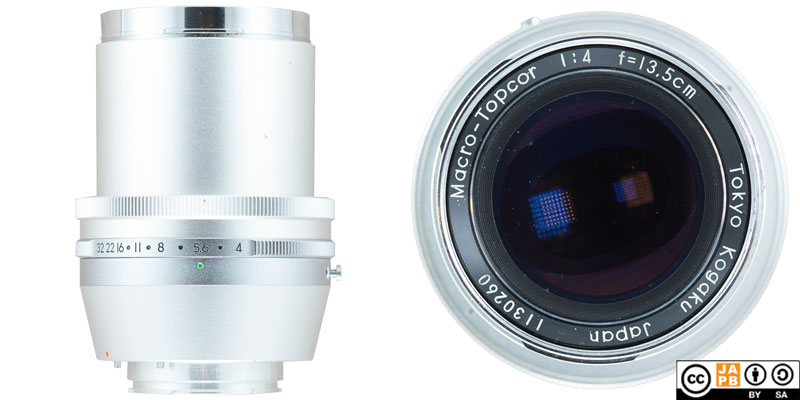
Specifications
The table below summarizes the lens’ key specifications (measurements based on pictured sample):
| Brand: | Tokyo Kogaku (Topcon) | Lens name | Macro-Topcor 1:4 f=13,5cm |
| Focal length(s)1 | 135 mm | Angle-of-view2 | 18 ° |
| Maximum Aperture | f/4 | In Production | 1967–78 |
| Lens mount (this lens) | Topcon/Exakta | Generation | RE.Auto (cosmetically) R (in mount communication) |
| Length3 | 84,1 mm | Diameter4 | 63,0 mm |
| Filter ring diameter | 49 mm | Weight | 244 grams |
| Lens element count | 4 | Lens group count | 3 |
| Aperture blades (S/R/C)5 | 8 S | Focus throw | none |
| Minimum focusing distance (measured, with variable extension ring) | 89 cm | Maximum magnification (measured, with variable extension ring) | 1:4,4 |
| Has manual aperture ring | YES | Has Manual focus ring | YES |
| Aperture mechanism type | preset (without cable release) semi-automatic (with cable release) | Aperture click stops | 4•5.6•8•11•16-22-32 |
Further notes:
• The Tokyo Kogaku (Topcon) Macro-Topcor 135/4 was introduced in 1967 for the Topcon RE-system and it is cosmetically very much in line with that era of Topcon lenses.
• At the same time, because it has no communication through the lens mount, it works just as well on any generation of Topcon cameras using the Exakta mount (from the 1957 Topcon R to the 1978 Topcon RE300) as well as any Exakta mount camera. That is also likely the reson why this is not technically part of the Topcon RE.Auto line of lenses.
• As part of that lack of mount communication, this lens does not take stop-down orders from the camera, nor does it report the selected aperture to the camera.
• However, as macro photography (due to effective aperture limitation) is generally metered manually, the lens’ lack of supporting advanced metering functions is more of a feature than a lack.
• The aperture mechanism is an elaborate form of preset aperture, that can be triggered to snap to the pre-selected aperture either by the photographer pressing the button on the aperture ring (visible below) or by installing a double cable release (one to the camera, one to the lens).
• However, opening the aperture back up necessitates user input, in the form of twisting the frontmost control ring.
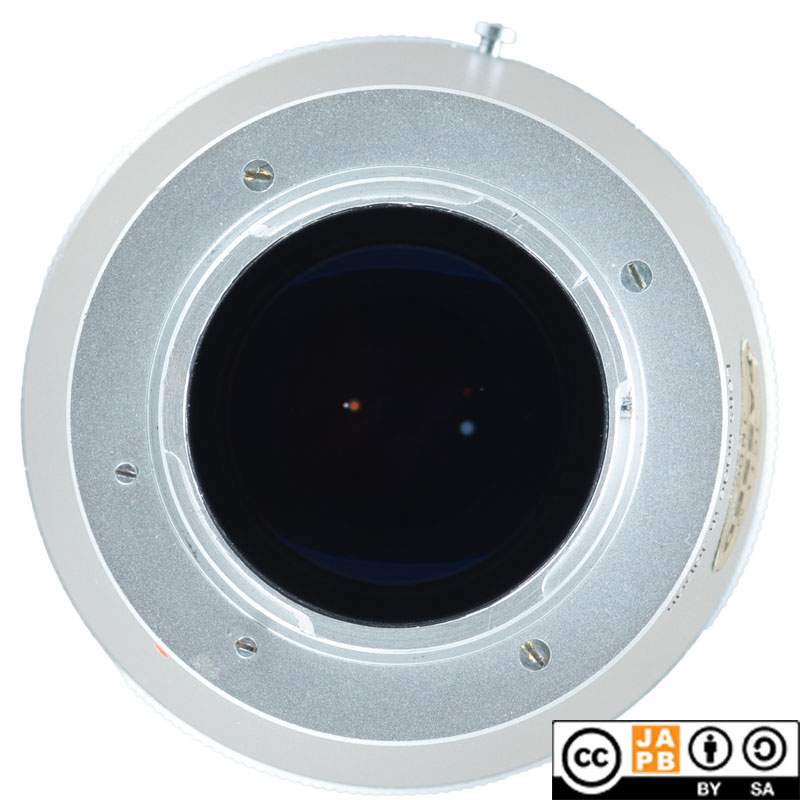
• Importantly, this is what is normally referred to as a ‘bellows-macro’ lens, because it does not have any system for focus adjustment. That focus adjustment needs to be offered either by a variable extension tube/ring or by a bellows unit. While you can mount this lens directly on any Topcon/Exakta mount camera, it will be permanently focused waaay past infinity.
• When the lens is mounted on the Topcon Variable extension tube (which is 29 mm long at its shortest setting and 59 mm at its longest setting, the lens becomes a normal tele lens that is able to focus from infinity to 0,89 m (1:4,4 maximum magnification). Larger magnifications can easily be achieved with any exakta-mount bellows unit.
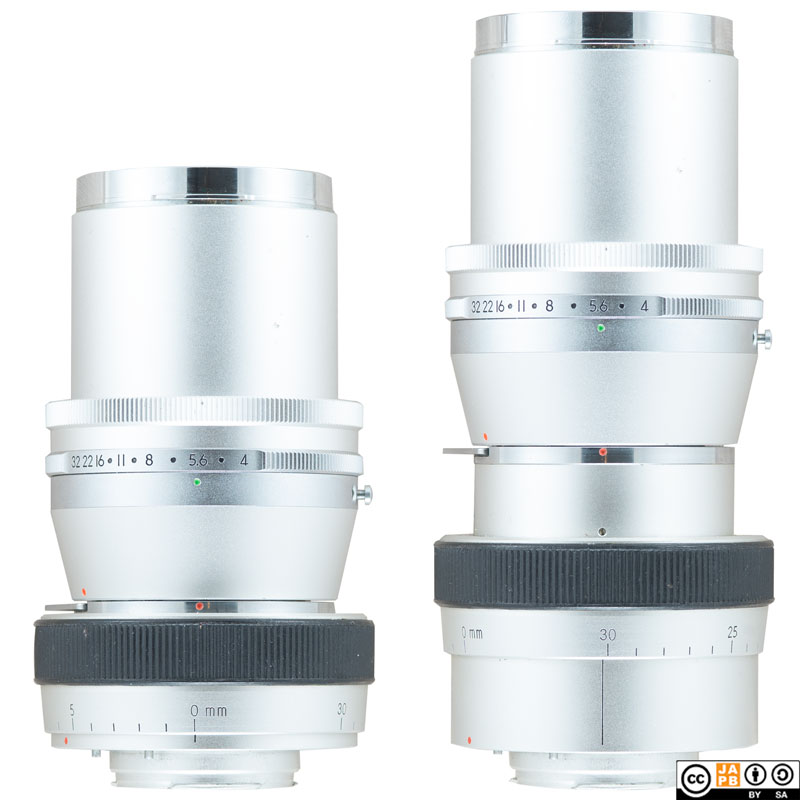
Right: Topcon Macro-Topcor 135/4 mounted on Topcon variable extension tube at its longest setting.
Versions and variations
There are two variants of the Topcon Macro-Topcor 135/4.
• The first variant (like the pictured lens) has its focal length reported in centimetres, uses flat-head screws in the mount and is a “Lens made in Japan”.
• The second variant reports its focal length in millimetres, uses x-head screws in the mount and is a “LENS MADE IN JAPAN”.
There are no indications of any more substantial differences between the two variants.
All variants of the Macro-Topcor 135/4 were manufactured in Topcon’s signature matte silver colour scheme. No black samples have been encountered.
History of Topcon
Unless you know your camera lore, you might not know that Topcon was once – between 1957 and 1976 – one of the foremost camera companies in the world.
You can read more details in the Topcon company profile.
Adapting
When intending to adapt Topcon/Exakta lenses keep in mind that most Topcon/Exakta lenses have control pins in the lens flange that vanilla Exakta lenses do not have. Hence, there is a theoretical possibility to that some old-time Exakta adapters have been manufactured that do not accommodate these pins. When procuring an adapter, make sure that it explicitly is compatible with Topcon lenses, or visually inspect the adapter regarding whether it makes room for the Topcon control pins.
With that caveat, the following applies to all Topcon/Exakta mount lenses.
This lens cannot be used natively on any current SLR or dSLRs. To use it in its native environment, you will need a Topcon RE Super film body or one of the subsequent Topcon cameras with the Topcon Exakta mount. While these were never produced in immense numbers, they seem to have stood the test of time reasonably well, and can still be found in perfectly serviceable condition.
Thanks to being a fully manual lens (manual aperture, manual focus), the lens can be adapted to all mirrorless cameras using a suitable ‘dumb adapter’. Moreover, due to the popularity of the Exakta mount, special adapters (helicoid adapters, tilt/shift adapters) are readily available.
Using Exakta mount lenses on dSLRs can also be an easy option, depending on the marque of dSLR.
• Canon EF has the shortest flange focal distance among full-frame dSLR’s and Canon’s wide range of dSLRs are able to mount Topcon/Exakta lenses perfectly using a simple adapter ring.
• Minolta / Sony A dSLRs, Pentax K and Nikon F mount dSLRs do not have a short enough flange focal distance to enable reaching infinity focus without an adapter that uses corrective optics.
Footnotes
- Focal length is (unless stated otherwise) given in absolute terms, and not in Full-frame equivalent. For an understanding of whether the lens is wide/tele, see ‘Angle-of-view’. ↩︎
- Picture angle is given in degrees (based on manufacturers’ specs) and concerns the diagonal picture angle. Rule of thumb:
> 90 ° ==> Ultra-wide-angle
70–90 ° ==> Wide-angle
50–70 ° ==> Moderate wide-angle
40–50 ° ==> ‘Standard’ or ‘normal’ lens
20–40 ° ==> Short tele lens
10-20 ° ==> Tele lens
5-10 ° ==> Long tele lens
< 5 ° ==> Ultra-tele lens ↩︎ - Length is given from the mount flange to the front of lens at infinity. ↩︎
- Diameter excludes protrusions such as rabbit ears or stop-down levers. ↩︎
- S=straight; R=rounded; C=(almost)circular at all apertures. ↩︎