Pekka Buttler, 03/2023
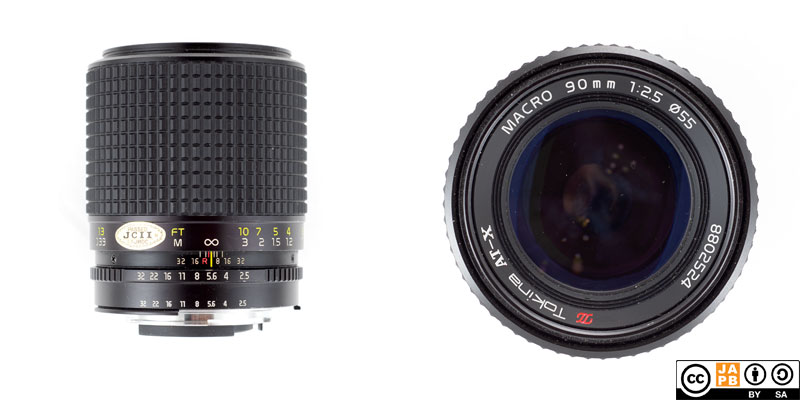
Specifications
The table below summarises the lens’ key specifications (measurements based on pictured sample):
| Brand: | Tokina | Lens name | AT-X Macro 90mm 1:2.5 |
| Focal length(s) 1 | 90 mm | Angle-of-view 2 | 27° |
| Maximum Aperture | f/2.5 | In Production | 1986–1997 |
| Lens mounts (this lens) | Nikon F | Other lens mounts | Canon FD, Contax/Yashica, Minolta SR, Olympus OM, Pentax K |
| Length 3 | 77,0 mm | Diameter 4 | 66,7 mm |
| Filter ring diameter | 52 mm | Weight | 513 grams |
| Lens element count | 8 | Lens group count | 7 |
| Aperture blades (S/R/C) 5 | 8 S | Focus throw | 290 ° |
| Minimum focusing distance | 39 cms | Maximum magnification | 1:2 |
| Has manual aperture ring | YES | Has Manual focus ring | YES |
| Aperture mechanism type | Automatic | Aperture click stops 6 | 2.5-4•5.6•8•11•16•22-32 |
Further notes:
• This lens is widely known as ‘the Bokina’ because of its especially pleasing way of rendering out-of-focus areas (both behind and in front of the focal plane).
• This lens has a maximum magnification of 1:2 at MFD. Tokina used to offer a dedicated ‘Macro extender’ that would bring the lens to 1:1. Interestingly, that ‘Macro extender’ was not just an extension tube, but contained some optics to improve close-up performance.
• Before 1986 Tokina produced a very similar lens exclusively for Vivitar (the Vivitar Series 1 90mm f/2.5 Macro). After Vivitar discontinued that lens, Tokina decided to redesign the lens slightly and sell it as part of the Tokina AT-X (premium) series.
• The Vivitar and Tokina versions differ in that the Vivitar version is more bulky (size, weight, filter thread) and in that Tokina upgraded the lens’ coatings before launching it as a Tokina lens.
• Alike all traditional macro lenses, the lens focuses by moving the entire objective (set of lenses) away from the film plane. Hence the focusing to MFD entails a significant lengthening of the lens (see below).
• Because the front-element is relatively exposed, using a lens hood might be advisable, even though the lens is not especially prone to flaring (any generic 55 mm thread short tele hood will do).
• This lens was later replaced by the ‘Tokina AT-X 100 AF PRO 100mm 1:2.8 Macro’.
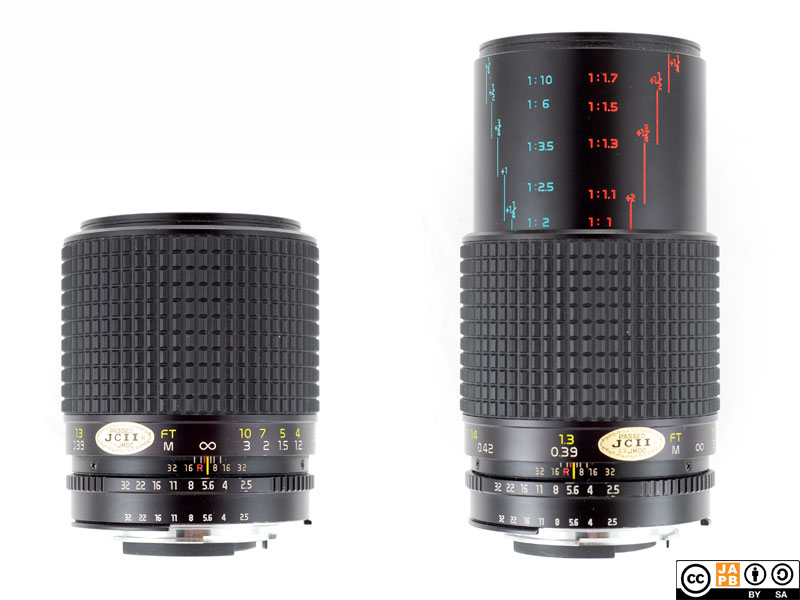
Right: Focused at MFD
Adapting
Given that this lens exists in at least 6 different mount versions, the question of adapting is a bit complicated.
On dSLRs
If you have a Nikon F or Pentax K SLR/dSLR, you can use the Nikon F / Pentax K versions of this lens natively on your camera.
If you have a Canon EF or Sony/Minolta A dSLR, some of the versions of this lens (most prominently Nikon F) can be adapted using a simple adapter ring. However, metering will only work in stop-down mode.
On Mirrorless
Thanks to being a fully manual lens (manual aperture, manual focus), the lens can be adapted to all mirrorless cameras using a simple dumb adapter. Also, with most mounts that this lens was manufactured using, you will have a wide range of special adapters (e.g. helicoid adapters; tilt-shift adapters; speed boosters) available.
On Film
If you have a Canon FD, Contax/Yashica, Minolta SR Nikon F, Olympus OM or Pentax K Film SLR, you can use the respective versions of this lens natively on your camera 7.
History of Tokina
Tokina was originally founded in 1950 by a group of ex-Nikon engineers, went out of business once, launched a successful intermediate lens mount and is one of the few Japanese postwar optics startups that has survived to this day. Sort-of, at least. Read more in the JAPB company profile on Tokina.
Footnotes
- Focal length is (unless stated otherwise) given in absolute terms, and not in Full-frame equivalent. For an understanding of whether the lens is wide/tele, see ‘Angle-of-view’. ↩︎
- Picture angle is given in degrees and concerns the diagonal picture angle. Rule of thumb:
> 90 ° ==> Ultra-wide-angle
70–90 ° ==> Wide-angle
50–70 ° ==> Moderate wide-angle
40–50 ° ==> ‘Standard’ or ‘normal’ lens
20–40 ° ==> Short tele lens
10-20 ° ==> Tele lens
5-10 ° ==> Long tele lens
< 5 ° ==> Ultra-tele lens ↩︎ - Length is given from the mount flange to the front of lens at infinity. ↩︎
- Diameter excludes protrusions such as rabbit ears or stop-down levers. ↩︎
- S=straight; R=rounded; C=(almost)circular at all apertures. ↩︎
- Numbers equal aperture values on aperture ring; • intermediate click; – no intermediate click. ↩︎
- When doing macro photography on a Film SLR, remain mindful of effective aperture. ↩︎
Hi.
Since this review is not too old, I wonder if you could help me somehow with my Bokina, Olympus mount. I have the whole set, 90/2 5, hood, extender and case. They all look perfect but the focus ring won’t go further than to 1.5m. Infinity is not available. It stops hard or with a thump. I asked a repairer who said it would be too expensive, about its value. He asked for a diagram too which I don’t have (but could surely find).
Have you ever heard of this malfunction and do you know what there is for a non-business man to do about it?
Regards,
Ian
Sweden
Hi Ian.
This is an interesting legacy-age macro lens because it has a rather steep focusing helicoid with the first 90° degrees takes the lens from infinity to 0,7 metres. This also means that that 1,5 metres you mention is barely 15° of rotation away from infinity. Considering the construction of this lens there are two prime candidates for your issue:
One: This lens is interesting in that its rearmost element is static (does not move) while the entire rest of the lens elements move forward as you focus towards MFD and backward as you focus toward infinity. This means that one possible reason for the lens not being able to focus to infinity is that some component within the lens has come loose and hinders the front group (7 out of 8 elements) from moving all the way back.
Two: Inexpert repair that has resulted either the rear lens element having been mounted incorrectly (hence blocking the movement of the main objective) or a very unlucky rethreading of the helicoid in combination with some other tomfoolery.
Some things that would help diagnose the issue:
1) when you carefully shake the lens, does it sound like there’s something loose in the lens?
2) How much of the front barrel (the outer barrel that moves in and out of the lens as you focus towards MFD) is visible when you reach that 1,5 m hard stop? (What of the light blue magnification scale is visible)?
3) Is the focusing scale accurate? If you mount the lens on a camera and focus on an object that is perpendicular to the optical axis (the oldskool newspaper test), is the distance from the sensor to the object roughly as indicated on the lens and is the image reasonably corner-to-corner sharp if you stop down to f/5.6 or beyond?
Hope this helps.
Pekka