Pekka Buttler, 12/2022
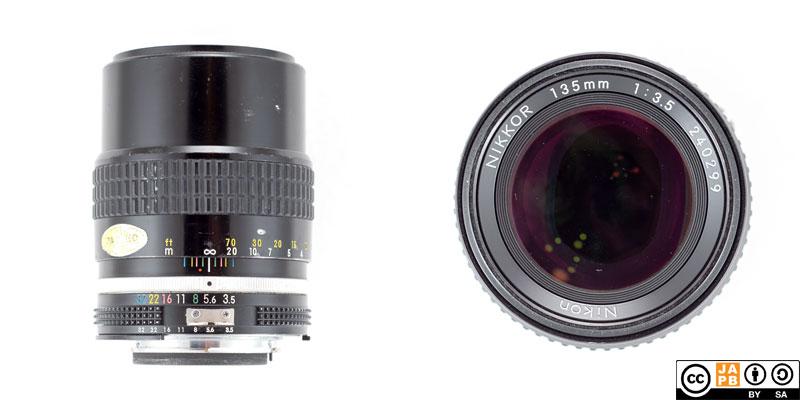
Specifications
The table below summarizes the lens’ key specifications (measurements based on pictured sample):
| Brand: | Nikon | Lens name | NIKKOR 135mm 1:3.5 |
| Focal length(s) 1 | 135 mm | Angle-of-view 2 | 18° |
| Maximum Aperture | f/3.5 | In Production | 1977–1981 |
| Lens mount | Nikon F | Subfamily (if applicable) | Ai-type |
| Length 3 | 81,6 mm | Diameter 4 | 64,6 mm |
| Filter ring diameter | 52 mm | Weight | 412 grams |
| Lens element count | 4 | Lens group count | 4 |
| Aperture blades (S/R/C) 5 | 7 S | Focus throw | 220 ° |
| Minimum focusing distance | 1,3 m | Maximum magnification | 1:7,5 |
| Has manual aperture ring | YES | Has Manual focus ring | YES |
| Aperture mechanism type | Automatic | Aperture click stops 6 | 3.5-5.6-8-11-16-22-32 |
Further notes:
• This lens was introduced to replace the earlier, K-type 135 mm f/3.5. Four years later it was in turn replaced by the Ai-s spec version. During that time, a bit over 100 000 copies were manufactured.
• This lens sports a built-in lens hood.
A brief genealogy of Nikon SLR lens types
Nikon is undoubtedly one of the great names in 35 mm SLR photography. The Nikon F mount has been in continuous production since 1959. During that time, the mount has developed/changed in some detail, however without ever fully sacrificing compatibility.
In short (a longer version is here), the development of Nikon’s SLR lenses can be traced as follows:
• 1959–1977: Pre-Ai. Manual focus lenses that use ‘rabbit ears’ to communicate selected aperture with the camera body. Pre-Ai lenses can further be subdivided into
• F-type (1959–early 1970s: metal focus ring and single-coated),
• C-type (early 1970s–mid 1970s: metal focus ring and multicoated), and
• K-type (mid 1970s to 1977: rubber focus ring and multicoated).
A significant share of remaining Pre-Ai lenses have since been converted to Ai-spec (Ai’d)
• 1977–1986: Ai and Ai-s. Manual focus lenses that may have ‘rabbit ears’ for backward compatibility, but are designed to communicate selected aperture with the camera body through indentations in base of aperture control ring.
• 1986–today: AF and AF-D. Autofocus lenses that do not have a focusing motor within the lens, but rely on the focus motor within the camera. All AF and AF-D lenses are simultaneously Ai-s lenses (they are Ai-s lenses extended with AF) 7
• 1996–today AF-S and AF-P. Autofocus lenses that have an internal focusing motor and do not rely on the body having a focusing motor.
Versions
Nikon has manufactured 135 mm f/3.5 lenses for the Nikon F system since the earliest beginnings. The lineage of Nikkor 135 mm f/3.5 lenses is summarised below
| Years | Type | Name | Mainline specifications | Optical design | Blades | MFD | Notes |
|---|---|---|---|---|---|---|---|
| 1959–69 | F-type | Nippon Kogaku | 13,5 cm f/3.5 | 4 elements 3 groups | 9, 6 | 1,5 m | [data sheet] |
| 1969–73 | F-type | Nikon | 135 mm f/3.5 | 4 elements 3 groups | 7 | 1,5 m | |
| 1973–75 | C-type | Nikon | 135 mm f/3.5 | 4 elements 3 groups | 7 | 1,5 m | |
| 1975–77 | K-type | Nikon | 135 mm f/3.5 | 4 elements 3 groups | 7 | 1,5 m | |
| 1977–1981 | Ai-type | Nikon | 135 mm f/3.5 | 4 elements 4 groups | 7 | 1,3 m | this lens |
| 1981–83 | Ai-s type | Nikon | 135 mm f/3.5 | 4 elements 4 groups | 7 | 1,3 m |
Adapting
Besides adapting, this lens can be used natively on all current high-end Nikon dSLRs and several earlier medium-to-high-end older Nikon dSLRs8. Likewise, if it still has its rabbit ears, it can be natively used on all Nikon F-mount film cameras ever produced (without the rabbit ears, it is limited to post 1977 bodies).
Thanks to being a fully manual lens (manual aperture, manual focus), the lens can be adapted to all mirrorless cameras using a suitable dumb adapter (and such adapters are easy to find). Moreover, a large range of special adapters (helicoid adapters, tilt/shift adapters, speed boosters) for using Nikon F lenses on most mirrorless systems are available.
Using Nikon F lenses on non-Nikon SLRs and dSLRs is likewise a distinct possibility. Thanks to the relatively generous flange focal distance of the Nikon F mount (46,5 mm), adapter rings for all dSLR mounts are available as well as for a goodly portion of film-era SLR mounts. Such rings may not allow for auto aperture, but even then the lenses can be used in stop-down metering mode.
Footnotes
- Focal length is (unless stated otherwise) given in absolute terms, and not in Full-frame equivalent. For an understanding of whether the lens is wide/tele, see ‘Angle-of-view’. ↩︎
- Picture angle is given in degrees and concerns the diagonal picture angle. Rule of thumb:
> 90 ° ==> Ultra-wide-angle
70–90 ° ==> Wide-angle
50–70 ° ==> Moderate wide-angle
40–50 ° ==> ‘Standard’ or ‘normal’ lens
20–40 ° ==> Short tele lens
10-20 ° ==> Tele lens
5-10 ° ==> Long tele lens
< 5 ° ==> Ultra-tele lens ↩︎ - Length is given from the mount flange to the front of lens at infinity. ↩︎
- Diameter excludes protrusions such as rabbit ears or stop-down levers. ↩︎
- S=straight; R=rounded; C=(almost)circular at all apertures. ↩︎
- Numbers equal aperture values on aperture ring; • intermediate click; – no intermediate click. ↩︎
- There is a further sub-class of AF-D lenses called AF-I lenses that are otherwise AF-D lenses (meaning, fully Ai-s compatible), but have an internal focus motor. Only long tele lenses were made in AF-I variants. ↩︎
- As of this writing, the following Nikon dSLRs fully support Aperture priority and manual metered modes on Nikkor Ai lenses: D2, D3, D4, D5, D6, D200, D300, D300s, D500, D600, D610, D700, D750, D780, D800, D800E, D810, D850, D7000, D7100, D7200 ↩︎