Pekka Buttler, 01/2026
This lens was kindly provided for cataloguing by Vladimir at #photogears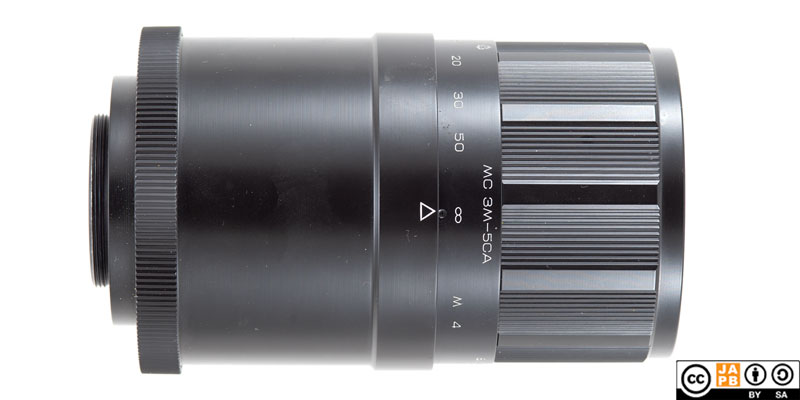
Specifications
The table below summarizes the lens’ key specifications (measurements based on pictured lens):
| Brand: | MS (latin) MC (cyr.) | Lens name | 3M-5SA (latin) 3M-5CA (cyr.) |
| Focal length(s) 1 | 500 mm | Angle-of-view 2 | 5 ° (on ‘full frame’) |
| Aperture | f/8 | In Production | 1973-onward (all versions) 1983–onward (this version) |
| Lens mounts | M42 | Other lens mount | none |
| Length 3 | 133,2 mm | Diameter 4 | 82,7 mm |
| Filter ring diameter | 77 mm | Weight | 585 grams |
| Lens element count | 4 | Lens group count | 3 |
| Aperture blades | 6 | Focus throw | 315 ° |
| Minimum focusing distance (indicated) | 4 m | Maximum magnification (measured) | 1:6 |
| Has manual aperture ring | No | Has Manual focus ring | YES |
| Aperture mechanism type | None | Aperture click stops | N/A |
Further notes:
• The MS 3M-5SA is a catadioptric (mirror) tele lens. It does not have an adjustable aperture
• The MS 3M-5SA is the successor of the MS 3M-5A that was introduced in 1973. Compared to its predecessor, this later version is both a bit more compact and considerably lighter (the MS 3M-5A is reported to have weighed in excess of 1,2 kilograms.
• After the introduction of the lighter version, also the heavier version remained in production at least to the end of the Soviet era.
• Both this lens and its predecessors were manufactured by LZOS (the Lytkarino plant).
• The MS-name does not refer to a brand, design bureau or indeed a factory. Instead, the name MS indicates that the lens is a member of a Soviet-era family of catadioptric/mirror tele lenses. See more in the JAPB articles on Soviet lenses and the Soviet lens ‘business’
Versions
As noted, the MS 3M-5SA lens had a predecessor that shared most of the optics but was built like a tank. Whether the MS 3M-5A and MS 3M-5SA should be seen as two variants of the same lens or as different lenses altogether is debatable.
In either case, both lenses received some minor cosmetic/ergonomic tweaks during their production run.
Adapting
We’re going to be discussing adapting the MS 3M-5CA with an M42 mount. However, because this lens has a rather broad base (ca 80 mm), it is possible that the lens will not fit every camera that sports an M42 mount. Should making the lens physically fit your camera not pose a problem…
If you want to natively mount an M42 lens you need to find a functioning M42 mount film camera. Luckily that should be relatively easy as M42 bodies were produced in their millions and most of them lack features that are especially likely to have deteriorated to the point of making the entire camera inoperable. If your sample of this lens offers a switch to choose between auto- and manual aperture, I recommend using the lens on a body that is capable of stopping down the lens automatically and offers stop-down metering.
Adapting this lens to a mirrorless, full-frame digital camera is a breeze thanks to the lens having full manual controls (aperture ring, focus ring). You simply need a dumb adapter from M42 to your mirrorless system.
Due to the medium flange focal distance used by the M42 mount (45,46 mm), whether you can adapt this lens to dSLR/SLR mounts depends on which dSLR mount: Canon EF, Four Thirds, Minolta/Sony A and Pentax K can mount m42 lenses using a simple adapter ring. Nikon F on the other hand is not as problem-free, and – to retain anything near infinity focus – the adapter will necessitate corrective optics. In all cases, your camera will work only in stop-down metering.
Footnotes
- Focal length is (unless stated otherwise) given in absolute terms, and not in Full-frame equivalent. For an understanding of whether the lens is wide/tele, see ‘Angle-of-view’. ↩︎
- Picture angle is given in degrees (based on manufacturers’ specs) and concerns the diagonal picture angle. Rule of thumb:
> 90 ° ==> Ultra-wide-angle
70–90 ° ==> Wide-angle
50–70 ° ==> Moderate wide-angle
40–50 ° ==> ‘Standard’ or ‘normal’ lens
20–40 ° ==> Short tele lens
10-20 ° ==> Tele lens
5-10 ° ==> Long tele lens
< 5 ° ==> Ultra-tele lens ↩︎ - Length is given from the mount flange to the front of lens at infinity. ↩︎
- Diameter excludes protrusions such as rabbit ears or stop-down levers. ↩︎