Pekka Buttler, 11/2026
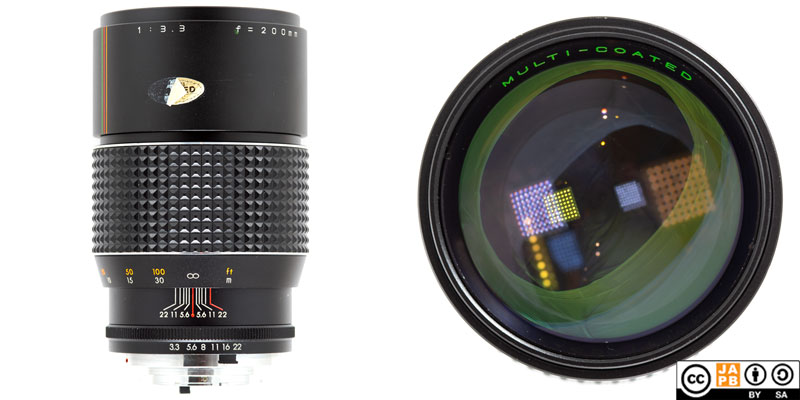
Specifications
The table below summarises the key specifications of the sampled lens.
| Brand: | Makinon | Lens name | Auto 1:3.3 f=200mm |
| Focal length 1 | 200 mm | Angle-of-view 2 | 12 ° |
| Maximum Aperture | f/3.3 | In Production | ≈1975–1983 |
| Lens mount | Minolta SR | Other lens mounts | Canon FD, Contax/Yashica, Konica AR, M42, Nikon F, Olympus OM, Pentax K, Rollei QBM |
| Length 3 | 121,3 mm | Diameter 4 | 75,1 mm |
| Filter ring diameter | 67 mm | Weight | 719 grams |
| Lens element count | unknown | Lens group count | unknown5 |
| Aperture blades (S/R/C) 6 | 6 S | Focus throw | 255 ° |
| Minimum focusing distance (indicated) | 301 cms | Maximum magnification (indicated) | 1:12,25 |
| Has manual aperture ring | YES | Has Manual focus ring | YES |
| Aperture mechanism type | Automatic | Aperture click stops 7 | 3.3-5.6-8-11-16-22 |
Further notes:
• Makinon used to offer at least two parallel 200 mm primes, one offering a relatively bright f/3.3 maximum aperture and the other offeringa more compact and economical f/4.5.
• The Makinon 200 mm f/3.3 lens was – once upon a time – a relatively popular lens and copies of its first variant (pictured) are even today easily and affordably available.
• There are altogether at least three different variants of this lens (see more below)
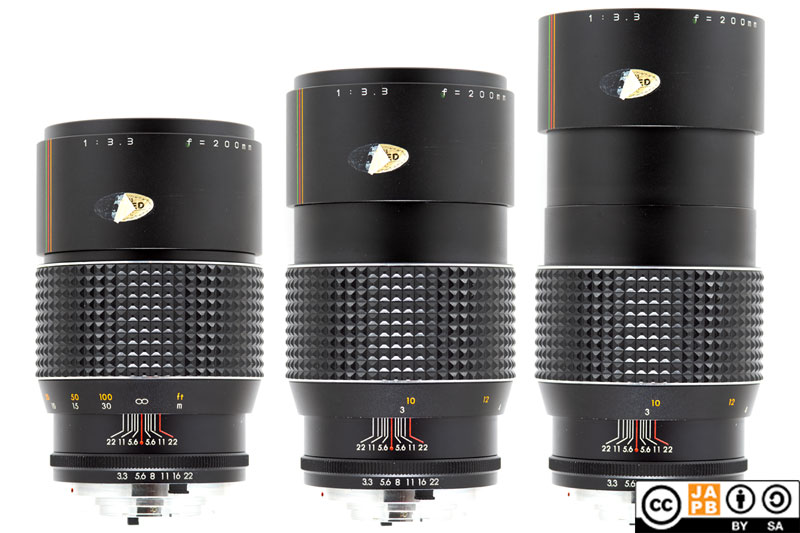
Left: Makinon 200 mm f/3.3 focused at MFD with hood retracted
Right: Makinon 200 mm f/3.3 focused at MFD with hood extended
Versions
First off, the Makinon 200 mm f/3.3 was offered for at least 9 different lens mounts, so the measurements given above do vary somewhat from mount to mount – especially the length and weight measurements are quite mount-dependent.
Secondly, the Makinon 200 mm f/3.3 lens sold quite well and Makina Optical launched at least three variants of the lens:
Variant A sports a 67 mm filter thread and a broad rubber focus ring filled with pyramid shapes – like the pictured lens. The lens also has a decent-sized integrated lens hood.
Among these lenses, the earliest samples have the aperture values 3.3 and 22 slightly bigger than the intermediate values (and a click stop at f/4) whereas subsequent samples (including the pictured lens) have all aperture ring values of identical size. This is by var the most usual variant, and was also rebranded to other brands, most notably Hanimex.
Variant B keeps the previous version’s largish shape (as well as likely the filter thread diameter) and the focus ring pattern, but does away with the integrated hood – instead broadening the focus ring further. The special characteristic of this lens is that when you focus closer (and the internal barrel of the lens appears from inside the focus ring) also a control ring for the lens’ macro mode (two rings of pyramids) appears. I have only seen very few samples of this lens and not under any other brand.
Variant C moves towards a more svelte shape and moves to a 62 mm filter thread. While it keeps the focus ring pattern it ditches the macro mode and again offers a pull-out hood. This lens was also rebranded as a ‘Presenta’ lens.
Introduction to Makinon
Makinon was the lens brand of Makina Optical of Japan. Makina Optical was founded in 1967 and focused on lens manufacture from day one: First Makina Optical focused on selling lenses to other retailers under their brands, but in 1974/5 Makina Optical started selling lenses under their own Makinon brand. See more details in the Company profile of Makina Optical
Adapting
Here we discuss adapting this lens assuming it has a Minolta SR mount – like the pictured sample. If your lens has one of the other mounts (Canon FD, Contax/Yashica, Konica AR, M42, Nikon F, Olympus OM, Pentax K, Rollei QBM) please see the lens mount’s article for adapting advice.
This lens cannot be used natively on any current SLR or dSLRs. To use it in its native environment, you will need a Minolta SR (SR/MC/MD/X-600) film camera. Luckily these are quite easy to find.
Thanks to being a fully manual lens (manual aperture, manual focus), the lens can be adapted to all mirrorless cameras using a suitable adapter. Moreover, a simple ‘dumb adapter’ will do the job perfectly. Thanks to the popularity of the Minolta SR mount, the availability of adapters to all mirrorless mounts can be taken for granted, on the other hand, specialist adapters (speed boosters, helicoid adapters, tilt/shift adapters) are not available for all mirrorless mounts, but daisy-chaining adapters (e.g. Minolta SR -> Canon EF; Canon EF –> mirrorless) can offer a work-around.
Using Minolta SR mount lenses on dSLRs is also be an option, but it is not trouble-free due to that the Minolta SR mount’s flange focal distance is shorter than that of any dSLR mount (technically with the exception of Olympus’ four thirds mount). Hence, any attempt at adapting Minolta SR lenses must rely on an adapter that uses corrective optics to allow infinity focus. However, such adapters are readily available.
Footnotes
- Focal length is (unless stated otherwise) given in absolute terms, and not in Full-frame equivalent. For an understanding of whether the lens is wide/tele, see ‘Angle-of-view’. ↩︎
- Picture angle is given in degrees and concerns the diagonal picture angle. Rule of thumb:
> 90 ° ==> Ultra-wide-angle
70–90 ° ==> Wide-angle
50–70 ° ==> Moderate wide-angle
40–50 ° ==> ‘Standard’ or ‘normal’ lens
20–40 ° ==> Short tele lens
10-20 ° ==> Tele lens
5-10 ° ==> Long tele lens
< 5 ° ==> Ultra-tele lens ↩︎ - Length is given from the mount flange to the front of lens at infinity. ↩︎
- Diameter excludes protrusions such as rabbit ears or stop-down levers. ↩︎
- Sadly, the exact optical recipe of this lens is unknown, but as I have seen one sample that showed a clear case of element separation in the rearmost lenses, the design has at least one doublet. ↩︎
- S=straight; R=rounded; C=(almost)circular at all apertures. ↩︎
- Numbers equal aperture values on aperture ring; • intermediate click; – no intermediate click. ↩︎