Pekka Buttler, 12/2025
This lens was kindly provided for cataloguing by Vladimir at #photogears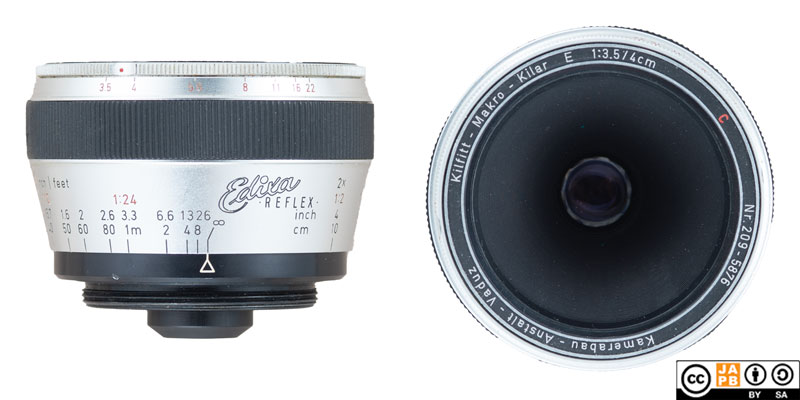
The pictured sample sports an M42 lens mount and prominently carries the logo of its intended system (Edixa Reflex).
Specifications
The table below summarizes the lens’ key specifications (Measurements based on pictured sample):
| Brand: | Kilfitt | Lens name | Makro-Kilar E 1:3.5/4cm |
| Focal length(s) 1 | 40 mm | Angle-of-view 2 | ≈ 57 ° |
| Maximum Aperture | f/3.5 | In Production | 1954– ≈58 |
| Lens mount (this lens) | M42 | Other lens mounts | Alpa, Exakta, Rectaflex |
| Length 3 | 38,2 mm | Diameter 4 | 61,1 mm |
| Filter ring diameter | 49 mm | Weight | 138 grams |
| Lens element count5 | 4 | Lens group count | 3 |
| Aperture blades (S/R/C) 6 | 10 S | Focus throw | 355 ° |
| Minimum focusing distance (indicated) | 10 cms | Maximum magnification (indicated) | 1:2 |
| Has manual aperture ring | YES | Has Manual focus ring | YES |
| Aperture mechanism type | Manual | Aperture click stops | none |
Further notes:
• This lens was designed and Manufactured by Heinz Kilfitt Optische Fabrik (aka ‘Kilfitt’) at their Kamerabau-Anstalt Vaduz factory in Liechtenstein(!).
• The 40/3.5 Makro-Kilar was introduced in 1954 and Popular photography reviewed the lens and proclaimed it “as close as it gets to one’s ‘Dream Lens'”.
• Considering that retrofocus wide-angle lenses at this stage were still in their infancy, this somewhat wider-than-standard lens with exceptional macro abilities to boot was quite an achievement.
• There are generally two versions of the 40/3.5 which differ mainly in the length of their helicoid movement. The E-versions (this lens included) allow focusing from infinity to 1:2 while the D-versions allow focusing all the way from infinity to 1:1 macro.
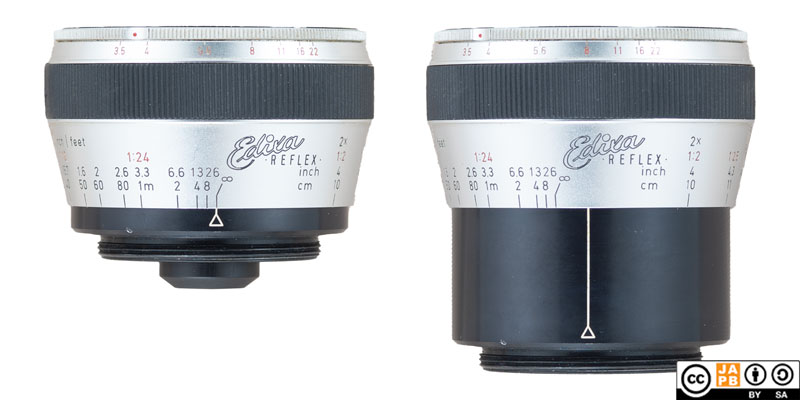
Right: Kilfitt 40 mm f/3.5 Makro-Kilar focused to MFD
• The front lens element is deeply recessed, so a hood is rarely necessary.
• The 40/3.5 Makro-Kilar was replaced by the slightly faster Makro-Kilar 40/2.8 which was introduced in 1958. However due to small manufacturing batches and outstanding stock, both versions overlapped in the marketplace for some years.
History of Kilfitt
Heinz Kilfitt Optische Werke developed from a small specialist workshop into one of the most innovative German lens makers and camera designers of the post‑war era, before ending its life under the Zoomar name in the United States. See more in the JAPB company profile on Kilfitt.
Versions
Besides having been made with a range of lens mounts (most shipped lenses sport an M42 mount), the 40 mm f/2.8 Makro-Kilar was made in E and D versions (different maximum magnifications).
Adapting
We’re going to be discussing adapting M42 mount lenses (as the M42 mount is the most likely mount of a Makro-Kilar). If your copy of the Makro-Kilar sports another mount, please study the JAPB article on the requisite lens mount (likely Exakta) for adapting tips.
If you want to natively mount an M42 lens you need to find a functioning M42 mount film camera. Luckily that should be relatively easy as M42 bodies were produced in their millions and most of them lack features that are especially likely to have deteriorated to the point of making the entire camera inoperable. If your sample of this lens offers a switch to choose between auto- and manual aperture, I recommend using the lens on a body that is capable of stopping down the lens automatically and offers stop-down metering.
Adapting this lens to a mirrorless, full-frame digital camera is a breeze thanks to the lens having full manual controls (aperture ring, focus ring). You simply need a dumb adapter from M42 to your mirrorless system.
Due to the medium flange focal distance used by the M42 mount (45,46 mm), whether you can adapt this lens to dSLR/SLR mounts depends on which dSLR mount: Canon EF, Four Thirds, Minolta/Sony A and Pentax K can mount m42 lenses using a simple adapter ring. Nikon F on the other hand is not as problem-free, and – to retain anything near infinity focus – the adapter will necessitate corrective optics. In all cases, your camera will work only in stop-down metering.
Footnotes
- Focal length is (unless stated otherwise) given in absolute terms, and not in Full-frame equivalent. For an understanding of whether the lens is wide/tele, see ‘Angle-of-view’. ↩︎
- Picture angle is given in degrees (based on manufacturers’ specs) and concerns the diagonal picture angle. Rule of thumb:
> 90 ° ==> Ultra-wide-angle
70–90 ° ==> Wide-angle
50–70 ° ==> Moderate wide-angle
40–50 ° ==> ‘Standard’ or ‘normal’ lens
20–40 ° ==> Short tele lens
10-20 ° ==> Tele lens
5-10 ° ==> Long tele lens
< 5 ° ==> Ultra-tele lens ↩︎ - Length is given from the mount flange to the front of lens at infinity. ↩︎
- Diameter excludes protrusions such as rabbit ears or stop-down levers. ↩︎
- Data on lens elements and groups is based on a single source. Alternatively, it might also be a 4 elements in 3 groups design. ↩︎
- S=straight; R=rounded; C=(almost)circular at all apertures. ↩︎