Pekka Buttler, 01/2026
This lens was kindly provided for cataloguing by Vladimir at #photogears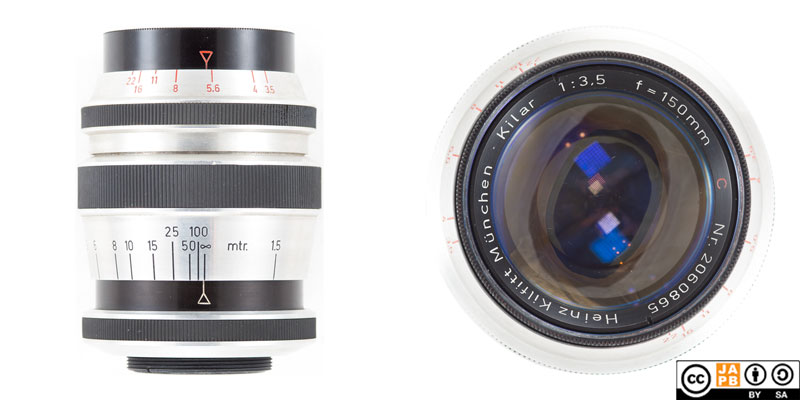
Specifications
The table below summarizes the lens’ key specifications (Measurements based on pictured sample):
| Brand: | Kilfitt | Lens name | Kilar 1:3.5 f=150mm C |
| Focal length(s) 1 | 150 mm | Angle-of-view 2 | 16 ° |
| Maximum Aperture | f/3.5 | In Production | 1948– ≈1970 (all versions) |
| Lens mount | proprietary intermediate mount | Kilfitt Adapter available for | See notes |
| Length 3 | 91,7 mm | Diameter 4 | 69,7 mm |
| Filter ring diameter | 52 mm | Weight | 385 grams (without adapter) |
| Lens element count5 | 3 | Lens group count | 3 |
| Aperture blades (S/R/C) 6 | 16 S | Focus throw | 330 ° |
| Minimum focusing distance (indicated) | 1,5 m | Maximum magnification (calculated) | ≈ 1:8 |
| Has manual aperture ring | YES | Has Manual focus ring | YES |
| Aperture mechanism type | Manual7 | Aperture click stops | none |
Further notes:
• The 150 mm Kilar is among the first lenses that Heinz Kilfitt Optische Fabrik started manufacturing after WWII.
• This 150 mm Kilar is sometimes available as the Tele-Kilar (see more in ‘versions’)
• Every lens was shipped with a matching lens hood, but many seem to have been lost over the decades. The image below shows the original hood.
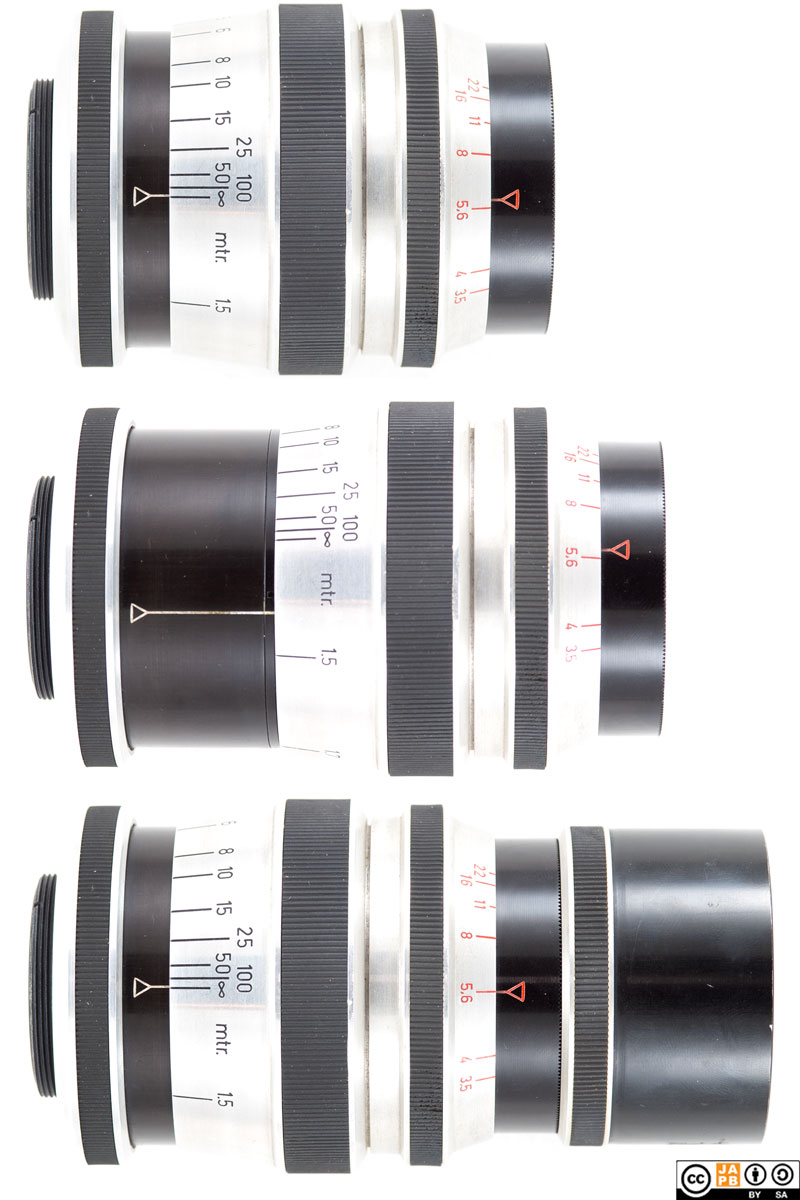
Middle: Kilfitt Kilar 150 mm f/3.5 focused at MFD (without lens hood)
Bottom: Kilfitt Kilar 150 mm f/3.5 focused at infinity (with lens hood)
Notes on adapters
• Alike many other Kilfitt lenses, this lens was never produced with a camera’s lens mount. Instead, It used Kilfitt’s proprietary intermediate mount in combination with Kilfitt’s own adapters that were manufactured for most contemporary mounts, including: Alpa, Canon R, Contarex, Exakta, LTM, Leica M, Minolta SR, Miranda, M42, Nikon F, Praktina and Rectaflex.
• In this there were two different types of adapters that could be used with the 150 mm Kilar: a regular adapter and a helicoid adapter.
• Both adapters offered a tripod foot as well as a slot for gelatin filters.
• With the regular adapter the 150 mm Kilar reached a minimum focusing distance of 1,5 metres, and with the helicoid adapter the minimum focusing distance was ca. 70 centimetres and the maximum magnification was 1:2.7.
• Infinity could be reached with both adapters.
• To see which specific adapters were available, check the JAPB company profile for Kilfitt
History of Kilfitt
Heinz Kilfitt Optische Werke developed from a small specialist workshop into one of the most innovative German lens makers and camera designers of the post‑war era, before ending its life under the Zoomar name in the United States. See more in the JAPB company profile on Kilfitt.
Versions
The 150 mm Kilar stayed in production for a considerable time, and there are several different variants. That said, these variations are mostly related to ergonomics, design and naming, whereas the original optical design remained the same throughout.
First, different variants can be distinguished based on naming:
• Early copies of the 150 mm Kilar were named “Tele-Kilar”
• Intermediate copies dropped the “Tele-” but added a red “C” to indicate coating.
• Late copies carried the Kilfitt logo “○○○” on the front barrel (some other Kilfitt lenses added the logo to the name ring)
• The Zoomar product catalogues that I have offer no mention of the 150 mm Kilar, meaning that this lens was dropped from the lineup before a number of other Kilfitt lenses.
Second, the 150 mm Kilar always carried only one distance scale, meaning that samples for the US market (and some other markets) could be distinguished by having a distance scale in feet (instead of metres)
Third, the lens is available in both silver–black duotone scheme and an all-black colouring (with black samples being relatively rare).
Fourth, the lens was initially launched as a manual aperture lens, but somewhere around SN 4000 the aperture mechanism was modernised to a preset aperture.
Adapting
We’re going to be discussing adapting M42 mount lenses (as the M42 adapter is the most likely following your Kilar). If your copy of the Kilar sports another mount, please study the JAPB article on the requisite lens mount (likely Exakta) for adapting tips.
If you want to natively mount an M42 lens you need to find a functioning M42 mount film camera. Luckily that should be relatively easy as M42 bodies were produced in their millions and most of them lack features that are especially likely to have deteriorated to the point of making the entire camera inoperable. If your sample of this lens offers a switch to choose between auto- and manual aperture, I recommend using the lens on a body that is capable of stopping down the lens automatically and offers stop-down metering.
Adapting this lens to a mirrorless, full-frame digital camera is a breeze thanks to the lens having full manual controls (aperture ring, focus ring). You simply need a dumb adapter from M42 to your mirrorless system.
Due to the medium flange focal distance used by the M42 mount (45,46 mm), whether you can adapt this lens to dSLR/SLR mounts depends on which dSLR mount: Canon EF, Four Thirds, Minolta/Sony A and Pentax K can mount m42 lenses using a simple adapter ring. Nikon F on the other hand is not as problem-free, and – to retain anything near infinity focus – the adapter will necessitate corrective optics. In all cases, your camera will work only in stop-down metering.
Footnotes
- Focal length is (unless stated otherwise) given in absolute terms, and not in Full-frame equivalent. For an understanding of whether the lens is wide/tele, see ‘Angle-of-view’. ↩︎
- Picture angle is given in degrees (based on manufacturers’ specs) and concerns the diagonal picture angle. Rule of thumb:
> 90 ° ==> Ultra-wide-angle
70–90 ° ==> Wide-angle
50–70 ° ==> Moderate wide-angle
40–50 ° ==> ‘Standard’ or ‘normal’ lens
20–40 ° ==> Short tele lens
10-20 ° ==> Tele lens
5-10 ° ==> Long tele lens
< 5 ° ==> Ultra-tele lens ↩︎ - Length is given from the mount flange to the front of lens at infinity. ↩︎
- Diameter excludes protrusions such as rabbit ears or stop-down levers. ↩︎
- Data on lens elements and groups is based on a single source. Alternatively, it might also be a 4 elements in 3 groups design. ↩︎
- S=straight; R=rounded; C=(almost)circular at all apertures. ↩︎
- A later variant also offered a preset aperture mechanism with click stops from 3.5 to 22 (whether half or full stop clicks, I do not know) ↩︎