Pekka Buttler, 11/2026
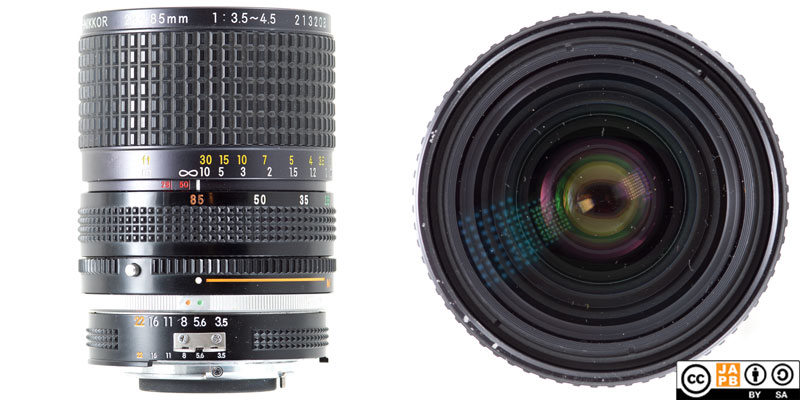
Specifications
The table below summarizes the lens’ key specifications:
| Brand: | Nikon | Lens name | Zoom-NIKKOR 28~85mm 1:3.5–4.5 |
| Focal length(s)1 | 28–85 mm | Angle-of-view2 | 74° – 28°30 |
| Maximum Aperture | f/3.5–4.5 | In Production | 1985–2005 |
| Lens mount | Nikon F | Subfamily (if applicable) | Ai-s |
| Length3 | 88,8 mm | Diameter4 | 67,5 mm |
| Filter ring diameter | 62 mm | Weight | 502 grams |
| Lens element count | 15 | Lens group count | 11 |
| Aperture blades (S/R/C)5 | 7 S | Focus throw | 105 ° |
| Minimum focusing distance (@ 28 mm / @ 85 mm) (measured) | normal: 1,31 m / 0,81 m macro: 0,23 m | Maximum magnification (measured) | normal: 1:8,5 (@85 mm) macro: 1:3,7 |
| Has manual aperture ring | YES | Has Manual focus ring | YES |
| Aperture mechanism type | Auto | Aperture click stops 6 | 3.5•5.6-8-11-16-22 |
Further notes:
• The Nikkor Ai-s 28–85 mm f/3.5–4.5 was introduced in 1985 and while Nikon only one year later introduced the same design as an autofocus lens (the Nikkor AF 28–85/3.5–4.5 [data sheet]) this lens stayed in production and was not officially discontinued before 2005. During those 20 years a bit under 95 000 copies were made.
• At the time of its introduction, this was Nikon’s first zoom to start at the wide angle focal length of 28 mm and reach past the normal range (there had been 28–45 and 28–50 wide zooms and several 35–xx zooms, but none starting at 28 and going past 50.)
• With its 15 elements in 11 groups design, this was a clear case of ambitious zoom design, and the lens has managed to acquire a loyal following (that the optically identical AF version never came close to).
• The lens offers altogether four rings: An aperture ring, a macro-mode ring, the zoom ring and the focusing ring.
• As is customary with manual-era Nikkor lenses, the lens offers only full stop clicks.
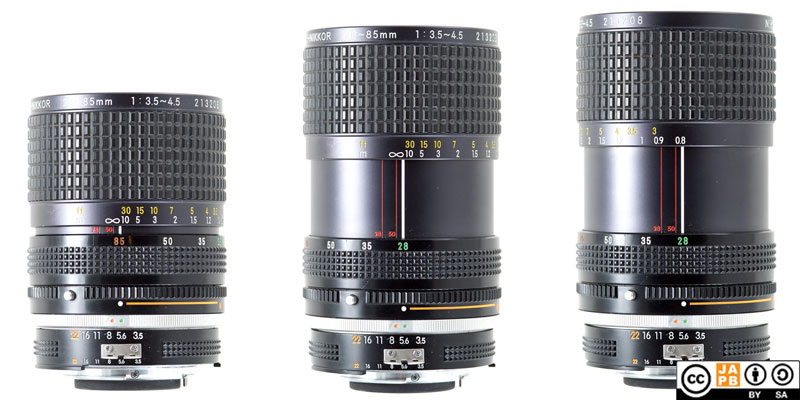
Centre: Nikkor Ai-s 28~85 mm f/3.5–4.5 zoomed to 28 mm & focused at infinity
Right: Nikkor Ai-s 28~85 mm f/3.5–4.5 zoomed to 28 mm & focused at MFD
• Manipulating the zoom ring changes the length of the lens. The lens is at its shortest around the 80 mm focal length and at its longest at 28 mm.
• Turning the focus ring towards MFD also lengthens the lens a bit. The lens’ entire front (including filter threads) rotate on focusing.
• This lens is by no means parfocal and while the MFD is decent at the tele end (0,81 m at 85 mm), the minimum focusing distance at the wide end is quite dismal (1,31 m at 28 mm) without using the macro mode.
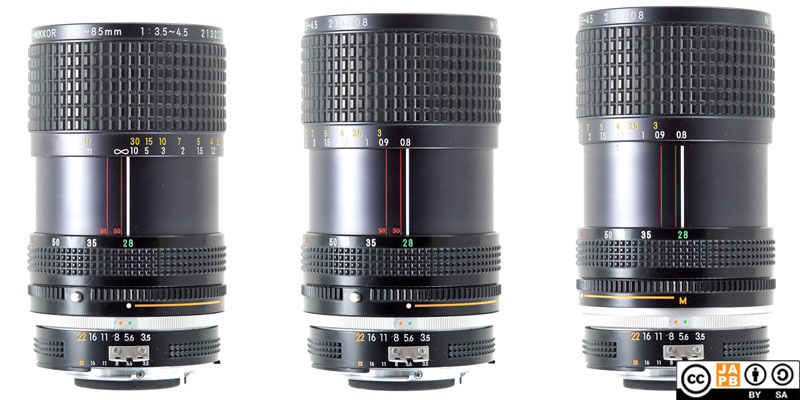
Centre: Nikkor Ai-s 28~85 mm f/3.5–4.5 zoomed to 28 mm & focused at MFD
Right: Nikkor Ai-s 28~85 mm f/3.5–4.5 zoomed to 28 mm & focused at MFD and with full macro mode.
• Twisting the macro mode ring to its closest focus setting also forces the zoom ring towards the 28 mm setting. The effective focal length at maximum macro is however close to 38 mm (not 28 mm).
• Nikon offered a dedicated hood (the HK-16, a clamp-on hood) for use with this lens, but as this is Nikon’s only ever lens to use that specific hood, availability of the dedicated hood tends to be weak. Moreover, as that hood fundamentally is a wide-angle lens hood, its protection is limited in all but the wide-angle scenario.
A brief genealogy of Nikon SLR lens types
Nikon is undoubtedly one of the great names in 35 mm SLR photography. The Nikon F mount has been in continuous production since 1959. During that time, the mount has developed/changed in some detail, however without ever fully sacrificing compatibility.
In short (a longer version is here), the development of Nikon’s SLR lenses can be traced as follows:
• 1959–1977: Pre-Ai. Manual focus lenses that use ‘rabbit ears’ to communicate selected aperture with the camera body. Pre-Ai lenses can further be subdivided into
• F-type (1959–early 1970s: metal focus ring and single-coated),
• C-type (early 1970s–mid 1970s: metal focus ring and multicoated), and
• K-type (mid 1970s to 1977: rubber focus ring and multicoated).
A significant share of remaining Pre-Ai lenses have since been converted to Ai-spec (Ai’d)
• 1977–1986: Ai and Ai-s. Manual focus lenses that may have ‘rabbit ears’ for backward compatibility, but are designed to communicate selected aperture with the camera body through indentations in base of aperture control ring.
• 1986–today: AF and AF-D. Autofocus lenses that do not have a focusing motor within the lens, but rely on the focus motor within the camera. All AF and AF-D lenses are simultaneously Ai-s lenses (they are Ai-s lenses extended with AF) 7
• 1996–today AF-S and AF-P. Autofocus lenses that have an internal focusing motor and do not rely on the body having a focusing motor.
Adapting
Besides adapting, this lens can be used natively on all current high-end Nikon dSLRs and several earlier medium-to-high-end older Nikon dSLRs8. Likewise, if it still has its rabbit ears, it can be natively used on all Nikon F-mount film cameras ever produced (without the rabbit ears, it is limited to post 1977 bodies).
Thanks to being a fully manual lens (manual aperture, manual focus), the lens can be adapted to all mirrorless cameras using a suitable dumb adapter (and such adapters are easy to find). Moreover, a large range of special adapters (helicoid adapters, tilt/shift adapters, speed boosters) for using Nikon F lenses on most mirrorless systems are available.
Using Nikon F lenses on non-Nikon SLRs and dSLRs is likewise a distinct possibility. Thanks to the relatively generous flange focal distance of the Nikon F mount (46,5 mm), adapter rings for all dSLR mounts are available as well as for a goodly portion of film-era SLR mounts. Such rings may not allow for auto aperture, but even then the lenses can be used in stop-down metering mode.
Footnotes
- Focal length is (unless stated otherwise) given in absolute terms, and not in Full-frame equivalent. For an understanding of whether the lens is wide/tele, see ‘Angle-of-view’. ↩︎
- Picture angle is given in degrees and concerns the diagonal picture angle. Rule of thumb:
> 90 ° ==> Ultra-wide-angle
70–90 ° ==> Wide-angle
50–70 ° ==> Moderate wide-angle
40–50 ° ==> ‘Standard’ or ‘normal’ lens
20–40 ° ==> Short tele lens
10-20 ° ==> Tele lens
5-10 ° ==> Long tele lens
< 5 ° ==> Ultra-tele lens ↩︎ - Length is given from the mount flange to the front of lens at infinity. ↩︎
- Diameter excludes protrusions such as rabbit ears or stop-down levers. ↩︎
- S=straight; R=rounded; C=(almost)circular at all apertures. ↩︎
- Numbers equal aperture values on aperture ring; • intermediate click; – no intermediate click. ↩︎
- There is a further sub-class of AF-D lenses called AF-I lenses that are otherwise AF-D lenses (meaning, fully Ai-s compatible), but have an internal focus motor. Only long tele lenses were made in AF-I variants. ↩︎
- As of this writing, the following Nikon dSLRs fully support Aperture priority and manual metered modes on Nikkor Ai/Ai-s lenses: D2, D3, D4, D5, D6, D200, D300, D300s, D500, D600, D610, D700, D750, D780, D800, D800E, D810, D850, D7000, D7100, D7200 ↩︎