Pekka Buttler, 10/2026
Specifications
The table below summarises the lens’ key specifications (measurements based on pictured sample):
| Brand: | Fuji Photo Film Co | Lens name | Fujinon•SW 1:2.5/28 |
| Focal length(s) 1 | 28 mm | Angle-of-view 2 | ≈74 ° |
| Maximum Aperture | f/3.5 | In Production | ≈1971–80 (all variants) |
| Lens mount | M42 | Subfamily (if applicable) | M42-auto |
| Length 3 | 38,4 mm | Diameter 4 | 58,0 mm |
| Filter ring diameter | 49 mm | Weight | 163 grams |
| Lens element count | 7 | Lens group count | 7 |
| Aperture blades (S/R/C) 5 | 5 S | Focus throw | ≈135 ° |
| Minimum focusing distance (measured) | 40 cms | Maximum magnification (measured) | 1:10,9 |
| Has manual aperture ring | YES | Has Manual focus ring | YES |
| Aperture mechanism type | Automatic | Aperture click stops 6 | 3.5••5.6•8•11-16 |
Historical notes:
• When Fuji Photo Film (nowadays Fujifilm) decided to enter the interchangeable lens SLR market (with the ST701) in 1971, they also launched a line of primes, containing: 28 mm f/3.5 (this lens); 35 mm f/2.8; 50 mm f/1.4; 55 mm f/1.8; 100 mm f/2.8; 135 mm f/3.5; and 200 mm f/4.5.
• This lens therefore held the role of covering the system’s widest-angle needs.
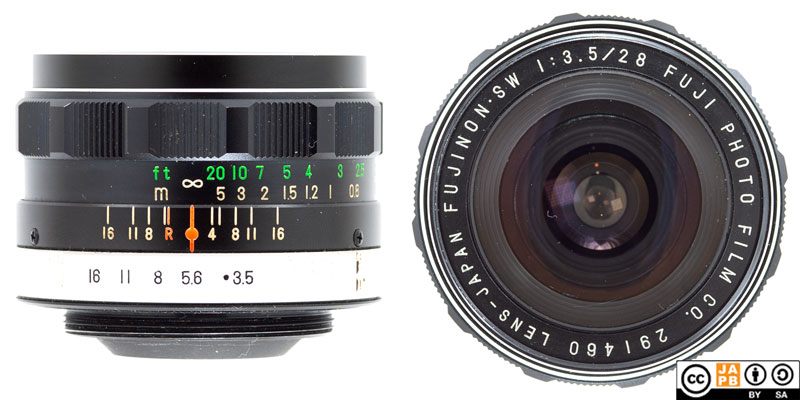
• This line of early Fujifilm primes are visually distinct thanks to a silver-coloured aperture ring at the base of the lens. These lenses also do not yet use Fuji’s signature method of communicating the chosen aperture to the camera (see more in ‘versions’).
Versions
About Fuji M42 lens types:
During the lifespan (1971–80) of the Fuji Photo Film M42 lenses, there can be distinguished 4 specific types of lenses:
• Type I – lenses originally introduced between 1971 and 1973 that lack Fuji’s proprietary extension of the M42 mount. These lenses are easy to distinguish visually because they have a silver aperture ring and metal focus rings. Type I lenses show their serial numbers on the lens’ name ring.
• Type II and Type III: lenses introduced after 1973 that have Fuji’s proprietary extension of the M42 mount (see more here), black aperture rings and rubberised, diamond patterned focus rings. The main distinction between types II and III is whether they are multicoated using Fuji’s EBC coatings. Type II lenses lack EBC, whereas Type III lenses are EBC coated7. Type II and III lenses have their serial numbers on the lens barrel (on integrated lens hoods or at the base of the barrel on the lens’ downside)
• Type IV lenses are an end-of life extension of the Type III lens, where the obvious changes are a new focus ring patterning (‘rows of knobs’ instead of the diamond patterning) and the return of the lens’ serial number to the name ring. Not every Type III lens has a Type IV variant.
Versions of the Fujinon 28 mm f/3.5
Given that the Fujinon 28 mm f/3.5 lens remained in production throughout the whole life of the M42 Fuji Photo Film SLR system, it is possible that there are four different versions of the 28 mm f/3.5 (I have seen all samples except for a Type II sample).
Type I (this lens)
Mount: Vanilla M42
Aperture ring colour: silver
Focusing ring: metal
Coating: Single-coated
Name ring text: FUJI PHOTO FILM CO [SERIAL] LENS-JAPAN FUJINON•SW 1:3.5/28
Serial number location: name ring
Type II
Mount: Fujica M42 (proprietary)
Aperture ring colour: black
Focus ring: rubberised, diamond-pattern
Coating: Single-coated
Name ring text: FUJI PHOTO FILM CO Lens-Japan FUJINON•SW 1:3.5 f=28mm
Serial number location: rear, downside of barrel (above aperture ring)
Type III
Mount: Fujica M42 (proprietary)
Aperture ring colour: black
Focus ring: rubberised, diamond-pattern
Coating: Multi-coated
Name ring text: FUJI PHOTO FILM CO Lens-Japan EBC FUJINON•SW 1:3.5 f=28mm
Serial number location: rear, downside of barrel (above aperture ring)
Type IV
Mount: Fujica M42 (proprietary)
Aperture ring colour: black
Focus ring: rubberised, knob-row pattern
Coating: Multi-coated
Name ring text: FUJI PHOTO FILM CO [SERIAL] Lens-Japan EBC FUJINON•SW 1:3.5/28
Serial number location: name ring
History
Fuji Photo Film (nowadays: Fujifilm) was founded in 1934 under the name Fuji Shashin Film, as a spinoff of Dai-Nippon Celluloid K.K. The company’s name was chosen in honour of Mt. Fuji. Initially the company concentrated on manufacturing photographic film, but diversified into optics in the early 1940s (as part of the war effort) and into cameras in 1948 (as part of the reconstruction of Japanese manufacturing). From early on, Fuji lenses have been sold under the ‘Fujinon’ moniker, and during the 1950s Fujinon lenses were made for both Leica thread mount and Nikon S mount.
While Fuji had become a major player in photographic gear already earlier, Fuji entered the interchangeable lens SLR business relatively late (with the 1970 introduction of the Fujica ST701). Originally Fujica SLR cameras and Fujinon SLR lenses used a vanilla m42 thread mount (with aperture stop-down) but with the 1972 introduction of the Fujica ST802 Fuji also introduced its proprietary extension of the M42 mount. Thereafter Fujinon M42 mount lenses could not be used on all M42 cameras (the protrusion of the base of the aperture ring fits some but not all M42 cameras), while Fujica cameras were able to use almost all other m42 lenses (See details of Fuji’s extension to the m42 mount here).
In the end, even Fuji abandoned the m42 mount for the Fujica-X mount (a proprietary bayonet mount). When Fuji abandoned the m42 mount, it was the last8 major manufacturer to do so.
Fuji has long been known for its high quality lenses – both in SLR’s compacts and medium and large format lenses – and it would have been interesting to see what Fuji Photo Film’s lineup of 35 mm lenses would have developed into. Alas, in the mid-1980s, Fuji Photo Film decided to withdraw from SLR manufacture and focused instead on both compacts and larger film formats. Whether that withdrawal was caused by disappointing sales of the Fujica X line, or due to the advent of autofocus SLR’s, I can only speculate.
Adapting
If you want to natively mount this lens you need to find a functioning M42 mount film camera. Luckily that should be relatively easy as M42 bodies were produced in copious numbers and most of them lack features that are especially likely to have deteriorated to the point of making the entire camera inoperable.
Adapting this lens to a mirrorless, full-frame digital camera is easy, assuming you find a suitable dumb adapter. Thanks to being a Fujica-variant of the m42 mount, that adapter needs to 1) make room for the aperture setting tab and 2) depress the aperture stop-down pin (otherwise the lens is permanently wide-open). But assuming you have such an adapter, thanks to the lens having full manual controls (aperture ring, focus ring), no further hassle should be expected.
Due to the medium flange focal distance used by the m42 mount (45,46 mm), whether you can adapt this lens to dSLR/SLR mounts depends on which dSLR mount: Canon EF, Four Thirds, Minolta/Sony A and Pentax K can mount m42 lenses using a simple adapter ring (but it needs to make space for the Fujica-m42 tab and depress the aperture stop-down pin). Nikon F on the other hand is not as problem-free, and – to retain anything near infinity focus – the adapter will necessitate corrective optics. In all cases, your camera will work only in stop-down metering.
Footnotes
- Focal length is (unless stated otherwise) given in absolute terms (not in Full-frame equivalent), and according to the manufacturer’s naming practice (which does not always reflect the lens’ actual field of view). For an understanding of whether the lens is wide/tele, see ‘Angle-of-view’. ↩︎
- Picture angle is given in degrees and concerns the diagonal picture angle. Rule of thumb:
> 90 ° ==> Ultra-wide-angle
70–90 ° ==> Wide-angle
50–70 ° ==> Moderate wide-angle
40–50 ° ==> ‘Standard’ or ‘normal’ lens
20–40 ° ==> Short tele lens
10-20 ° ==> Tele lens
5-10 ° ==> Long tele lens
< 5 ° ==> Ultra-tele lens ↩︎ - Length is given from the mount flange to the front of lens at infinity. Measured unless stated otherwise. ↩︎
- Diameter excludes protrusions such as rabbit ears or stop-down levers. Measured unless stated otherwise. ↩︎
- S=straight; R=rounded; C=(almost)circular at all apertures. ↩︎
- Numbers equal aperture values on aperture ring; • intermediate click; – no intermediate click. ↩︎
- Some lenses (including the 50/1.4 and 55/1.8) have both Type II and Type II lenses, whereas with most other lenses it was an either/or situation (lenses like the 35/3.5, 55/1.6 and 55/2.2 where only ever made without EBC coating) ↩︎
- Even Pentacon of East Germany – the company that can be said to have popularised the m42 mount – had shifted its focus on the Praktica B mount (introduced 1978), even though they never stopped offering m42 cameras and lenses. ↩︎