Pekka Buttler, 10/2026
Specifications
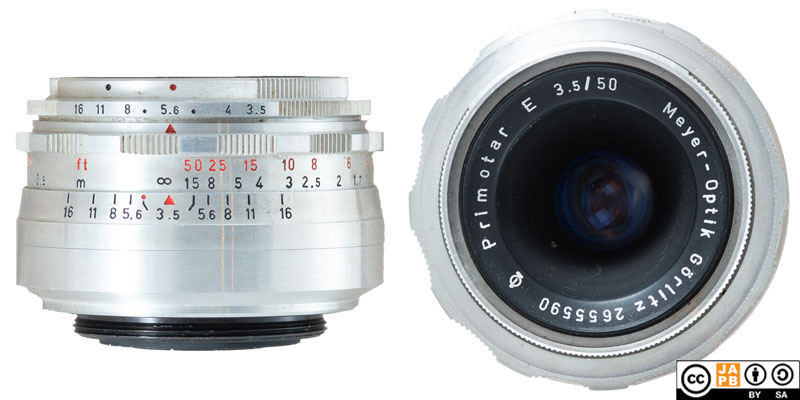
The table below summarises the lens’ key specifications (measurements based on pictured sample):
| Brand: | Meyer-Optik Görlitz | Lens name | Primotar E 3.5/50 |
| Focal length(s) 1 | 50 mm | Angle-of-view 2 | 46 ° |
| Maximum Aperture | f/3.5 | In Production | 1956– ≈1960 |
| Lens mount (this lens) | M42 | Other lens mounts | Exakta |
| Length 3 | 38,1 mm | Diameter 4 | 60,0 mm |
| Filter ring diameter | 49 mm | Weight | 174 grams |
| Lens element count | 4 | Lens group count | 3 |
| Aperture blades (S/R/C) 5 | 6 S | Focus throw | 310 ° |
| Minimum focusing distance (measured) | 51 cm | Maximum magnification (measured) | 1:7,8 |
| Has manual aperture ring | YES | Has Manual focus ring | YES |
| Aperture mechanism type | Automatic/Manual | Aperture click stops | 3.5-4•5.6•8-11-16 |
Further notes:
• The name Primotar signifies a Tessar-type design. Meyer-Optik Görlitz had been designing Tessar-type lenses under this name starting in the 1930s.
• In 1956 MOG decided to re-design their standard Primotar lenses, in part to allow the new lenses to get auto-aperture housings. As a result the Primotar E series was designed with two variants: a Primotar E 50/3.5 for 35 mm film and a Primotar E 80/3.5 for medium format. The earlier was offered for the Exakta and M42 mounts whereas later was offered for the then new Pentacon Six mount.
• The Primotar E for M42 was – from the beginning – offered as an auto-aperture lens. The frontmost control ring allows switching between manual aperture and auto aperture.
• The Primotar E series are by some considered to be among the finest examples of the Tessar type design.
• The Primotar E design offers an interesting quirk in that while it is designed to have an effective max aperture close to f/2.8 that you can use for composing and focusing, it is not designed to be used at that aperture. Instead, the maximum shooting aperture is f/3.5. While this might have made sense in the age when the lens’ maximum aperture was crucial for being able to focus and frame effectively in a dark optical viewfinder, today this is a limitation that you might want to work around.
• For further notes on Meyer-Optik Görlitz and especially their naming logic, see the JAPB article on MOGnames (the company’s later history is summarised below).
History of Meyer-Optik Görlitz
The original Meyer-Optik Görlitz (not the modern company that has taken the classic company’s name) was founded in the town of Görlitz (modern-day Germany) by Hugo Meyer in 1896, and remained in existence until the state-directed merger into VEB Pentacon 1970. Due to its vicinity with the German camera and optics industries in Saxony (Dresden, etc.), Meyer-Optik was from an early stage heavily involved with manufacturing lenses for all kinds of cameras, but the company’s real golden age started with the advent of interchangeable lens cameras, where Meyer-Optik was uniquely placed to offer a cost-effective alternative to premium brands such as Carl Zeiss Jena.
Meyer-Optik was pronouncedly a camera lens manufacturer and never had serious ambitions for pursuing horizontal integration (diversifying into cameras and other photo gear). Instead, MOG pursued a vigorous strategy of seeking economies of scale, combined with never putting too many eggs in any basket – typically Meyer-Optik would choose which designs to put into production based on being able to cover as many platforms/mounts with one basic design. As a result, many early MOG designs were made available for a wide range of camera platforms. Later, as the number of alternative platforms diminished, that strategy had to go in favour of a strong focus on M42 and (to a somewhat lesser extent) Exakta. Even so, throughout the 60s, MOG vigorously pursued innovative designs and could by the end of the decade proudly offer a wide range of high-quality, cost effective designs.
When the lens maker Meyer-Optik was then merged with the camera maker Pentacon, it became obvious that the role the company (and its product portfolio) was intended to play was to aid Pentacon in its designs of gaining a significant global market share in the price-conscious consumer segment (and help bring hard currency to the G.D.R). Instead of focusing on continued optical innovation, the new overlords were more keen on redesigning lenses for greater economy and easier manufacture. As a result, the pace of optical innovation at MOG/Pentacon fell drastically, and very few new designs or significant redesigns were to be forthcoming in the next two decades.
Versions
To the best of my knowledge, only one version of the 50 mm Primotar E was manufactured. However, many earlier samples carry the red letter ‘V’ on their name ring. This was MOG’s early indicator that a lens was coated (V = Vergütet), but later samples skip that red letter V (but are nevertheless also coated).
Adapting
If you want to natively mount this lens you need to find a functioning m42 mount film camera. Luckily that should be relatively easy as m42 bodies were produced in their millions and most of them lack features that are especially likely to have deteriorated to the point of making the entire camera inoperable.
Adapting this lens to a mirrorless, full-frame digital camera is a breeze thanks to the lens having full manual controls (aperture ring, focus ring). You simply need a dumb adapter from M42 to your mirrorless system, but be mindful of that your adapter should have an extra flange to actuate the aperture stop-down pin (otherwise you cannot stop down the lens).
Due to the medium flange focal distance used by the m42 mount (45,46 mm), whether you can adapt this lens to dSLR/SLR mounts depends on which dSLR mount: Canon EF, Four Thirds, Minolta/Sony A and Pentax K can mount m42 lenses using a simple adapter ring. Nikon F on the other hand is not as problem-free, and – to retain anything near infinity focus – the adapter will necessitate corrective optics. In all cases, your camera will work only in stop-down metering.
Footnotes
- Focal length is (unless stated otherwise) given in absolute terms, and not in Full-frame equivalent. For an understanding of whether the lens is wide/tele, see ‘Angle-of-view’. ↩︎
- Picture angle is given in degrees (based on manufacturers’ specs) and concerns the diagonal picture angle. Rule of thumb:
> 90 ° ==> Ultra-wide-angle
70–90 ° ==> Wide-angle
50–70 ° ==> Moderate wide-angle
40–50 ° ==> ‘Standard’ or ‘normal’ lens
20–40 ° ==> Short tele lens
10-20 ° ==> Tele lens
5-10 ° ==> Long tele lens
< 5 ° ==> Ultra-tele lens ↩︎ - Length is given from the mount flange to the front of lens at infinity. ↩︎
- Diameter excludes protrusions such as rabbit ears or stop-down levers. ↩︎
- S=straight; R=rounded; C=(almost)circular at all apertures. ↩︎