Pekka Buttler, 09/2026
Specifications
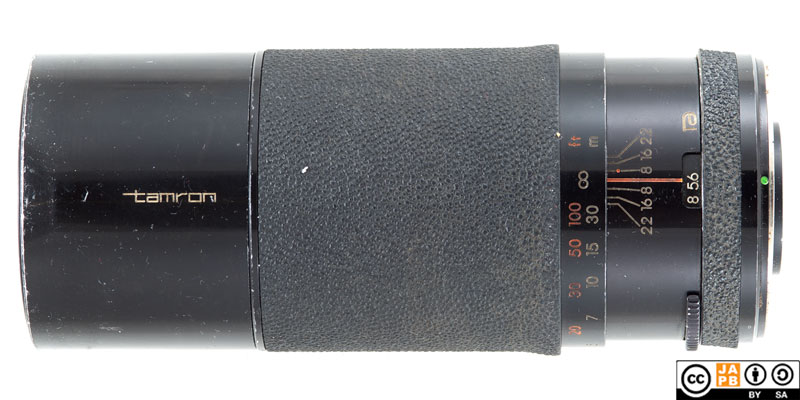
The table below summarises the lens’ key specifications (measurements based on pictured sample with Pentax K adapter):
| Brand: | Tamron | Lens name | 1:5.6 f=300mm BBAR MULTI C. |
| Focal length(s) 1 | 300 mm | Angle-of-view 2 | 8° |
| Maximum Aperture | f/5.6 | In Production | 1976–79 |
| Lens mounts (native) | Tamron Adaptall | Other lens mounts | See article on Adaptall |
| Length 3 | 161,5 mm (without adapter) 166,6 mm (with Pentax K adapter) | Diameter 4 | 66,7 mm |
| Filter ring diameter | 58 mm | Weight | 544 grams (without adapter) 606 grams (with Pentax K adapter) |
| Lens element count | 4 | Lens group count | 4 |
| Aperture blades (S/R/C) 5 | 9 S | Focus throw | 180 ° |
| Minimum focusing distance (measured) | 238 cms | Maximum magnification (measured) | 1:6,6 |
| Has manual aperture ring | YES | Has manual focus ring | YES |
| Aperture mechanism type | Automatic | Aperture click stops (on preset ring) 6 | 5.6•8•11•16-22 |
Further notes:
• This lens was designed to use the Tamron Adaptall/Adaptall2 intermediate mount
• Tamron has always had its own coding scheme for lens designs. This coding scheme is extremely useful to discern between two (or more) lenses that have the same mainline specifications (focal length and maximum aperture). According to the Tamron coding scheme, this lens is “Model CT-300”.
• This lens replaced the previous Tamron 300mm f/5.6 that was made for the Adapt-a-matic mount.
• The focus ring is wide and grippy. The aperture ring is narrow but does have a rubber grip.
• Sadly – as with many lenses from this age of Tamron lenses – the rubber rings have swollen somewhat and are no longer a tight fit.
• When focusing the entire front of the lens (including the filter threads) rotates.
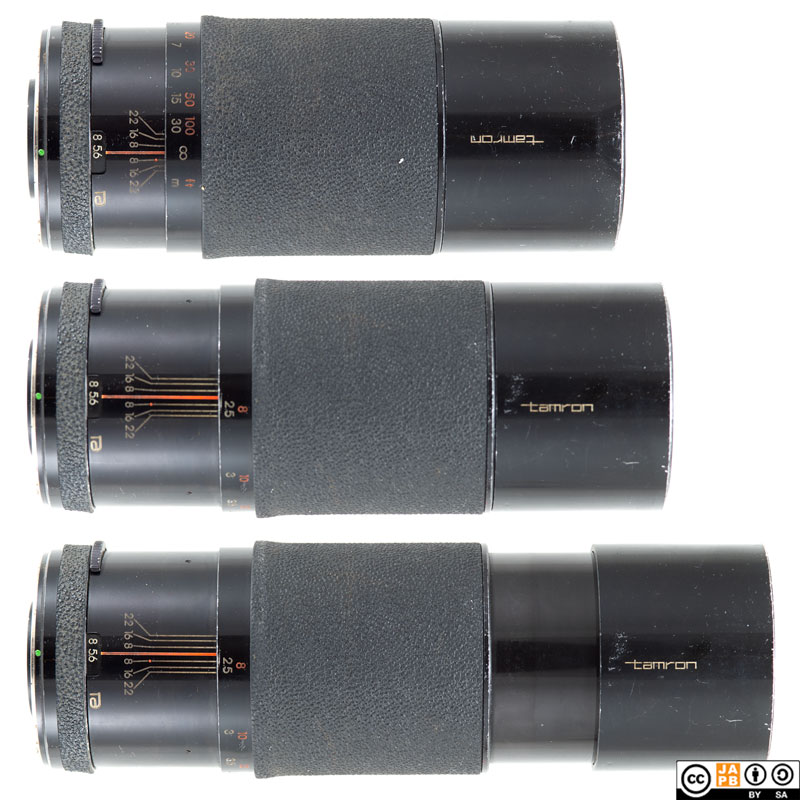
• the lens at infinity with hood retracted
• the lens at MFD with hood retracted
• the lens at MFD with hood extended
• The lens features a decent-sized pull-out lens hood.
• Next to the aperture ring there is a switch for choosing between manual and automatic aperture.
Versions
There seems to be only one variant of the Tamron Model CT-300.
Adapting
Given that this lens uses an intermediate mount, there are several ways to go, depending on what your intention is
If you intend to adapt your Tamron Adaptall lens to a dSLR…
There are original Tamron Adaptall adapters to both Pentax K and Nikon F (Ai) available. These adapters allow you to use the tamron Adaptall lens as if it was a native (manual focus) lens (including aperture and aperture priority exposure automation). There are also modern adapters available from several adapter manufacturers, but – in general – these adapters are dumb adapters and do not allow aperture control.
If your dSLR is a Canon EF or Sony/Minolta A and Four thirds camera, you can get an aftermarket dumb adapter, but will have to manually control aperture.
To film SLRs?
You’re in luck, because there used to be Adaptall/Adaptall-2 adapters made for pretty much every mainstream SLR system available before the mid-70s, (including at least7: Canon FD*, Contax/Yashica*, Fujica X†, Konica AR*, M42 (several variants8), Mamiya Z°, Minolta SR*, Miranda°, Nikon F° (Pre-Ai and Ai), Olympus OM*, Pentax K (K° and A† versions), Praktica B†, Rollei QBM° and Topcon RE° (Exakta). What you need to do is head to your favourite online classifieds platform and procure an adapter (adapters for dSLR mounts are still available new).
Notes:
* Available both as Adaptall 1 and 2 (with different features)
° Available only as Adaptall 1
† Available only as Adaptall 2
To Mirrorless
If you already have a number of adapters from the typical SLR mounts to your mirrorless camera (e.g. Canon FD / M42 / Nikon F / Olympus OM / Pentax K …) your best choice is to either:
- get an original Tamron adapter from Adaptall to whatever your most favoured SLR era lens mount is or
- get a modern Tamron adapter to mirrorless adapter from one of the contemporary adapter manufacturers (K&F Concept seems to offer dumb adapters for Adaptall to most mirrorless mounts)
Of these, the earlier option is likely to be cheaper and the later less finicky.
History of Tamron
A short history of Tamron can be found as part of the Tamron company profile.
Footnotes
- Focal length is (unless stated otherwise) given in absolute terms, and not in Full-frame equivalent. For an understanding of whether the lens is wide/tele, see ‘Angle-of-view’. ↩︎
- Picture angle is given in degrees and concerns the diagonal picture angle. Rule of thumb:
> 90 ° ==> Ultra-wide-angle
70–90 ° ==> Wide-angle
50–70 ° ==> Moderate wide-angle
40–50 ° ==> ‘Standard’ or ‘normal’ lens
20–40 ° ==> Short tele lens
10-20 ° ==> Tele lens
5-10 ° ==> Long tele lens
< 5 ° ==> Ultra-tele lens ↩︎ - Length is given from the mount flange to the front of lens at infinity. ↩︎
- Diameter excludes protrusions such as rabbit ears or stop-down levers. ↩︎
- S=straight; R=rounded; C=(almost)circular at all apertures. ↩︎
- Numbers equal aperture values on aperture ring; • intermediate click; – no intermediate click. ↩︎
- This list will only contain adapters that we at JAPB have witnessed. ↩︎
- There were both adaptall adapters to vanilla M42 mounts as well as some of the M42 variants (such as Fujica M42, Mamiya M42, Praktica electronic M42). For details, see the JAPB article on the m42 mount.
↩︎