Pekka Buttler, 07/2025
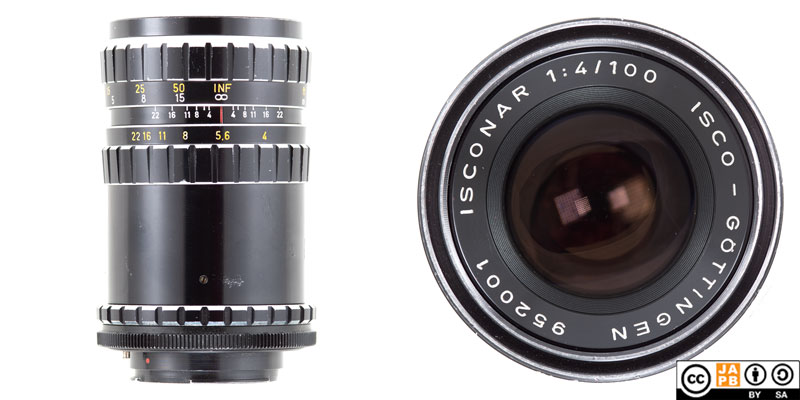
Specifications
The table below summarizes the lens’ key specifications (measurements based on pictured version of the lens):
| Brand: | ISCO-Göttingen | Lens name | Isconar 1:4/100 |
| Focal length(s)1 | 100 mm | Angle-of-view2 | 23 ° |
| Maximum Aperture | f/4 | In Production | 1960s |
| Lens mount (this lens) | Exakta | Other lens mounts | M42 |
| Length3 | 80,2 mm | Diameter4 | 53,9 mm |
| Filter ring diameter | 41 mm (!) | Weight | 209 grams |
| Lens element count | 3 | Lens group count | 3 |
| Aperture blades (S/R/C)5 | 10 S | Focus throw | 270 ° |
| Minimum focusing distance (measured) | 73 cms | Maximum magnification (measured) | 1:11,7 |
| Has manual aperture ring | YES | Has Manual focus ring | YES |
| Aperture mechanism type | manual | Aperture click stops | 4-5.6-8-11-16-22 |
Further notes:
• This lens is a relatively cheap short tele lens featuring a Cooke triplet. Fundamentally it is a triplet mounted at the end of a 4 centimetre tube.
• This sample is intended for use for use Exakta mount cameras.
• Front to back, the lens has the following controls: Focus ring and aperture ring. The aperture ring steers a manual aperture mechanism (when you turn the aperture ring, the aperture changes). The aperture ring offers full stop clicks.
• The filter threads rotate in step with the focusing ring.
• This lens’ filter threads have a somewhat non-standard diameter: 41 mm instead of 40,5 mm. The difference is small enough that it is possible to mount 40,5 mm filters, but those can become loose and fall off.
Versions and variations
First, the 100 mm f/4 Isconar is in itself a further development of the 100 mm f/4.5 Isconar.
The 100 mm f/4 Isconar exists in (at least) three substantial cosmetic generations.
The first generation is otherwise similar to the pictured lens (glossy metal construction), but the focus ring has a thin lengthwise ribbed grip, whereas the aperture ring has a hills and valleys form.
The second generation is like the pictured lens with all rings textured with broad plates that – unlike usual for this era in German lenses – does not use the zebra pattern. In this generation it seems that there is an earlier subtype where even the hindmost grip ring follows the same patterning as the focus and aperture rings, whereas the later subtype is like the pictured sample.
The third generation is very different and – while mechanically still a manual aperture lens – is outwardly a lot more modern with a sleek barrel, broad rings with coarse ribbings and a (faux?) leather ring covering the area between the aperture ring and rear ring.
Based on the samples I have seen, the lens was available with both the Exakta and M42 mounts
Adapting the ISCO Göttingen Isconar 100 mm f/4
n.B! The following applies this lens in either Exakta or M42 mount.
This lens cannot be used natively on any current SLR or dSLRs. To use it in its native environment, you will need an Exakta or M42-mount film body. Luckily there are a lot of those (especially in M42 mount) available.
Thanks to being a fully manual lens (manual aperture, manual focus), the lens can be adapted to all mirrorless cameras using a suitable adapter. Moreover, both Exakta and M42 lenses are so uncomplicated that a simple ‘dumb adapter’ will do the job perfectly. Moreover, due to the popularity of both mounts, special adapters (helicoid adapters, tilt/shift adapters) are readily available. Alternatively, one can choose to daisy-chain adapters (e.g. M42->Canon EF; Canon EF –> mirrorless) which also opens up a wide range of speed boosters .
Using m42 and Exakta lenses on dSLRs can also be an easy option, depending on which dSLR.
• Canon EF has the shortest flange focal distance among full-frame dSLR’s and Canon’s wide range of dSLRs are able to mount both M42 and Exakta lenses perfectly using a simple adapter ring.
• Minolta / Sony A dSLRs are likewise able to mount M42 lenses using a simple adapter ring, but for Exakta lenses, the difference in flange focal distances is not enough to enable reaching infinity focus without an adapter that uses corrective optics.
• Pentax K dSLRs are likewise able to use M42 lenses using a simple adapter ring, but for Exakta lenses an adapter that uses corrective optics would be needed to allow infinity focus.
• Nikon F dSLRs have a long flange focal distance, meaning that mounting either M42 or Exakta lenses needs an adapter that uses corrective optics to allow anything close to infinity focus.
History of ISCO Göttingen
ISCO Göttingen was one of many German optics companies that was prominent for a time, but was squeezed out of the market as competition became less forgiving. You can read more details in the ISCO Göttingen company profile.
Footnotes
- Focal length is (unless stated otherwise) given in absolute terms, and not in Full-frame equivalent. For an understanding of whether the lens is wide/tele, see ‘Angle-of-view’. ↩︎
- Picture angle is given in degrees (based on manufacturers’ specs) and concerns the diagonal picture angle. Rule of thumb:
> 90 ° ==> Ultra-wide-angle
70–90 ° ==> Wide-angle
50–70 ° ==> Moderate wide-angle
40–50 ° ==> ‘Standard’ or ‘normal’ lens
20–40 ° ==> Short tele lens
10-20 ° ==> Tele lens
5-10 ° ==> Long tele lens
< 5 ° ==> Ultra-tele lens ↩︎ - Length is given from the mount flange to the front of lens at infinity. ↩︎
- Diameter excludes protrusions such as rabbit ears or stop-down levers. ↩︎
- S=straight; R=rounded; C=(almost)circular at all apertures. ↩︎