Pekka Buttler, 08/2026
Specifications
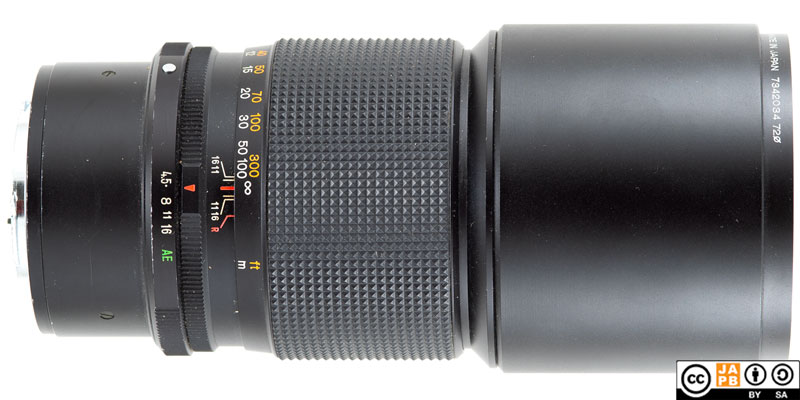
The table below summarises the lens’ key specifications. Measurements are based on the pictured sample:
| Brand: | Konica | Lens name | HEXANON AR 300 mm F4.5 |
| Focal length(s) 1 | 300 mm | Angle-of-view 2 | 8 ° |
| Maximum Aperture | f/4.5 | In Production | 1970–1987 |
| Lens mount | Konica AR | Subfamily (if applicable) | –– |
| Length 3 | 164 mm | Diameter 4 | 79,5 mm |
| Filter ring diameter | 72 mm | Weight | 935 grams |
| Lens element count | 8 | Lens group count | 5 |
| Aperture blades (S/R/C) 5 | 6 S | Focus throw | 250 ° |
| Minimum focusing distance (measured) | 3,95 m | Maximum magnification (measured) | 1:9,8 |
| Has manual aperture ring | YES | Has Manual focus ring | YES |
| Aperture mechanism type | Automatic | Aperture click stops 6 | 4.5••8•11•16 |
Further notes:
• Konica only ever produced two 300 mm focal length tele lenses: this 300 mm f/4.5 (produced 1970–87) as well as the 300 mm f/6.3 FL7 (produced 1973–87).
• Somewhat surprisingly, this lens does not have a tripod mount.
• The lens lengthens considerably when focusing toward MFD, but the front of the lens (including filter threads) does not rotate.
• The lens has a well–proportioned built-in (pull-out) lens hood.
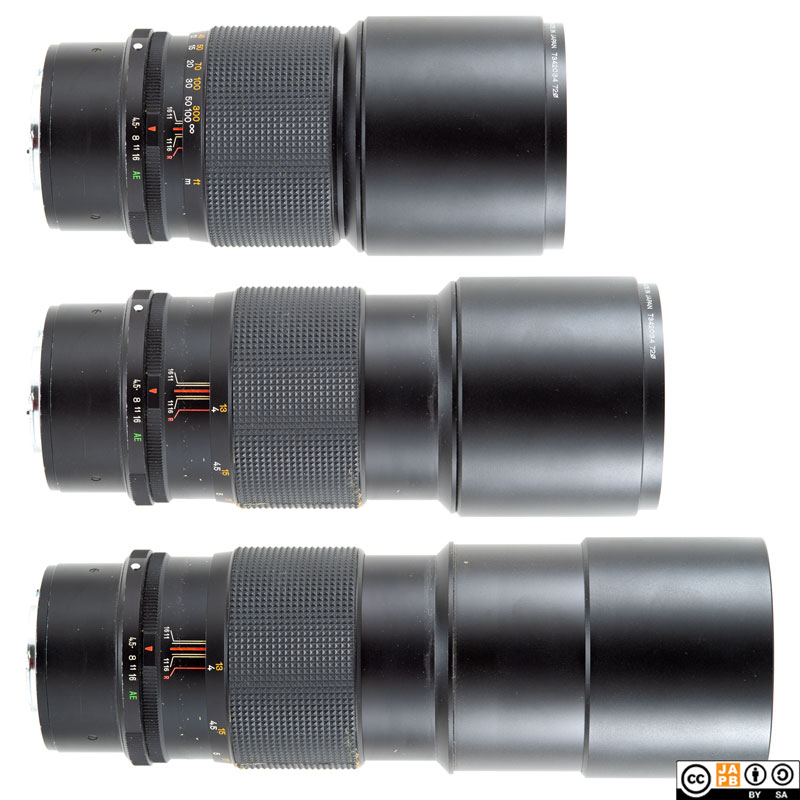
• Konica Hexanon AR 300 mm f/4.5 focused at infinity with lens hood retracted
• Konica Hexanon AR 300 mm f/4.5 focused at MFD with lens hood retracted
• Konica Hexanon AR 300 mm f/4.5 focused at MFD with lens hood extended.
• There are (technically) two versions of this lens, but the version shown above is by far more frequent. See ‘versions’ below for more details.
• All versions of the Konica Hexanon AR 300 mm f/4.5 are multicoated using Konica’s CDC coating.
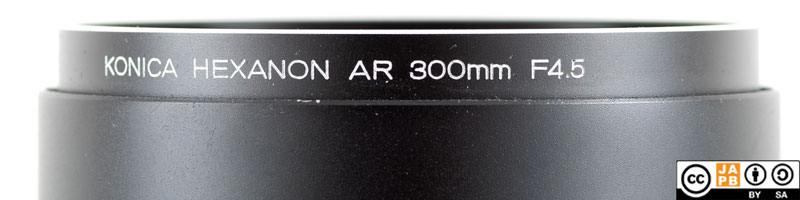
• Like many longer Konica lenses, the lens’ name is printed on the outside of the filter threads (not inside the filter threads).
Versions
This Konica lens was introduced 1970, right before Konica settled on a combination of allover matte-black colour and rubber focus rings. Hence, some of the earliest samples of this lens exist in what is referred to as a hybrid cosmetic scheme, combining the (earlier) aluminum ring with the (later) rubberised focus ring.
Version 1 (1970–≈1971)
• Aluminum band/ring between aperture ring and focus ring
• Rubber focus ring
Version 2 (≈1971–1987) (pictured lens)
• All-black exterior
• Rubber focus ring
History of Konica AR lenses
Konica is one of those names that will not ring any bells to those who’ve only recently started photographing, but for many years Konica was one of the ‘Great Japanese camera companies’.
After a short-lived and only moderately successful line of SLR cameras known as the Konica F-line (1960-1965), Konica hit pay dirt with the introduction of the Konica Auto-Reflex in 1965 and its new, Konica AR mount. The Auto-Reflex was at the time the first affordable system camera with integrated auto-exposure (albeit the exposure metering was not yet TTL). The Auto-Reflex was followed by a two lines of successful cameras – the more ambitious Autoreflex T-line and the more pedestrian Autoreflex A-line – before Konica (along with the rest of Japanese camera companies) stepped up the automation of their SLR cameras with the 1-series (FS-1, FC-1, FP-1, and FT-1).
But while Konica had often been at the forefront of automation (first shutter priority auto-exposure system, first SLR with integrated winder), Konica’s star had been waning, and Konica decided to not compete against the likes of Minolta, Nikon, Canon, and Pentax in autofocus technology. Instead Konica withdrew from SLR and SLR lens manufacture and focused on compacts and other optoelectronics. Two decades later Konica merged with Minolta to form KonicaMinolta, which subsequently sold its camera business to Sony. So, after a fashion, the DNA of Konica’s camera business lives on in Sony’s camera division.
Relevantly, the Konica AR mount had a relatively good and long (1965–1987) run, and stayed remarkably unchanged throughout. Hence, while Konica changed the design of their AR lenses during those years – moving towards lighter constructions, rubber focus rings, and a more modern look (for more detail, look here) – all AR lenses are physically entirely compatible with all AR-mount bodies.´
Adapting
n.B! The following applies to all Konica AR mount lenses.
This lens cannot be used natively on any current SLR or dSLRs. To use it in its native environment, you will need a Konica AR-mount film body.
Thanks to being a fully manual lens (manual aperture, manual focus), the lens can be adapted to all mirrorless cameras using a suitable adapter. Moreover, Konica AR lenses are so uncomplicated that a simple ‘dumb adapter’ will do the job perfectly. However, due to Konica AR lenses not being among the most numerously manufactured, special adapters (helicoid adapters, tilt/shift adapters) are not easy to come by and speed boosters are currently unavailable.
Using Konica AR lenses on dSLRs is possible, but difficult. Due to the exceptionally short flange focal distance of the Konica AR mount (at 40,5 mm, a lot shorter than that of any full-frame dSLR mount), any adapter will necessitate some optics to achieve anything near infinity focus.
Footnotes
- Focal length is (unless stated otherwise) given in absolute terms, and not in Full-frame equivalent. For an understanding of whether the lens is wide/tele, see ‘Angle-of-view’. ↩︎
- Picture angle is given in degrees (based on manufacturers’ specs) and concerns the diagonal picture angle. Rule of thumb:
> 90 ° ==> Ultra-wide-angle
70–90 ° ==> Wide-angle
50–70 ° ==> Moderate wide-angle
40–50 ° ==> ‘Standard’ or ‘normal’ lens
20–40 ° ==> Short tele lens
10-20 ° ==> Tele lens
5-10 ° ==> Long tele lens
< 5 ° ==> Ultra-tele lens ↩︎ - Length is given from the mount flange to the front of lens at infinity. ↩︎
- Diameter excludes protrusions such as rabbit ears or stop-down levers. ↩︎
- S=straight; R=rounded; C=(almost)circular at all apertures. ↩︎
- Numbers equal aperture values on aperture ring; • intermediate click; – no intermediate click. ↩︎
- The Konica FL-Hexanon AR 300/6.3 FL is special in that it uses a fluorite element to achieve a very compact build in combination with exceptional handling of chromatic aberrations. ↩︎