Pekka Buttler, 06/2026
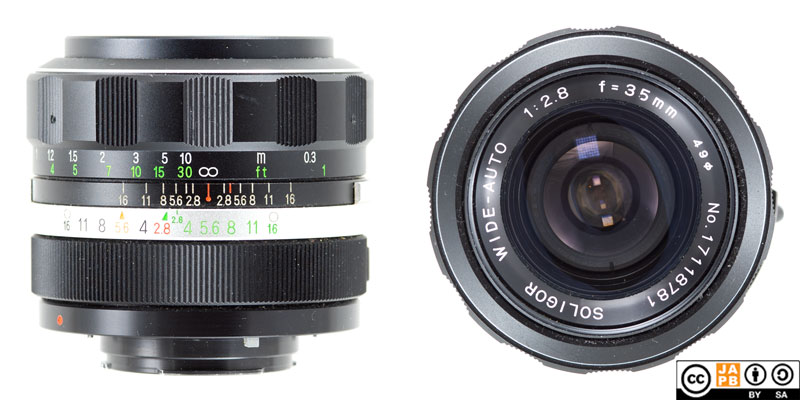
Specifications
The table below summarises the lens’ key specifications (measurements based on pictured sample):
| Brand: | Soligor | Lens name | wide-auto 1:2.8 f=35mm |
| Focal length(s) 1 | 35 mm | Angle-of-view 2 | 63 ° |
| Maximum Aperture | f/2.8 | In Production | Likely 1969–1974 |
| Lens mounts (this lens) | Topcon/Exakta | Other lens mounts3 | Several (T4) |
| Length 4 | 55,0 mm | Diameter 5 | 66,0 mm |
| Filter ring diameter | 49 mm | Weight | 262 grams |
| Lens element count | 6 | Lens group count | 5 |
| Aperture blades (S/R/C) 6 | 8 S7 | Focus throw | 330 ° |
| Minimum focusing distance | 32 cms | Maximum magnification (measured) | 1:6,3 |
| Has manual aperture ring | YES | Has manual focus ring | YES |
| Aperture mechanism type | Automatic | Aperture click stops 8 | 2.8•4•5.6•8•11-16 |
Further notes:
• This lens uses the T4 interchangeable lens mount (which Vivitar called the T-4 mount). As such it can be mounted on any camera for which a T4/T-4 adapter is available.
• It is important to remember that Soligor (a brand of the Allied Impex Corp) was not a lens manufacturer, but a marketing&sales organisation and that all ‘Soligor’ lenses were manufactured by various Japanese optic companies, including both well-known names such as Tokina, Tamron and Kowa, as well as less well-known companies such as Kobori, Kyoei Acall and Itoh (for a full list of Soligor lens makers, see the Allied Impex company profile.
• As indicated by this lens’ serial number, this lens is a Tokina manufactured lens. The same lens was also offered by Vivitar, but it does not seem that Tokina ever sold this lens under its own brand (unlike some other T-4 lenses)
Versions
Notwithstanding that the same lens exists both under the Vivitar brand, I have not found any evidence of more than one version or variant of this lens having been made
Adapting
Given that this lens uses an intermediate mount, the first step is to either identify which adapter comes fitted to your lens.
Alternatively, if your copy came without a fitted adapter, you need to procure one.
In that case my recommendation is to get a M42 or Nikon F adapter10.
Next we will assume you have this lens with an M42 adapter (which was back then the most popular and therefore likeliest solution today) If you have this lens with any of the other film camera mounts (typical for the 1960s), please see the article on the respective mount for advice on how to adapt: Canon FD, Exakta, Konica AR, Minolta SR, Miranda, Nikon F, Petri FT
On dSLRs
If you have a Canon EF, Pentax K or Sony/Minolta A dSLR, and you have this lens with an M42 adapter ring, you can adapt your lens using a simple adapter ring. However, metering will only work in stop-down mode.
If your dSLR is uses a Nikon F mount or if your lens’ adapter ring is of any other type, adapting will only work using an adapter with corrective optics to make up for the negative flange focal distance difference.
On Mirrorless
Assuming you already have an M42 adapter ring on your lens, the only thing that you need is an adapter from M42 to your mirrorless mount. Thanks to being a fully manual lens (manual aperture, manual focus), a simple dumb adapter is sufficient for photography. However, because this lens is an auto-aperture only lens (it does not have a selector for manual aperture), your adapter should be of the type with an internal flange to keep the stop-down pin pressed in (see more on the distinction in the JAPB article on the M42 mount).
On Film
Whatever adapter ring you have on your lens, you’re sure to be able to find a film camera to mount this lens on..
This lens cannot be used natively on any current SLR or dSLRs. To use it in its native environment, you will need a Canon FD or FL-mount film body.
Thanks to being a fully manual lens (manual aperture, manual focus), the lens can be adapted to all mirrorless cameras using a suitable adapter. However, for the adapter to allow the lens to stop down, you will need an adapter that can be set to engage the FD lens’ aperture control lever.
Moreover, a large range of special adapters (helicoid adapters, tilt/shift adapters, speed boosters) for using Canon FD lenses on most mirrorless systems are available.
Using Canon FD lenses on dSLRs is a possibility, but is not problem free. Thanks to the relatively short flange focal distance of the Canon FD mount (at 42,0 mm, clearly shorter than that of any full-frame dSLR mount), any adapter will necessitate some corrective optics to achieve infinity focus.
Footnotes
- Focal length is (unless stated otherwise) given in absolute terms, and not in Full-frame equivalent. For an understanding of whether the lens is wide/tele, see ‘Angle-of-view’. ↩︎
- Picture angle is given in degrees and concerns the diagonal picture angle. Rule of thumb:
> 90 ° ==> Ultra-wide-angle
70–90 ° ==> Wide-angle
50–70 ° ==> Moderate wide-angle
40–50 ° ==> ‘Standard’ or ‘normal’ lens
20–40 ° ==> Short tele lens
10-20 ° ==> Tele lens
5-10 ° ==> Long tele lens
< 5 ° ==> Ultra-tele lens ↩︎ - JAPB is here listing only those adapters that we have seen with our own eyes, but other period-typical adapters can also have existed. ↩︎
- Length is given from the mount flange to the front of lens at infinity. ↩︎
- Diameter excludes protrusions such as rabbit ears or stop-down levers. ↩︎
- S=straight; R=rounded; C=(almost)circular at all apertures. ↩︎
- Aperture shape is ‘ninja star’ from f/4 to f/11. ↩︎
- Numbers equal aperture values on aperture ring; • intermediate click; – no intermediate click. ↩︎