Pekka Buttler, 02/2026
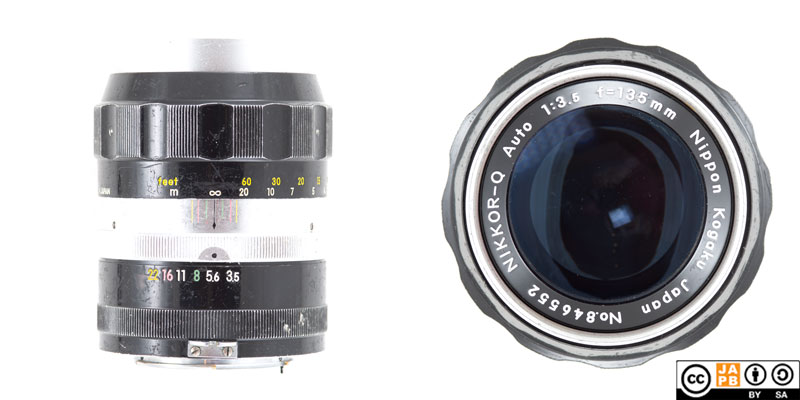
Specifications
The table below summarizes the lens’ key specifications:
| Brand: | Nikon (Nippon Kogaku) | Lens name | Nikkor-Q Auto 1:3.5 f=135mm |
| Focal length(s) 1 | 135 mm | Angle-of-view 2 | 18 ° |
| Maximum Aperture | f/3.5 | In Production | 1966–1969 |
| Lens mount | Nikon F | Subfamily (if applicable) | Pre-Ai (F-type) |
| Length 3 | 85,2 mm | Diameter 4 | 65,9 mm |
| Filter ring diameter | 52 mm | Weight | 383 grams |
| Lens element count | 4 | Lens group count | 3 |
| Aperture blades (S/R/C) 5 | 6 S | Focus throw | 220 ° |
| Minimum focusing distance (measured) | 150 cms | Maximum magnification (measured) | 1:9 |
| Has manual aperture ring | YES | Has Manual focus ring | YES |
| Aperture mechanism type | Automatic | Aperture click stops 6 | 3.5-5.6-8-11-16-22 |
Further notes:
• This lens is a relatively early sample of Nikon’s 135 mm f/3.5 lenses. Its design (silver rings at rear and front) mark it out as a F-type lens. (See more under ‘versions’).
Versions
Nikon has manufactured 135 mm f/3.5 lenses for the Nikon F system from the earliest beginnings to 1983. The lineage of Nikkor 135 mm f/3.5 lenses is summarised below
| Years | Type | Name | Mainline specifications | Optical design | Blades | MFD | Notes |
|---|---|---|---|---|---|---|---|
| 1959–69 | F-type | Nippon Kogaku | 13,5 cm f/3.5 | 4 elements 3 groups | 9, 6 | 1,5 m | this lens* |
| 1969–73 | F-type | Nikon | 135 mm f/3.5 | 4 elements 3 groups | 7 | 1,5 m | |
| 1973–75 | C-type | Nikon | 135 mm f/3.5 | 4 elements 3 groups | 7 | 1,5 m | |
| 1975–77 | K-type | Nikon | 135 mm f/3.5 | 4 elements 3 groups | 7 | 1,5 m | |
| 1977–1981 | Ai-type | Nikon | 135 mm f/3.5 | 4 elements 4 groups | 7 | 1,3 m | [data sheet] |
| 1981–83 | Ai-s type | Nikon | 135 mm f/3.5 | 4 elements 4 groups | 7 | 1,3 m |
* Note that this lens (pictured sample combines traits from the first two versions. Its name ring says Nippon Kogaku, but has already moved from reporting its focal length in centimetres to millimetres. Because of its unmistakable 6-blade design, it is however clearly a first-version lens (albeit a very late sample)
A brief genealogy of Nikon SLR lens types
Nikon is undoubtedly one of the great names in 35 mm SLR photography. The Nikon F mount has been in continuous production since 1959. During that time, the mount has developed/changed in some detail, however without ever fully sacrificing compatibility.
In short (a longer version is here), the development of Nikon’s SLR lenses can be traced as follows:
• 1959–1977: Pre-Ai. Manual focus lenses that use ‘rabbit ears’ to communicate selected aperture with the camera body. Pre-Ai lenses can further be subdivided into
• F-type (1959–early 1970s: metal focus ring and single-coated),
• C-type (early 1970s–mid 1970s: metal focus ring and multicoated), and
• K-type (mid 1970s to 1977: rubber focus ring and multicoated).
A significant share of remaining Pre-Ai lenses have since been converted to Ai-spec (Ai’d)
• 1977–1986: Ai and Ai-s. Manual focus lenses that may have ‘rabbit ears’ for backward compatibility, but are designed to communicate selected aperture with the camera body through indentations in base of aperture control ring.
• 1986–today: AF and AF-D. Autofocus lenses that do not have a focusing motor within the lens, but rely on the focus motor within the camera. All AF and AF-D lenses are simultaneously Ai-s lenses (they are Ai-s lenses extended with AF) 7
• 1996–today AF-S and AF-P. Autofocus lenses that have an internal focusing motor and do not rely on the body having a focusing motor.
Adapting
There are good chances this lens can still be used natively:
• If the lens has been AI’d, this lens can be used natively on all current high-end Nikon dSLRs and several earlier medium-to-high-end older Nikon dSLRs 8 as well as all post-1977 Nikon Film cameras.
• If it is in its original Pre-Ai form, it can be used natively on the Nikon Df and on all Nikon F-mount film cameras produced before 1977.
Thanks to being a fully manual lens (manual aperture, manual focus), the lens can be adapted to all mirrorless cameras using a suitable dumb adapter (and such adapters are easy to find). Moreover, a large range of special adapters (helicoid adapters, tilt/shift adapters, speed boosters) for using Nikon F lenses on most mirrorless systems are available.
Using Nikon F lenses on non-Nikon SLRs and dSLRs is likewise a distinct possibility. Thanks to the relatively generous flange focal distance of the Nikon F mount (46,5 mm), adapter rings for all dSLR mounts are available as well as for a goodly portion of film-era SLR mounts. Such rings may not allow for auto aperture, but even then the lenses can be used in stop-down metering mode.
Footnotes
- Focal length is (unless stated otherwise) given in absolute terms, and not in Full-frame equivalent. For an understanding of whether the lens is wide/tele, see ‘Angle-of-view’. ↩︎
- Picture angle is given in degrees and concerns the diagonal picture angle. Rule of thumb:
> 90 ° ==> Ultra-wide-angle
70–90 ° ==> Wide-angle
50–70 ° ==> Moderate wide-angle
40–50 ° ==> ‘Standard’ or ‘normal’ lens
20–40 ° ==> Short tele lens
10-20 ° ==> Tele lens
5-10 ° ==> Long tele lens
< 5 ° ==> Ultra-tele lens ↩︎ - Length is given from the mount flange to the front of lens at infinity. ↩︎
- Diameter excludes protrusions such as rabbit ears or stop-down levers. ↩︎
- S=straight; R=rounded; C=(almost)circular at all apertures. ↩︎
- Numbers equal aperture values on aperture ring; • intermediate click; – no intermediate click. ↩︎
- There is a further sub-class of AF-D lenses called AF-I lenses that are otherwise AF-D lenses (meaning, fully Ai-s compatible), but have an internal focus motor. Only long tele lenses were made in AF-I variants. ↩︎
- As of this writing, the following Nikon dSLRs fully support Aperture priority and manual metered modes on Nikkor Ai lenses: D2, D3, D4, D5, D6, D200, D300, D300s, D500, D600, D610, D700, D750, D780, D800, D800E, D810, D850, D7000, D7100, D7200 ↩︎