Pekka Buttler, 01/2026
This lens was kindly provided for cataloguing by Vladimir at #photogears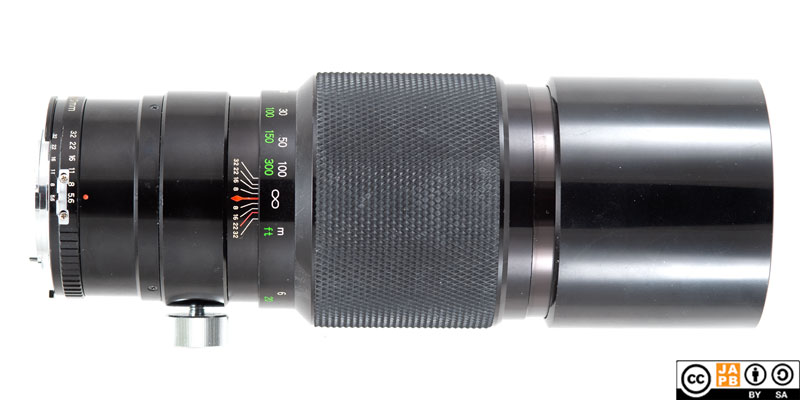
Specifications
The table below summarises the lens’ key specifications (measurements based on pictured, Canon FD mount sample):
| Brand: | Soligor | Lens name | Tele-Auto 400 mm f/5.6 MC |
| Focal length(s) 1 | 400 mm | Angle-of-view 2 | 6,2 ° |
| Maximum Aperture | f/5.6 | In Production | unknown |
| Lens mounts (this lens) | Nikon F (Ai) | Other lens mounts3 | Canon FD, Fujica X, Minolta SR, M42, Olympus OM, Pentax K |
| Length 4 | 239 mm | Diameter 5 | 78,6 mm |
| Filter ring diameter | 72 mm | Weight | 971 grams |
| Lens element count | 4 | Lens group count | 4 |
| Aperture blades (S/R/C) 6 | 6 S | Focus throw | 330 ° |
| Minimum focusing distance (indicated) | 141 cms | Maximum magnification (calculated) | 1:13 |
| Has manual aperture ring | YES | Has manual focus ring | YES |
| Aperture mechanism type | Automatic/manual | Aperture click stops 7 | 5.6•8•11•16•22-32 |
Further notes:
• This is a long tele lens sold by Soligor.
• The lens has a tripod collar that can be rotated (and locked using a tightening screw).
• The lens offers a built-in extendable hood that seems to offer rather good protection against stray light.
• It is important to remember that Soligor (a brand of the Allied Impex Corp) was not a lens manufacturer, but a marketing&sales organisation and that all ‘Soligor’ lenses were manufactured by various Japanese optic companies, including both well-known names such as Tokina, Tamron and Kowa, as well as less well-known companies such as Kobori, Kyoei Acall and Itoh (for a full list of Soligor lens makers, see the Allied Impex company profile.
• As indicated by this lens’ serial number, this lens is manufactured by Sun Optical. ´
Versions
I have not found any evidence of more than one version or variant of this lens having been made. I have seen different types of tightening screw arrangements, but that might simply indicate that some lenses have lost their tightening screw and another type of screw has been installed.
Adapting
We’re going to discuss adapting Nikon F lenses (because the pictured sample has a Nikon F mount. If your copy of the Soligor 400/5.6 has another mount, please refer to the JAPB article on your lens’ mount: Canon FD, Fujica X, Minolta SR, M42, Olympus OM, Pentax K
Adapting Nikon F mount, Ai compatible lenses
Besides adapting, this lens can be used natively on all current high-end Nikon dSLRs and several earlier medium-to-high-end older Nikon dSLRs8. Likewise, if it still has its rabbit ears, it can be natively used on all Nikon F-mount film cameras ever produced (without the rabbit ears, it is limited to post 1977 bodies).
Thanks to being a fully manual lens (manual aperture, manual focus), the lens can be adapted to all mirrorless cameras using a suitable dumb adapter (and such adapters are easy to find). Moreover, a large range of special adapters (helicoid adapters, tilt/shift adapters, speed boosters) for using Nikon F lenses on most mirrorless systems are available.
Using Nikon F lenses on non-Nikon SLRs and dSLRs is likewise a distinct possibility. Thanks to the relatively generous flange focal distance of the Nikon F mount (46,5 mm), adapter rings for all dSLR mounts are available as well as for a goodly portion of film-era SLR mounts. Such rings may not allow for auto aperture, but even then the lenses can be used in stop-down metering mode.
Footnotes
- Focal length is (unless stated otherwise) given in absolute terms, and not in Full-frame equivalent. For an understanding of whether the lens is wide/tele, see ‘Angle-of-view’. ↩︎
- Picture angle is given in degrees and concerns the diagonal picture angle. Rule of thumb:
> 90 ° ==> Ultra-wide-angle
70–90 ° ==> Wide-angle
50–70 ° ==> Moderate wide-angle
40–50 ° ==> ‘Standard’ or ‘normal’ lens
20–40 ° ==> Short tele lens
10-20 ° ==> Tele lens
5-10 ° ==> Long tele lens
< 5 ° ==> Ultra-tele lens ↩︎ - JAPB is here listing only those adapters that we have seen with our own eyes, but other period-typical adapters can also have existed. ↩︎
- Length is given from the mount flange to the front of lens at infinity. ↩︎
- Diameter excludes protrusions such as rabbit ears or stop-down levers. ↩︎
- S=straight; R=rounded; C=(almost)circular at all apertures. ↩︎
- Numbers equal aperture values on aperture ring; • intermediate click; – no intermediate click. ↩︎
- As of this writing, the following Nikon dSLRs fully support Aperture priority and manual metered modes on Nikkor Ai/Ai-s lenses: D2, D3, D4, D5, D6, D200, D300, D300s, D500, D600, D610, D700, D750, D780, D800, D800E, D810, D850, D7000, D7100, D7200 ↩︎