Pekka Buttler, 03/2026
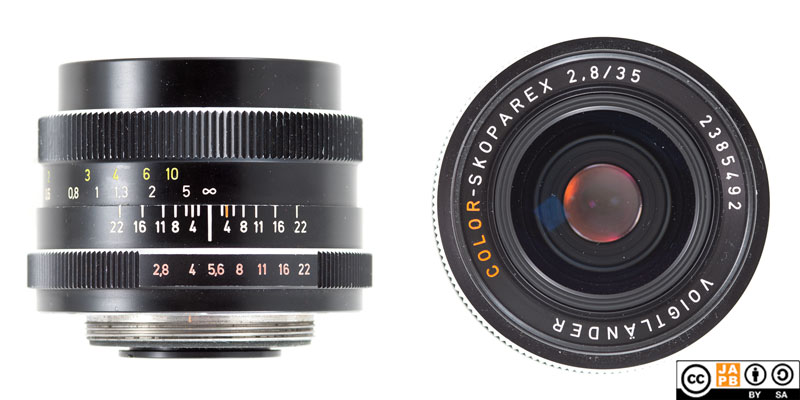
Specifications
The table below summarizes the lens’ key specifications (Measurements based on pictured sample):
| Brand: | Voigtländer | Lens name | Color-Skoparex 2.8/35 |
| Focal length(s) 1 | 35 mm | Angle-of-view 2 | 63 ° |
| Maximum Aperture | f/2.8 | In Production | 1972–1976 (M42 version) 1970–1981 (all versions) |
| Lens mount (this sample) | M42 | Other lens mounts | Rollei QBM |
| Length 3 | 44,6 mm | Diameter 4 | 62,2 mm |
| Filter ring diameter | N/A | Weight | 201 grams |
| Lens element count | 5 | Lens group count | 5 |
| Aperture blades (S/R/C) 5 | 1: | Focus throw | 120 ° |
| Minimum focusing distance | 40 cms | Maximum magnification | 1:7,3 |
| Has manual aperture ring | YES | Has Manual focus ring | YES |
| Aperture mechanism type | Automatic | Aperture click stops | 2.8-4-5.6-8-11-16 |
Please Note:
• This lens is part of a trio of lenses:
• The Carl Zeiss Distagon 35/2.8 (for Rollei QBM & M42) is the original design. There are two variants of this lens: an early variant (1970) without Rollei HFT coating and a later version with Rollei HFT coating. Both versions were made by Carl Zeiss in West Germany.
• The Rollei-HFT Distagon 35/2.8 (for Rollei QBM & M42) is the same lens, made by Rollei under license from Carl Zeiss. Early copies were made in West Germany. Later production was shifted to Singapore.
• This Voigtländer Color Skoparex 35/2.8 (Rollei QBM and M42) is again the same lens, made by Rollei under license from Carl Zeiss. Production was in Singapore6.
• Later in the life of the Rolleiflex 35 system Rollei needed to cut costs further and started offering Mamiya-made lenses for their cameras, and these often have surprisingly similar names. Hence, the Voigtländer Color Skoparex AR 35/2.8 and the Rolleinar-MC 35/2.8 are again the same lens (while also being optically the same lens as the Auto Mamiya/Sekor SX 35/2.8) but are very different from this lens.
Other notes:
• The M42 version of the lens is an auto-only lens, meaning that it does not have a switch to choose between manual and automatic modes. This has implications on adapting (see below).
Historical notes:
• Rollei launched its 35 mm SLR lineup (generally referred to as the ‘Rollei SL35’ line) in 1970. With Rollei being a camera company and with Carl Zeiss (west) struggling with its failing camera line and needing to find some way to sell lenses, the combination of a Rollei camera and Carl Zeiss lenses could have been a match made in heaven.
• Problematically the Rollei SLR cameras offered little that the competition did not also offer and was often lagging behind the competition. Rollei’s decision to – from the start – launch its own bayonet mount was not a fully trouble-free decision as it limited the system’s appeal for those consumers who would have liked to buy a Rollei camera but not need to buy a set of expensive Zeiss lenses.
• Rollei bought the assets of Voigtländer from Carl Zeiss in 1974. Because there were several markets where the Voigtländer brand had more appeal than the Rollei brand, Rollei made the tactical decision to start selling cameras and lenses under the Voigtländer brand. Hence, the same gear can turn up in different places under different names.
• As part of Voigtländer’s assets was the Zeiss Ikon SL706 camera (the last of the Zeiss Ikon Icarex line), which Rollei quickly repurposed as the Voigtländer VSL-1. Besides having different origins, that camera differed in that it used the M42 lens mount (with the Zeiss Ikon extensions).
• For some years Rollei sold both Rollei-designed cameras and Carl Zeiss/Voigtländer designed cameras side-by-side, hence also supporting two mounts. This changed when in 1976 Rollei decided to double-down on its proprietary bayonet mount.
• After its 1981 bankruptcy and restructuring Rollei quit using the Voigtländer name. Any copied of the same lens manufactured thereafter would have been sold as ‘Rollei’ lenses.
Versions
• The Voigtländer Color-Skoparex 35 mm f/2.8 lens is available both using the Rollei QBM mount as well as using M42 mount (with Zeiss Ikon’s proprietary extensions, see below)
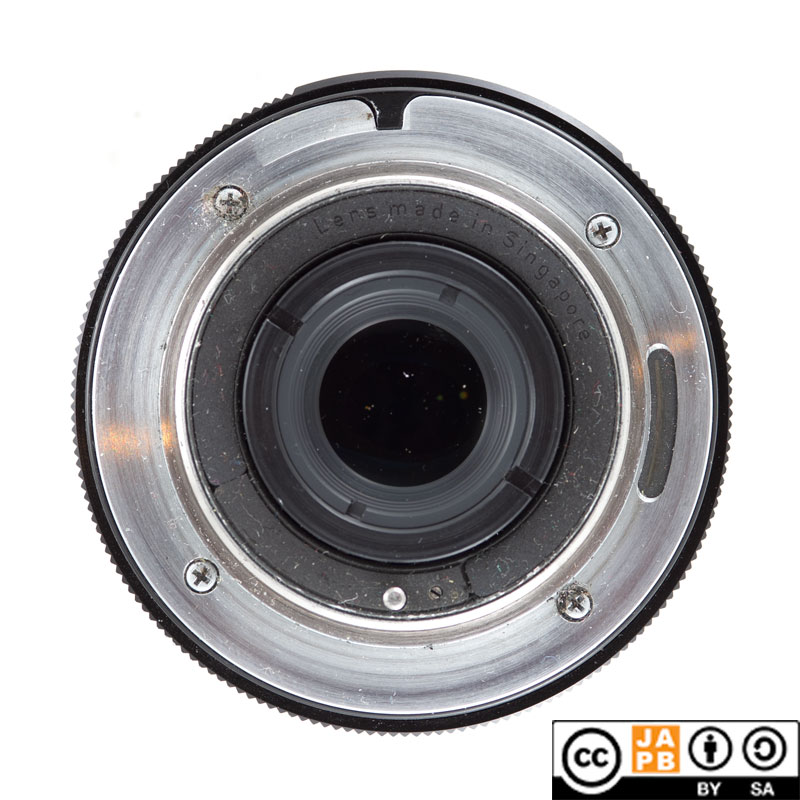
For more details on this implementation of the M42 mount, see here
Adapting
Adapting M42 versions of this lens:
This lens cannot be used natively on any current SLR or dSLRs. To use it in its native environment, you will need an M42-mount film body. Luckily there are a lot of those available and in working order.
Thanks to being a fully manual lens (manual aperture, manual focus), the lens can be adapted to all mirrorless cameras using a suitable adapter. Moreover, M42 lenses are so uncomplicated that a simple ‘dumb adapter’ will do the job perfectly. However, your M42 adapter must be of the type to activate the M42 stop-down pin as you will not be able to stop down the lens otherwise.
Further, due to the popularity of the M42 mount, special adapters (helicoid adapters, tilt/shift adapters) are readily available. Alternatively, one can choose to daisy-chain adapters (e.g. M42->Canon EF; Canon EF –> mirrorless) which also opens up a wide range of speed boosters .
Using M42 lenses on dSLRs can also be an easy option, depending on which dSLR.
• Canon EF has the shortest flange focal distance among full-frame dSLR’s and Canon’s wide range of dSLRs are able to mount M42 lenses perfectly, using a simple adapter ring.
• Minolta / Sony A dSLRs and Pentax dSLRs are likewise able to mount M42 lenses using a simple adapter ring.
• Nikon F dSLRs have a long flange focal distance, meaning that mounting M42 lenses needs an adapter that uses corrective optics to allow anything close to infinity focus.
Adapting Rollei QBM versions of this lens:
This lens cannot be used natively on any current SLR or dSLRs. To use it in its native environment, you will need an Rollei QBM-mount film body. Luckily there are still some of those available and in working order.
Thanks to being a fully manual lens (manual aperture, manual focus), the QBM lenses can be adapted to all mirrorless cameras using a suitable adapter. Moreover, QBM lenses are so uncomplicated that a simple ‘dumb adapter’ will do the job perfectly.
However, due to the relatively low popularity of the QBM mount, special adapters (helicoid adapters, tilt/shift adapters) are only rarely available. Alternatively, one can choose to daisy-chain adapters (e.g. QBM->Canon EF; Canon EF –> mirrorless) which also opens up a wide range of speed boosters.
Using QBM lenses on dSLRs can also be an easy option, depending on which dSLR.
• Canon EF has the shortest flange focal distance among full-frame dSLR’s and Canon’s wide range of dSLRs are able to mount QBM lenses perfectly, using a simple adapter ring.
• Other dSLRs (Minolta / Sony A dSLRs, Pentax dSLRs and Nikon F dSLRs) have a longer flange focal distance, meaning that mounting QBM lenses needs an adapter that uses corrective optics to allow anything close to infinity focus.
Footnotes
- Focal length is (unless stated otherwise) given in absolute terms, and not in Full-frame equivalent. For an understanding of whether the lens is wide/tele, see ‘Angle-of-view’. ↩︎
- Picture angle is given in degrees (based on manufacturers’ specs) and concerns the diagonal picture angle. Rule of thumb:
> 90 ° ==> Ultra-wide-angle
70–90 ° ==> Wide-angle
50–70 ° ==> Moderate wide-angle
40–50 ° ==> ‘Standard’ or ‘normal’ lens
20–40 ° ==> Short tele lens
10-20 ° ==> Tele lens
5-10 ° ==> Long tele lens
< 5 ° ==> Ultra-tele lens ↩︎ - Length is given from the mount flange to the front of lens at infinity. ↩︎
- Diameter excludes protrusions such as rabbit ears or stop-down levers. ↩︎
- S=straight; R=rounded; C=(almost)circular at all apertures. ↩︎
- At least, I have not found a single copy that would say ‘Made in Germany’. ↩︎