Pekka Buttler, 01/2026
This lens was kindly provided for cataloguing by Vladimir at #photogears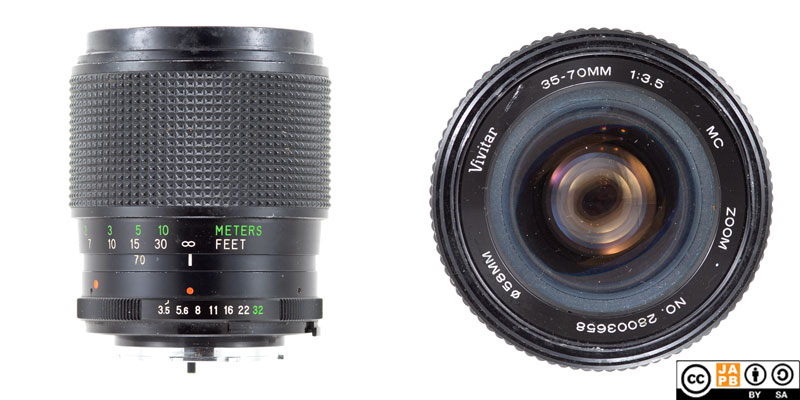
Specifications
The table below summarizes the lens’ key specifications (measurements based on pictured, last version of the lens):
| Brand: | Vivitar | Lens name | 35–70mm 1:3.5 MC ZOOM |
| Focal length(s)1 | 35-70 mm | Angle-of-view2 | 63 ° – 34 ° |
| Maximum Aperture | f/3.5 | In Production | 1981–? 3 |
| Lens mount (this lens) | Minolta SR | Other lens mounts | multiple4 |
| Length5 | 77,8 mm | Diameter6 | 68,5 mm |
| Filter ring diameter | 58 mm | Weight | 431 grams |
| Lens element count | 8 | Lens group count | 8 |
| Aperture blades (S/R/C)7 | 6 S | Focus throw | ca. 180 ° |
| Minimum focusing distance (indicated) | 75 cms | Maximum magnification (calculated) | 1:9 |
| Has manual aperture ring | YES | Has Manual focus ring | YES |
| Aperture mechanism type | Auto | Aperture click stops 8 | 3.5-4•5.6•8•11•16•22-32 |
Further notes:
• The mainline specifications of this zoom – especially the unchanging and rather wide maximum aperture – mark this lens as more than a kit zoom.
• This lens was manufactured for Vivitar by Komine and while its introduction can be placed in the early 1981, it is unclear when Vivitar stopped selling it.
• Komine made also another 35–70 lens for Vivitar, this with a variable (but brighter) maximum aperture of f/2.8–3.8 and a close-focusing function. Records show that this second Komine for Vivitar lens was launched 1982. Whether the later replaced the earlier in Vivitar’s lineup or whether they stayed on side by side is unclear.
• As with many lenses made by Komine for Vivitar, it seems this lens never made an appearance under another brand.
• The Vivitar 35–70/3.5 is a one-ring, push-pull zoom. Its zooming action is reversed, meaning that you push forward for a wider angle-of-view (which is rather typical for many similar lenses of this era).
• The lens lengthens considerably on zooming, and lengthens a bit more when focusing towards MFD.
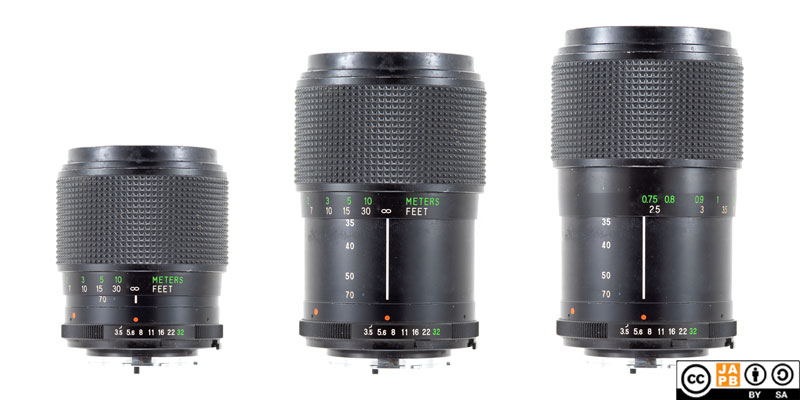
Centre: Vivitar 35–70/3.5 @ 35 mm and infinity
Right: Vivitar 35–70/3.5 @ 35 mm and MFD
Versions and variations
Vivitar only ever sold one lens with the 35–70/3.5 specifications and there is nothing to indicate that there would be more than one ergonomic/cosmetic/optical version of this lens.
Also, this exact lens seems to never have been sold under another brand than Vivitar.
History of Vivitar
Vivitar initially was the trade name used by Ponder & Best Inc. until Ponder & Best changed its name to Vivitar Corp. From the 1960s to the early 2000s the company contracted various (mostly Japanese) optical and electronics manufacturers to manufacture photographic gear to be branded as Vivitar.
You can read more details in the Vivitar company profile.
Adapting
We’re discussing the adapting of Minolta SR mount lenses. If your copy of this lens uses another lens mount, please check the adapting tips on the JAPB pages of the other lens mounts: Canon FD, Contax/Yashica, Konica AR, M42, Nikon F, Olympus OM and Pentax K
This lens cannot be used natively on any current SLR or dSLRs. To use it in its native environment, you will need a Minolta SR (SR/MC/MD/X-600) film camera. Luckily these are quite easy to find. To use the lens’ full designed capabilities, a Minolta MD-compatible body (any Minolta SR body launched after 1977) is most recommended..
Thanks to being a fully manual lens (manual aperture, manual focus), the lens can be adapted to all mirrorless cameras using a suitable adapter. Moreover, a simple ‘dumb adapter’ will do the job perfectly. Thanks to the popularity of the Minolta SR mount, the availability of adapters to all mirrorless mounts can be taken for granted, on the other hand, specialist adapters (speed boosters, helicoid adapters, tilt/shift adapters) are not available for all mirrorless mounts, but daisy-chaining adapters (e.g. Minolta SR -> Canon EF; Canon EF –> mirrorless) can offer a work-around.
Using Minolta SR mount lenses on dSLRs is also be an option, but it is not trouble-free due to that the Minolta SR mount’s flange focal distance is shorter than that of any dSLR mount (technically with the exception of Olympus’ four thirds mount). Hence, any attempt at adapting Minolta SR lenses must rely on an adapter that uses corrective optics to allow infinity focus. However, such adapters are readily available.
Footnotes
- Focal length is (unless stated otherwise) given in absolute terms, and not in Full-frame equivalent. For an understanding of whether the lens is wide/tele, see ‘Angle-of-view’. ↩︎
- Picture angle is given in degrees (based on manufacturers’ specs) and concerns the diagonal picture angle. Rule of thumb:
> 90 ° ==> Ultra-wide-angle
70–90 ° ==> Wide-angle
50–70 ° ==> Moderate wide-angle
40–50 ° ==> ‘Standard’ or ‘normal’ lens
20–40 ° ==> Short tele lens
10-20 ° ==> Tele lens
5-10 ° ==> Long tele lens
< 5 ° ==> Ultra-tele lens ↩︎ - Information is sparse. ↩︎
- Including: Canon FD, Contax/Yashica, Konica AR, M42, Minolta SR, Nikon F, Olympus OM and Pentax K ↩︎
- Length is given from the mount flange to the front of lens at infinity. ↩︎
- Diameter excludes protrusions such as rabbit ears or stop-down levers. ↩︎
- S=straight; R=rounded; C=(almost)circular at all apertures. ↩︎
- Numbers equal aperture values on aperture ring; • intermediate click; – no intermediate click. ↩︎