Pekka Buttler, 01/2026
This lens was kindly provided for cataloguing by Vladimir at #photogears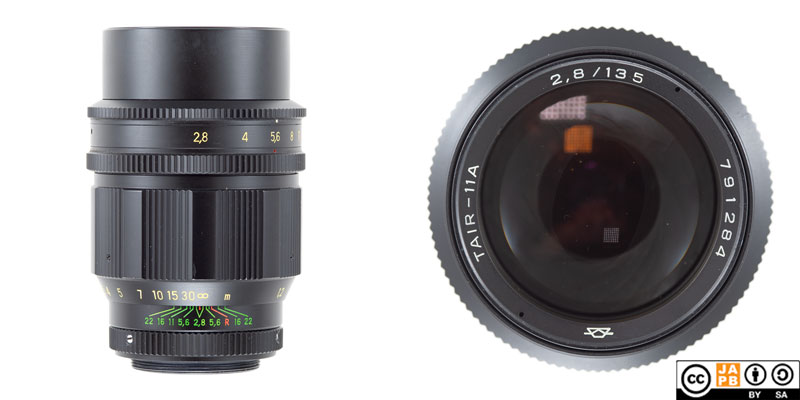
Specifications
The table below summarizes the lens’ key specifications (measurements based on pictured lens):
| Manufacturer: | KMZ | Lens name | Таир-11A / Tair-11A 2.8/135 |
| Focal length(s) 1 | 135 mm | Angle-of-view 2 | 18 ° |
| Maximum Aperture | f/2.8 | In Production | 1960–≈? (all variants) |
| Lens mounts (this lens) | M42 | Other lens mounts | Z39 |
| Length 3 | 104,2 mm | Diameter 4 | 70 mm |
| Filter ring diameter | 55 mm | Weight | 602 grams |
| Lens element count | 4 | Lens group count | 3 |
| Aperture blades (S/R/C) 5 | 20 S | Focus throw | 310 ° |
| Minimum focusing distance (indicated) | 1,2 m | Maximum magnification (calculated) | 1:6,7 |
| Has manual aperture ring | YES | Has Manual focus ring | YES |
| Aperture mechanism type | Preset | Preset click stops 6 | 2.8-4-5.6-8-11-16-22 |
Further notes:
• The Tair-11 is a classic interpretation of the Sonnar formula to create a large aperture medium tele lens.
• The initial design work for the Tair-11 was done already 1950, and an experimental batch was manufactured just in time for the 1958 Brussels world fair where a lineup of Soviet lenses including the Tair-11 was rewarded with the Grand prix. Serial production did however not begin before 1960.
• Initially the Tair-11 was manufactured mainly for the early Zenit SLRs that used the Zenit M39 (Z39) mount. Later another version was designed for the M42 mount (Tair-11-2).
• Finally a version was designed with the option of having interchangeable mounts, hence allowing the same lens to be sold with either Z39 or M42 mounts. That version of the Tair-11 is the Tair-11A (this lens).
Versions
There are three main versions of the Tair-11:
• Tair-11 for Z39 mount
• Tair-11-s for M42 mount
• Tair-11A for either Z39 or M42 mounts.
Besides these there are small batches and prototypes for everything cine and television cameras as well as the Start SLR’s bayonet mount. Also a multicoated variant was being planned…
In terms of cosmetic variants, the range is considerable (with the pictured sample being a representative of a rather late design), but in terms of basic functionality (preset aperture) and optical recipe (4 elements in 3 groups), no radical changes were made.
History of Tair and other Soviet lenses
If you’re interested, I recommend you read JAPB’s article about the Soviet lens ‘business’.
History of the Sonnar designs
The Sonnar designs were originally born out of necessity. Back before the invention of lens coating technology, each air-glass boundary represented a serious problem. Every air-glass boundary meant roughly 5% of the light that would hit such a boundary would be bounced back, instead of passing through the boundary. This not only meant that each air-glass boundary would decrease the amount of light that passed through the lens to the film plane, a goodly portion of that reflected light was liable to be bounced around within the lens, leading to veiling flare and loss of contrast. Hence, design a lens to minimise the number of lens groups was crucially important.
Until the invention of the Sonnar design, the only ways to produce large aperture lenses were based on the double-Gauss (a.k.a. Planar) and Ernostar designs, both of which were hampered by that the number of air-glass boundaries were relatively high (a minimum of 8). The Ernostar was the 1924 creation of the young (then only 23 years old) lens designer Ludwig Bertele for the company Ernemann. At the time of its launch it was – at f/2 – the fastest still camera lens in existence, and one year later Bertele bested his previous record with the f/1.8 Ernostar.
After Carl Zeiss acquired Ernemann in 1926, Ludwig Bertele continued pushing the boundaries and the Sonnar was a further development of the Ernostar. Not only did the Sonnar in 1932 manage to achieve an even larger maximum aperture (at f/1.5), it did so while simultaneously decreasing the number of lens groups to 3 (hence decreasing the number of air-glass boundaries to 6). It seemed like the perfect solution.
Bertele developed a range of Sonnar-based designs: Standard lenses for rangefinder cameras (that did not necessitate a long back focal length) and tele lenses (for both rangefinders and SLRs). Some of those tele lenses were relatively ‘ordinary’ in their headline specifications (e.g. 135 mm f/4) but ahead of other contemporary lenses in their image quality, whereas other designs were clearly aimed at producing exceptionally bright tele lenses (such as the 85/2 or 180/2.8).
Adapting
This chapter will discuss adapting the Z39 and M42 versions of the lens.
Adapting Z39 version
If you want to adapt a Z39 mount version of this lens, you have two options:
The easiest approach is to buy a Z39->M42 adapter ring and then treating the lens as if it was a M42 mount lens. While simple, and — theoretically – opening the door to adapting the lens also to some dSLR mounts (Canon EF, Pentax K), there is a possible problem in that the flange focal distance of the Z39 mount (45,2 mm) is ever so slightly shorter than that of the M42 mount (45,46 mm). This might therefore lead to your lens’ depth of field not quite reaching infinity unless you stop down a bit.
The other approach is to use a 16,4 mm long M39-thread extension tube to bridge the gap from Z39 to the Leica thread mount (LTM; 28,8mm) and then going from there to your mirrorless mount. While this does not allow adapting to SLRs, it is rather elegant. Eh?
Where – you might wonder – is one to find such a specific extension tube? Due to the fact that the Soviet lens industry was manufacturing both Leica thread mount cameras (FEDs and Zorkis) and Z39 SLRs (early Zenits), pretty much every soviet LTM/Z39 extension tube set contains an extension tube of that precise length 😉
Adapting M42 version
If you want to natively mount an M42 lens you need to find a functioning M42 mount film camera. Luckily that should be relatively easy as M42 bodies were produced in their millions and most of them lack features that are especially likely to have deteriorated to the point of making the entire camera inoperable. If your sample of this lens offers a switch to choose between auto- and manual aperture, I recommend using the lens on a body that is capable of stopping down the lens automatically and offers stop-down metering.
Adapting this lens to a mirrorless, full-frame digital camera is a breeze thanks to the lens having full manual controls (aperture ring, focus ring). You simply need a dumb adapter from M42 to your mirrorless system.
Due to the medium flange focal distance used by the M42 mount (45,46 mm), whether you can adapt this lens to dSLR/SLR mounts depends on which dSLR mount: Canon EF, Four Thirds, Minolta/Sony A and Pentax K can mount m42 lenses using a simple adapter ring. Nikon F on the other hand is not as problem-free, and – to retain anything near infinity focus – the adapter will necessitate corrective optics. In all cases, your camera will work only in stop-down metering.
Footnotes
- Focal length is (unless stated otherwise) given in absolute terms, and not in Full-frame equivalent. For an understanding of whether the lens is wide/tele, see ‘Angle-of-view’. ↩︎
- Picture angle is given in degrees (based on manufacturers’ specs) and concerns the diagonal picture angle. Rule of thumb:
> 90 ° ==> Ultra-wide-angle
70–90 ° ==> Wide-angle
50–70 ° ==> Moderate wide-angle
40–50 ° ==> ‘Standard’ or ‘normal’ lens
20–40 ° ==> Short tele lens
10-20 ° ==> Tele lens
5-10 ° ==> Long tele lens
< 5 ° ==> Ultra-tele lens ↩︎ - Length is given from the mount flange to the front of lens at infinity. ↩︎
- Diameter excludes protrusions such as rabbit ears or stop-down levers. ↩︎
- S=straight; R=rounded; C=(almost)circular at all apertures. ↩︎
- Numbers equal aperture values on aperture ring; • intermediate click; – no intermediate click. ↩︎