Pekka Buttler, 02/2026
Note, please: This data sheet covers two versions of the Soligor C/D 28/2.8 – both versions manufactured by Sun Optical. There were however many other lenses sold as “Soligor C/D 28 mm f/2.8”. Read on.
Early version
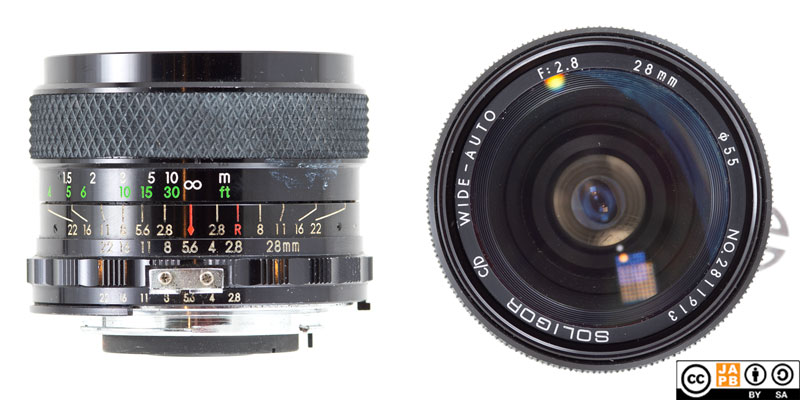
Specifications
| Brand: | Soligor | Lens name | C/D Wide-auto F:2.8 28mm |
| Focal length(s) 1 | 28 mm | Angle-of-view 2 | 75 ° |
| Maximum Aperture | f/2.8 | In Production | This version: 1980–81 All versions: 1977–95 |
| Lens mounts (this lens) | Nikon F | Other lens mounts3 | Canon FD, Contax/Yashica, Konica AR, M42, Minolta SR, Olympus OM, Pentax K |
| Length 4 | 46,5 mm | Diameter 5 | 63,2 mm |
| Filter ring diameter | 55 mm | Weight | 265 grams |
| Lens element count | 7 | Lens group count | 6 |
| Aperture blades (S/R/C) 6 | 6 S | Focus throw | 240 ° |
| Minimum focusing distance (measured) | 41 cms | Maximum magnification (measured) | 1:11,8 |
| Has manual aperture ring | YES | Has manual focus ring | YES |
| Aperture mechanism type | Automatic | Aperture click stops 7 | 2.8•4•5.6•8•11•16-22 |
Late version
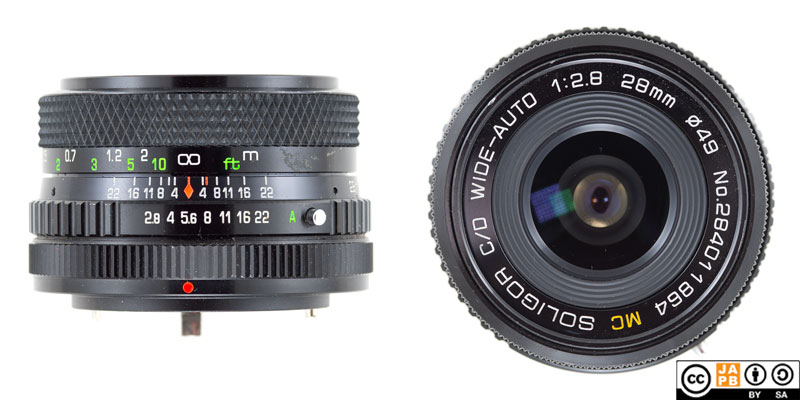
Specifications
The table below summarises the lens’ key specifications (measurements based on pictured, Canon FD mount sample):
| Brand: | Soligor | Lens name | C/D Wide-auto 1:2.8 28mm MC |
| Focal length(s) 1 | 28 mm | Angle-of-view 2 | 75 ° |
| Maximum Aperture | f/2.8 | In Production | This version: 1983–84 All versions: 1977–95 |
| Lens mounts (this lens) | Canon FD | Other lens mounts3 | Contax/Yashica, Konica AR, M42, Minolta SR, Nikon F, Olympus OM, Pentax K |
| Length 4 | 39,1 mm | Diameter 5 | 63,0 mm |
| Filter ring diameter | 49 mm | Weight | 186 grams |
| Lens element count | 6 | Lens group count | 6 |
| Aperture blades (S/R/C) 6 | 6 S | Focus throw | 150 ° |
| Minimum focusing distance (measured) | 29,5 cms | Maximum magnification (measured) | 1:7,8 |
| Has manual aperture ring | YES | Has manual focus ring | YES |
| Aperture mechanism type | Automatic | Aperture click stops 7 | 2.8•4•5.6•8•11•16-22 |
Further notes:
• These lenses are part of Soligor’s “C/D” line of lenses that were (at the time) Soligor’s premium offering.
• Soligor seems to never have been very clear on the exact meaning of “C/D”. While the majority understanding seems to be that “C/D” stands for “Computer Designed” there is also a persistent alternative version indicating that “C/D” indicates “Compact Design”.
• It is important to remember that Soligor (a brand of the Allied Impex Corp) was not a lens manufacturer, but a marketing&sales organisation and that all ‘Soligor’ lenses were manufactured by various Japanese optic companies, including both well-known names such as Tokina, Tamron and Kowa, as well as less well-known companies such as Kobori, Kyoei Acall and Itoh (for a full list of Soligor lens makers, see the Allied Impex company profile.
Versions
As mentioned above, over the years a wide range of lenses were sold under the “Soligor C/D 28 mm f/2.8” moniker. Those listed below are the ones I have been able to spot (including some I have only seen online). Information on ‘year’ is based on serial numbers spotted.
| Name engraved | Year | Manufacturer | Filter thread diameter | |
|---|---|---|---|---|
| SOLIGOR C/D 28mm 1:2.8 | 1977 | Tokina | 52 mm | |
| SOLIGOR C/D WIDE-AUTO F:2.8 28mm | 1980–81 | Sun Optical | 55 mm | (pictured above) |
| SOLIGOR C/D WIDE-AUTO F:2.8 28mm | 1981–82 | Sun Optical | 49 mm | |
| MC SOLIGOR C/D WIDE-AUTO 1:2.8 28mm | 1982–83 | Komine | 49 mm | |
| MC SOLIGOR C/D WIDE-AUTO 1:2.8 28mm | 1983–84 | Sun Optical | 49 mm | (pictured above) |
| MC SOLIGOR C/D WIDE-AUTO 1:2.8 f=28mm | 1985–90 | Tokina | 49 mm | |
| MC SOLIGOR C/D WIDE-AUTO 1:2.8 f=28mm | 1992-95 | Kobori | 49mm |
Adapting
This article will discuss adapting a lens that has the Canon FD mount. Should your copy of the lens have another mount, please see the JAPB articles on the other relevant mounts: Contax/Yashica, Konica AR, M42, Minolta SR, Nikon F, Olympus OM, Pentax K.
This lens cannot be used natively on any current SLR or dSLRs. To use it in its native environment, you will need a Canon FD-mount film body.
Thanks to being a fully manual lens (manual aperture, manual focus), the lens can be adapted to all mirrorless cameras using a suitable adapter. However, for the adapter to allow the lens to stop down, you will need an adapter that can be set to engage the FD lens’ aperture control lever.
Moreover, a large range of special adapters (helicoid adapters, tilt/shift adapters, speed boosters) for using Canon FD lenses on most mirrorless systems are available.
Using Canon FD lenses on dSLRs is a possibility, but is not problem free. Thanks to the relatively short flange focal distance of the Canon FD mount (at 42,0 mm, clearly shorter than that of any full-frame dSLR mount), any adapter will necessitate some corrective optics to achieve infinity focus.
Footnotes
- Focal length is (unless stated otherwise) given in absolute terms, and not in Full-frame equivalent. For an understanding of whether the lens is wide/tele, see ‘Angle-of-view’. ↩︎
- Picture angle is given in degrees and concerns the diagonal picture angle. Rule of thumb:
> 90 ° ==> Ultra-wide-angle
70–90 ° ==> Wide-angle
50–70 ° ==> Moderate wide-angle
40–50 ° ==> ‘Standard’ or ‘normal’ lens
20–40 ° ==> Short tele lens
10-20 ° ==> Tele lens
5-10 ° ==> Long tele lens
< 5 ° ==> Ultra-tele lens ↩︎ - JAPB is here listing only those adapters that we have seen with our own eyes, but other period-typical adapters can also have existed. ↩︎
- Length is given from the mount flange to the front of lens at infinity. ↩︎
- Diameter excludes protrusions such as rabbit ears or stop-down levers. ↩︎
- S=straight; R=rounded; C=(almost)circular at all apertures. ↩︎
- Numbers equal aperture values on aperture ring; • intermediate click; – no intermediate click. ↩︎
- Focal length is (unless stated otherwise) given in absolute terms, and not in Full-frame equivalent. For an understanding of whether the lens is wide/tele, see ‘Angle-of-view’. ↩︎
- Picture angle is given in degrees and concerns the diagonal picture angle. Rule of thumb:
> 90 ° ==> Ultra-wide-angle
70–90 ° ==> Wide-angle
50–70 ° ==> Moderate wide-angle
40–50 ° ==> ‘Standard’ or ‘normal’ lens
20–40 ° ==> Short tele lens
10-20 ° ==> Tele lens
5-10 ° ==> Long tele lens
< 5 ° ==> Ultra-tele lens ↩︎ - JAPB is here listing only those adapters that we have seen with our own eyes, but other period-typical adapters can also have existed. ↩︎
- Length is given from the mount flange to the front of lens at infinity. ↩︎
- Diameter excludes protrusions such as rabbit ears or stop-down levers. ↩︎
- S=straight; R=rounded; C=(almost)circular at all apertures. ↩︎
- Numbers equal aperture values on aperture ring; • intermediate click; – no intermediate click. ↩︎