Pekka Buttler, 01/2026
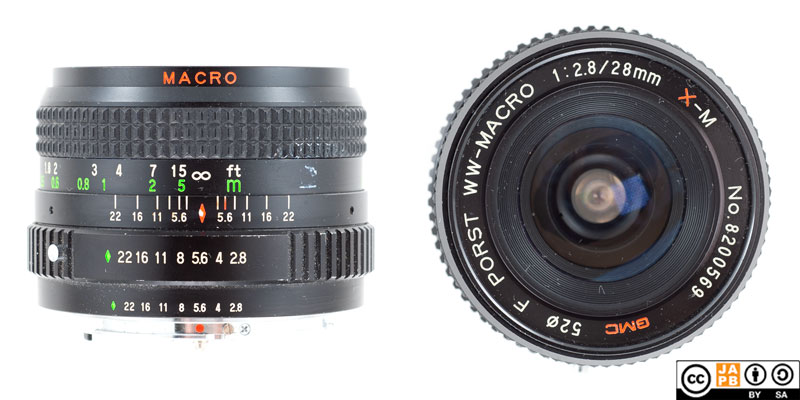
Specifications
The table below summarizes the lens’ key specifications:
| Brand: | Porst | Lens name | WW-Macro 1:2.8/28 mm X-M GMC F |
| Focal length 1 | 28 mm | Angle-of-view 2 | 75 ° |
| Maximum Aperture | f/2.8 | In Production | unknown |
| Lens mount | Fujica X | Subfamily (if applicable) | –– |
| Length 3 | 42,9 mm | Diameter 4 | 63,1 mm |
| Filter ring diameter | 52 mm | Weight | 225 grams |
| Lens element count | unknown | Lens group count | unknown |
| Aperture blades (S/R/C) 5 | 6 S | Focus throw | ≈300 ° |
| Minimum focusing distance (measured) | 20 cm | Maximum magnification (measured) | 1:4 |
| Has manual aperture ring | YES | Has Manual focus ring | YES |
| Aperture mechanism type | Automatic | Aperture click stops 6 | 2.8-4-5.6-8-11-16-22 |
Further notes:
• Porst was a retailer/rebrander, and not a lens manufacturer, hence this lens was originally manufactured by a Japanese lens manufacturer. However, it is somewhat unclear which manufacturer that might be. However it is difficult to conclusively identify the origins of this lens7.
• The ‘X-M’ in the lens’ name stands for DM (in Fuji terms), or “Dial Mode” and means that the lens can be used (on a Fujica X or Porst body) in program and shutter priority mode, once the aperture ring’s auto setting is engaged.
• Besides aperture ring and focus ring, this lens has a button to control the aperture ring’s auto setting (indicated by the yellow diamond). To enter or exit the auto setting, that button has to be pressed.
• This lens’ special feature is the “Macro” ability that allows 1:4 maximum magnification. That close focus ability is facilitated with a longer than ordinary focus throw and attending lens movement.
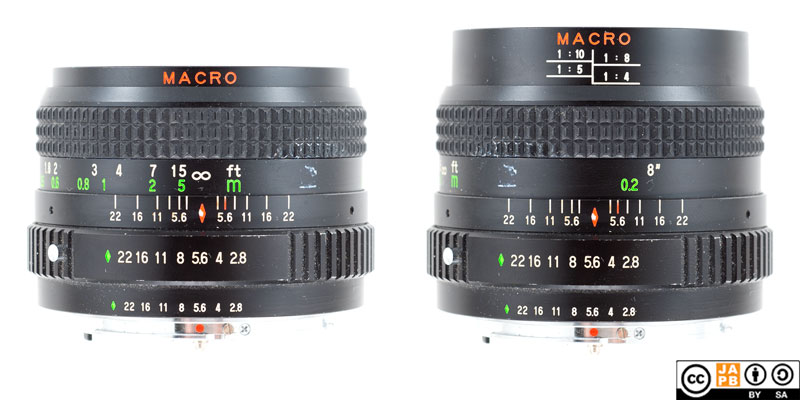
Right: Porst WW-Marco 28 mm f/2.8 focused at MFD (20 cms)
History
See the JAPB company profile on Porst for more information about the company.
Porst sourced its lenses widely. While some of Porst lenses were direct rebrands of identical lenses of major brands, most were sourced from (mostly Japanese) off-brand/OEM manufacturers.
Adapting
The only cameras able to natively mount Fujica X lenses are the Fujica STX and AX lines of manual focus, film SLRs and its rebrands (such as the Porst CR-line of SLR’s). Should you want to use this lens on film, you can count yourself lucky that the AX and STX lines of Fujica’s (and Porst CR’s) generally seem to have well designed and manufactured, hence making compatible film bodies readily available for a pittance.
Adapting this lens to a mirrorless, full-frame digital camera is a breeze thanks to the lens having full manual controls (aperture ring, focus ring). However, due to the method of aperture control used the Fujica X lenses, the adapter will need a control ring to allow stopping down the lens (and you will need to remember to engage that ring). However, thanks to the relative scarcity of Fujica X lenses (caused, in part, by the shortish production run), Fujica X adapters are not quite as readily available as for more common, film-era mounts. Hence, while regular adapters are not difficult to come by, specialised adapters (such as speed boosters or tilt/shift adapters) are not easy to obtain.

Due to the shortish flange focal distance used by the Fujica X mount (43,5 mm), adapting this lens to dSLR/SLR mounts is not as problem-free, and – to retain anything near infinity focus – the adapter will necessitate corrective optics. Even so, adapters to many dSLR mounts are available.
Footnotes
- Focal length is (unless stated otherwise) given in absolute terms, and not in Full-frame equivalent. For an understanding of whether the lens is wide/tele, see ‘Angle-of-view’. ↩︎
- Picture angle is given in degrees and concerns the diagonal picture angle. Rule of thumb:
> 90 ° ==> Ultra-wide-angle
70–90 ° ==> Wide-angle
50–70 ° ==> Moderate wide-angle
40–50 ° ==> ‘Standard’ or ‘normal’ lens
20–40 ° ==> Short tele lens
10-20 ° ==> Tele lens
5-10 ° ==> Long tele lens
< 5 ° ==> Ultra-tele lens ↩︎ - Length is given from the mount flange to the front of lens at infinity. ↩︎
- Diameter excludes protrusions such as rabbit ears or stop-down levers. ↩︎
- S=straight; R=rounded; C=(almost)circular at all apertures. ↩︎
- Numbers equal aperture values on aperture ring; • intermediate click; – no intermediate click.a ↩︎
- The Porst 28 mm f/2.8 WW (Weitwinkel; wide-angle) Macro has considerably similarities with the Sigma 28/2.8 Mini-wide (but also some differences). Another potential candidate is a Cosina 28/2.8 Macro lens, but also the samples of that lens show some differences to this lens. ↩︎