Pekka Buttler, 01/2026
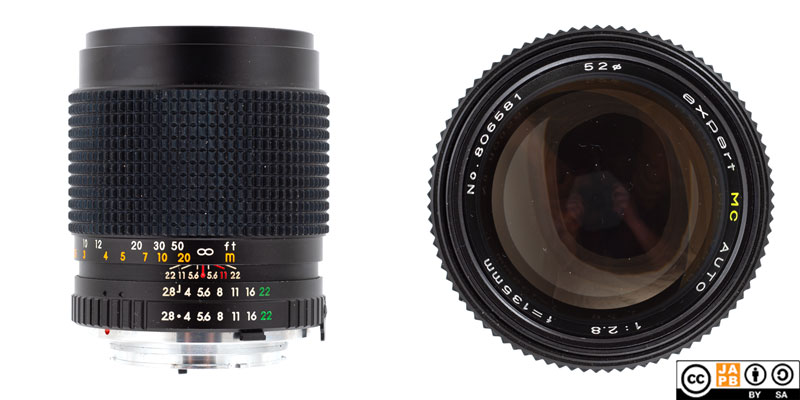
Specifications
The table below summarizes the lens’ key specifications (Measurements based on pictured sample):
| Brand: | Expert | Lens name | MC Auto 1:2.8 f=135mm |
| Focal length(s) 1 | 135 mm | Angle-of-view 2 | 18 ° |
| Maximum Aperture | f/2.8 | In Production | likely early 80s3 |
| Lens mount (this lens) | Minolta SR | Other lens mounts | uncertain4 |
| Length 5 | 78,9 mm | Diameter 6 | 64,9 mm |
| Filter ring diameter | 52 mm | Weight | 450 grams |
| Lens element count7 | unknown | Lens group count | unknown |
| Aperture blades (S/R/C) 8 | 6 S | Focus throw | 270 ° |
| Minimum focusing distance (measured) | 1 m | Maximum magnification (measured) | 1:5,4 |
| Has manual aperture ring | YES | Has Manual focus ring | YES |
| Aperture mechanism type | Manual/Auto | Aperture click stops | 2.8-4•5.6•8•11•16-22 |
Further notes:
• First off: ‘Expert’ is not a lens manufacturer, but a rebrander (see more below).
• The Expert MC Auto 135 mm f/2.8 is with a very high likelihood9 a rebrand copy of the Osawa 135 mm f/2.8.
• This lens combines a relatively compact design with a shorter-than normal MFD of 1 metre, resulting in a maximum magnification of ≈ 1:5,4
• The lens offers a pull-out hood that might help in some circumstances.
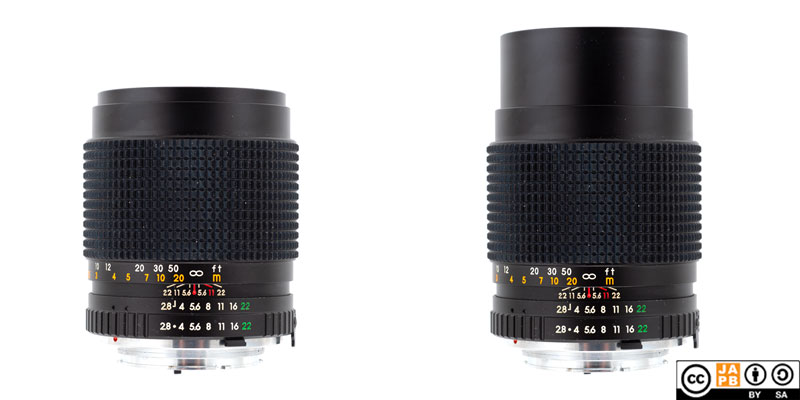
Rightt: expert 135/2.8 focused at infinity with hood extended
History of Expert
Expert was not a lens manufacturer but a rebrander. Expert is/was a giant, European electronics retail chain that for some time also sold lenses under their own house brand. You can read more in the JAPB company profile on expert.
Versions
It is more than likely that this lens existed also in other mounts than Minolta SR, and in that case the measurements of those lenses may differ slightly.
Expert also offered altogether three 135 mm f/2.8 lenses, namely:
• Expert 135mm f/2.8
• Expert 135mm f/2.8 MC
• Expert MC Auto 135 mm f/2.8 (this lens)
While this final design seems to be a rebrand of an Osawa lens, and while the first is a rebrand of a Tamron lens, I have not seen a copy of the second type, so I cannot way to which extent it differs from the others.
Adapting
We’re going to be discussing adapting Minolta SR mount lenses. If your copy of the Expert MC Auto 135/2.8 sports another mount, please study the JAPB article on the requisite lens mount for adapting tips.
This lens cannot be used natively on any current SLR or dSLRs. To use it in its native environment, you will need a Minolta SR (SR/MC/MD/X-600) film camera. Luckily these are quite easy to find. To use the lens’ full designed capabilities, a Minolta MD-compatible body (any Minolta SR body launched after 1977) is most recommended..
Thanks to being a fully manual lens (manual aperture, manual focus), the lens can be adapted to all mirrorless cameras using a suitable adapter. Moreover, a simple ‘dumb adapter’ will do the job perfectly. Thanks to the popularity of the Minolta SR mount, the availability of adapters to all mirrorless mounts can be taken for granted, on the other hand, specialist adapters (speed boosters, helicoid adapters, tilt/shift adapters) are not available for all mirrorless mounts, but daisy-chaining adapters (e.g. Minolta SR -> Canon EF; Canon EF –> mirrorless) can offer a work-around.
Using Minolta SR mount lenses on dSLRs is also be an option, but it is not trouble-free due to that the Minolta SR mount’s flange focal distance is shorter than that of any dSLR mount (technically with the exception of Olympus’ four thirds mount). Hence, any attempt at adapting Minolta SR lenses must rely on an adapter that uses corrective optics to allow infinity focus. However, such adapters are readily available.
Footnotes
- Focal length is (unless stated otherwise) given in absolute terms, and not in Full-frame equivalent. For an understanding of whether the lens is wide/tele, see ‘Angle-of-view’. ↩︎
- Picture angle is given in degrees (based on manufacturers’ specs) and concerns the diagonal picture angle. Rule of thumb:
> 90 ° ==> Ultra-wide-angle
70–90 ° ==> Wide-angle
50–70 ° ==> Moderate wide-angle
40–50 ° ==> ‘Standard’ or ‘normal’ lens
20–40 ° ==> Short tele lens
10-20 ° ==> Tele lens
5-10 ° ==> Long tele lens
< 5 ° ==> Ultra-tele lens ↩︎ - The MC Auto lenses largely followed the earlier lenses, indicating this lens would be late in the line of’expert’ lenses. On the other hand, Osawa went out of business 1984. ↩︎
- Expert-lenses were usually available in the typical lens mounts of the era (M42, Canon FD, Konica AR, Minolta SR, Nikon F, Olympus OM, Pentax K), but it is not certain that each lens was offered in everyone of these mounts. ↩︎
- Length is given from the mount flange to the front of lens at infinity. ↩︎
- Diameter excludes protrusions such as rabbit ears or stop-down levers. ↩︎
- Data on lens elements and groups is based on a single source. Alternatively, it might also be a 4 elements in 3 groups design. ↩︎
- S=straight; R=rounded; C=(almost)circular at all apertures. ↩︎
- While there are gazillions of 135 mm f/2.8 lenses, there are relatively few that have a) 52 mm filter diameter; MFD of 1 metre; 2.8–22 aperture range with a 6 bladed aperture and similar barrel design (including pull-out hood). ↩︎