Pekka Buttler, 11/2026
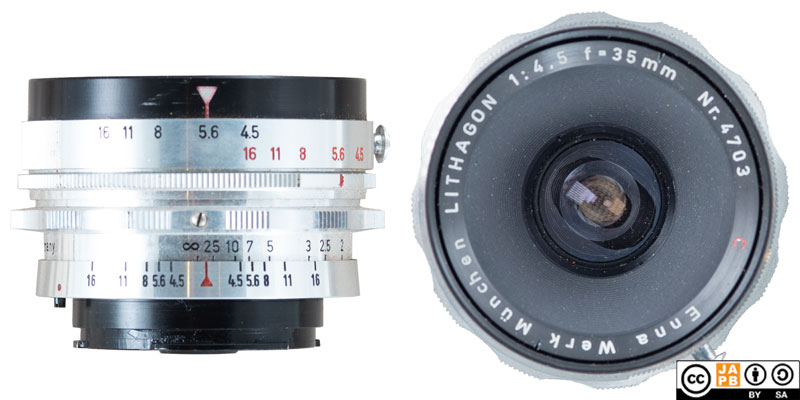
Specifications
The table below summarizes the lens’ key specifications (measurements based on pictured version of the lens):
| Brand: | Enna Werk München | Lens name | Lithagon 1:4,5 f=35mm |
| Focal length(s)1 | 35 mm | Angle-of-view2 | ≈64 ° |
| Maximum Aperture | f/4.5 | In Production | 1952–53 |
| Lens mount (this lens) | Exakta | Other lens mounts | Praktina, maybe M42 |
| Length3 | 32,8 mm | Diameter4 | 56,8 mm |
| Filter ring diameter | 49 mm | Weight | 119 grams |
| Lens element count | 4 | Lens group count | 4 |
| Aperture blades (S/R/C)5 | 10 S | Focus throw | 180 ° |
| Minimum focusing distance (measured) | 81 cms | Maximum magnification (measured) | 1:20 |
| Has manual aperture ring | YES | Has Manual focus ring | YES |
| Aperture mechanism type | Preset | Aperture click stops | none (aperture ring) 4.5-5.6-8-11-16 (preset ring) |
Further notes:
• At the time of its introduction in 1952, the 35 mm f/4.5 Enna Lithagon was the widest-angle SLR lens manufactured by a West-German optics company (and was among the widest 5 lenses in the world).
• This lens’ serial number shows this lens to be among the first 5000 lenses manufactured by Enna.
• In 1953 Enna would go on to introduce a faster (f/3.5) version of this lens, and the original design would end up an oddity.
• The pictured sample has the Exakta lens mount. Sources indicate that also a version for the Praktina mount was available. Whether this 35 mm f/4.5 design was available in other lens mounts is unclear.
• At the time of its launch, the mere 35 mm focal length was enough to set this lens apart. Hence, the decidedly modest minimum focusing distance was easily excusable.
• The lens uses a preset aperture mechanism with the button on the preset ring used to unlock the preset ring.
• Looking at the lens above, the control surfaces/rings of the lens (from camera to filter thread) are: mount; depth-of-field indicators; focus ring; preset ring; aperture ring (including preset change button) ; front of barrel with filter threads.
• As is indicated by the red letter ‘C’ on the lens’ name ring, even this early Enna lens was coated (not multicoated).
• The front lens is quite deeply recessed and a separate lens hood is therefore rarely useful.
Versions and variations
ENNA München’s family of 35 mm wide-angle lenses was both commercially successful and groundbreaking.
• Lithagon 35 mm f/4.5 – West Germany’s first retrofocus SLR lens (1952)
• Lithagon 35 mm f/3.5 – an upgrade that cemented the Lithagon’s position (1953)
• Super-Lithagon 35 mm f/2.5 – a fast 35 mm lens (1956)
• Super-Lithagon 35 mm f/1.9 – the world’s fastest 35 mm lens, for many years to come (1958)
The early f/4.5–f/2.5 Lithagons all look outwardly surprisingly similar with shiny silver barrels, narro focus rings and prominent black filter rings. From the end of the 1950s onward, Enna would start shifting its design language towards black and zebra lenses.
History of ENNA München
ENNA München (also: Enna Werk München) is one of the 1950s and 60s most prominent and innovative German optics companies. ENNA is especially well-known for being the West-German pioneer in developing retrofocus wide-angle lenses (such as the Lithagon here).
You can read more details in the ENNA München company profile.
Adapting the ENNA München Lithagon 35 mm f/4.5
Assuming your copy of the 35/4.5 Lithagon has the Exakta lens mount:
Adapting Exakta mount lenses
Exakta mount lenses cannot be used natively on any current SLR or dSLRs. To use it in its native environment, you will need an Exakta-mount film body. Exakta bodies were manufactured in large numbers, but many of them are no longer in a good shape. That said, procuring a workable sample should neither be impossible or especially expensive.
Thanks to being a fully manual lens (manual aperture, manual focus), the lens can be adapted to all mirrorless cameras using a suitable adapter. Moreover, the Exakta lenses are so uncomplicated that a simple ‘dumb adapter’ will do the job perfectly. Furthermore, due to the popularity of the Exakta mount, special adapters (helicoid adapters, tilt/shift adapters) are readily available. Alternatively, one can choose to daisy-chain adapters (e.g. Exakta->Canon EF; Canon EF –> mirrorless) which also opens up a wide range of speed boosters .
Using Exakta lenses on dSLRs can also be an easy option, depending on which dSLR.
• Canon EF has the shortest flange focal distance among full-frame dSLR’s and Canon’s wide range of dSLRs are able to mount Exakta lenses perfectly using a simple adapter ring.
• Nikon F, Pentax K and Minolta / Sony A dSLRs need an adapter that uses corrective optics for Exakta lenses (the difference in flange focal distances is not enough to enable reaching infinity focus without corrective optics).
Footnotes
- Focal length is (unless stated otherwise) given in absolute terms, and not in Full-frame equivalent. For an understanding of whether the lens is wide/tele, see ‘Angle-of-view’. ↩︎
- Picture angle is given in degrees (based on manufacturers’ specs) and concerns the diagonal picture angle. Rule of thumb:
> 90 ° ==> Ultra-wide-angle
70–90 ° ==> Wide-angle
50–70 ° ==> Moderate wide-angle
40–50 ° ==> ‘Standard’ or ‘normal’ lens
20–40 ° ==> Short tele lens
10-20 ° ==> Tele lens
5-10 ° ==> Long tele lens
< 5 ° ==> Ultra-tele lens ↩︎ - Length is given from the mount flange to the front of lens at infinity. ↩︎
- Diameter excludes protrusions such as rabbit ears or stop-down levers. ↩︎
- S=straight; R=rounded; C=(almost)circular at all apertures. ↩︎