Note! This lens has been reviewed as part of a JAPB comparison (see more here)
Pekka Buttler, 01/2023 (Updated 1/2024)
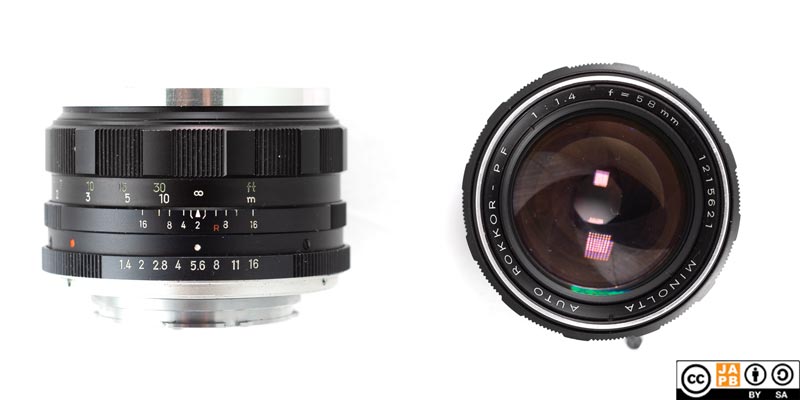
Specifications
The table below summarizes the lens’ key specifications (Measurements based on pictured sample):
| Brand: | Minolta | Lens name | Auto Rokkor-PF 1:1.4 f=58mm |
| Focal length(s) 1 | 58 mm | Angle-of-view 2 | 40,9 ° |
| Maximum Aperture | f/1.4 | In Production | 1961–1965 |
| Lens mounts | Minolta SR | Subfamily (if applicable) | AR (II) |
| Length 3 | 42,9 mm | Diameter 4 | 66,3 mm |
| Filter ring diameter | 55 mm | Weight | 322 grams |
| Lens element count | 6 | Lens group count | 5 |
| Aperture blades (S/R/C) 5 | 8 S | Focus throw | 270 ° |
| Minimum focusing distance | 60 cms | Maximum magnification | 1:8,2 |
| Has manual aperture ring | YES | Has Manual focus ring | YES |
| Aperture mechanism type | Automatic | Aperture click stops 6 | 1.4-2-2.8-4-5.6-8-11-16 |
Further notes:
• From the introduction if the Minolta SR system until 1973, Minolta’s choice focal length for standard lenses was 55–58 mm – 58 for the fast fifty (f/1.4) and superfast fifty (f/1.2) and 53–55 for the nifty fifty (f/1.7–f/2).
• Starting in 1973, Minolta converted all its standard lenses to a 50 mm focal length, and cemented the maximum apertures of these in a four-tier structure that stayed unchanged throughout the remaining life of the SR system: f/1.2 – f/1.4 – f/1.7 – f/2.
• Up until 1977 (and the launch of the MD versions) Minolta lens names typically were followed by two letters: One signifying the number of lens groups, and the second signifying the number of elements. See Minolta elements and groups coding (click for details).
• This lens offers a small external aperture stop-down lever to be used on cameras that did not offer that functionality.
• This lens comes from the first generation of Minolta 58 mm fast fifties.
• The original Minolta 55 mm thread lens hood might be hard to come by, but most 55 mm thread standard lens hoods should work.
Versions
The table below shows the genealogy of all Minolta fast fifties:
| Name (on lens) | Variant & Generation | years | focal length | max. aperture | min. aperture | elements | groups | filter thread | weight |
| Auto-ROKKOR-PF | AR II | 1961–1965 | 58 | f/1.4 | f/16 | 6 | 5 | 55 | 320 |
| Auto-ROKKOR-PF | AR C | 1965–1966 | 58 | f/1.4 | f/16 | 6 | 5 | 55 | 265 |
| MC ROKKOR-PF | MC I | 1966–1969 | 58 | f/1.4 | f/16 | 6 | 5 | 55 | 275 |
| MC ROKKOR-PF | MC II | 1969–1973 | 58 | f/1.4 | f/16 | 6 | 5 | 55 | 275 |
| MC ROKKOR(-X)-PG | MC X | 1973–1977 | 50 | f/1.4 | f/16 | 7 | 5 | 55 | 305 |
| MD-ROKKOR(-X) | MD I | 1977–1978 | 50 | f/1.4 | f/16 | 7 | 5 | 55 | 245 |
| MD ROKKOR(-X) | MD II | 1978–1979 | 50 | f/1.4 | f/16 | 7 | 5 | 55 | 245 |
| MD-ROKKOR(-X) | MD II | 1979–1981 | 50 | f/1.4 | f/16 | 7 | 6 | 49 | 220 |
| MD | MD III | 1981–≈1995 | 50 | f/1.4 | f/16 | 7 | 6 | 49 | 235 |
Adapting
This lens cannot be used natively on any current SLR or dSLRs. To use it in its native environment, you will need a Minolta SR (SR/MC/MD/X-600) film camera. Luckily these are quite easy to find. To use the lens’ full designed capabilities, a Minolta MD-compatible body (any Minolta SR body launched after 1977) is most recommended..
Thanks to being a fully manual lens (manual aperture, manual focus), the lens can be adapted to all mirrorless cameras using a suitable adapter. Moreover, a simple ‘dumb adapter’ will do the job perfectly. Thanks to the popularity of the Minolta SR mount, the availability of adapters to all mirrorless mounts can be taken for granted, on the other hand, specialist adapters (speed boosters, helicoid adapters, tilt/shift adapters) are not available for all mirrorless mounts, but daisy-chaining adapters (e.g. Minolta SR -> Canon EF; Canon EF –> mirrorless) can offer a work-around.
Using Minolta SR mount lenses on dSLRs is also be an option, but it is not trouble-free due to that the Minolta SR mount’s flange focal distance is shorter than that of any dSLR mount (technically with the exception of Olympus’ four thirds mount). Hence, any attempt at adapting Minolta SR lenses must rely on an adapter that uses corrective optics to allow infinity focus. However, such adapters are readily available.
History of Minolta
Minolta exited the camera business in 2006 and sold its remaining photographic assets to Sony. The 50 years before that ignominious date tell a very different story: one of a Japanese optics and innovation powerhouse that has interesting links to Germany – not Nazi Germany, but both pre WWII Germany as well as postwar West Germany. Read more in the Minolta company profile.
Footnotes
- Focal length is (unless stated otherwise) given in absolute terms, and not in Full-frame equivalent. For an understanding of whether the lens is wide/tele, see ‘Angle-of-view’. ↩︎
- Picture angle is given in degrees (based on manufacturers’ specs) and concerns the diagonal picture angle. Rule of thumb:
> 90 ° ==> Ultra-wide-angle
70–90 ° ==> Wide-angle
50–70 ° ==> Moderate wide-angle
40–50 ° ==> ‘Standard’ or ‘normal’ lens
20–40 ° ==> Short tele lens
10-20 ° ==> Tele lens
5-10 ° ==> Long tele lens
< 5 ° ==> Ultra-tele lens ↩︎ - Length is given from the mount flange to the front of lens at infinity. ↩︎
- Diameter excludes protrusions such as rabbit ears or stop-down levers. ↩︎
- S=straight; R=rounded; C=(almost)circular at all apertures. ↩︎
- Numbers equal aperture values on aperture ring; • intermediate click; – no intermediate click. ↩︎
I started using the old Rokkor lens from the MC 55mm f1.7PF. It’s an old lens but has attractive image quality, and I use it on my Sony. A friend told me that the even older Auto-Rokkor lens has an even more unique image quality, so I bought the 58mm f1.4PF for $20, half-believing. Being used to the design of the MC-Rokkor, I initially felt a sense of discomfort with the old-fashioned Auto-Rokkor series. However, I was astonished by the image displayed on the iMac monitor. It wasn’t just the outstanding resolution that surprised me, but the sense of air, the breath of the subject. Specifically, it was the three-dimensional effect and the excellent background bokeh. It was clearly different from the images created by AI on the latest iPhones and the like. In fact, this lens is probably not suitable for those seeking high specs and extreme resolution. When you enlarge the focused area, it ends up looking like a “bleed of light.” In other words, this lens may not offer the ultimate resolution. The important thing is that if I wanted the ultimate in resolution, I probably wouldn’t buy a lens that’s over 60 years old. In other words, this lens is a lens that I happened to come across that can reproduce the world as seen by the human eye. Lenses like this are rare, even though there are many old lenses out there. Finally, I’d like to introduce the best way I use this lens. Obviously, this lens is not a super versatile product. It works best at f2 to f4.5, with a subject distance of about 1 to 2 meters. Avoid direct light, and for portraits, it’s best to use it for half-body bust shots. Lenses from this era have a long helicoid rotation distance. However, if you think about it, this allows for highly precise focus adjustment. We must not forget the unfortunate side. My lens was overhauled by a skilled technician, but some parts are missing, probably due to the numerous disassemblies by previous owners, and the shape of the aperture is slightly distorted. It would be very difficult to find a lens on the market that has been maintained in such high condition. However, I would like to say to everyone: if you continue to own and use this lens, you have no right to own it unless you love it, including its flaws and its past. However, if you accept all of these and use this lens sincerely, you will surely find happiness. Good luck to those who own the Auto-Rokkor 58mm f1.4!
Yoshio,
I share your sentiments and I thank your friend for having introduced this lens to You.
I have also made the experience that it can be challenging to find a 60 year old lens that still is in perfect order and has been spared inexpert ‘repair’men.
Kind regards,
Pekka