Pekka Buttler, 08/2022 (Updated 01/2024)
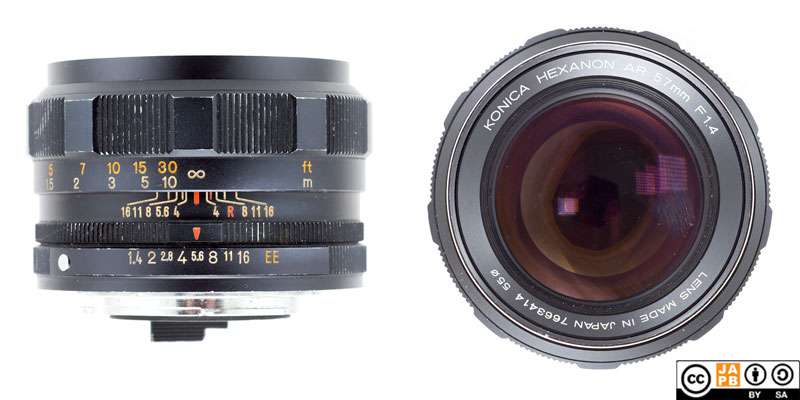
Specifications
The table below summarizes the lens’ key specifications:
| Brand: | Konica | Lens name | HEXANON AR 57mm F 1.4 |
| Focal length 1 | 57 mm | Angle-of-view 2 | 42° |
| Maximum Aperture | f/1.4 | In Production | 1965–1972 |
| Lens mount | Konica AR | Subfamily (if applicable) | –– |
| Length 3 | 42,2 mm | Diameter 4 | 65,2 mm |
| Filter ring diameter | 55 mm | Weight | 278 grams |
| Lens element count | 6 | Lens group count | 5 |
| Aperture blades (S/R/C) 5 | 6 S | Focus throw | 255 ° |
| Minimum focusing distance | 45 cms | Maximum magnification | 1:5,7 |
| Has manual aperture ring | YES | Has Manual focus ring | YES |
| Aperture mechanism type | Automatic | Aperture click stops 6 | 1.4•2•2.8•4•5.6•8•11•16 |
Further notes:
• During the time of this lens’ production, Konica had an agreement with German retailer/rebrander Revue, leading to that Konica optics and cameras were also available under the Revue-name. If you find a lens saying “Revue” and “57 mm f/1.4”, it most likely is a version of this lens.
• Konica offered a dedicated lens hood for the 57 mm f/1.4, but these are today relatively hard to come by. Alternatively, one may use any generic 55 mm thread standard to short tele hood. I have the hood for the Konica 100 mm f/2.8 and it works perfectly on both its intended lens, as well as the 85/1.8 and the 57/1.4 (!)
Versions and variants
Konica’s offering in the class of fast fifties comes in three major generations:
1960–65: Konishiroku Hexanon 52 mm f/1.4 [data sheet] Konica F mount
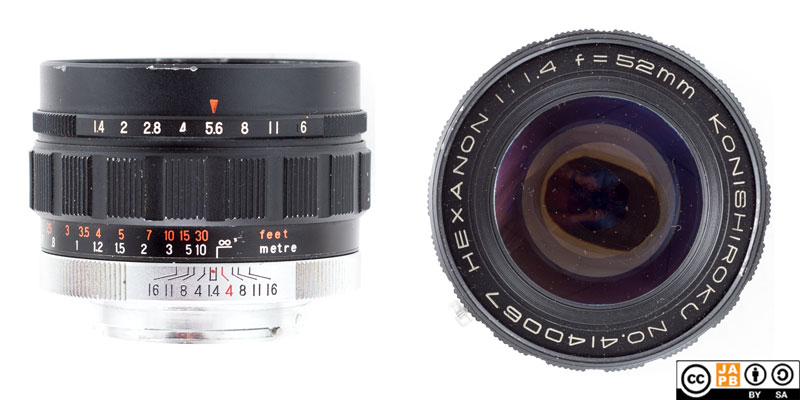
Konica’s first fast fifty. There are two main variants of this lens, but everything indicates that they are optically identical.
• The earlier variant had a 49 mm filter thread and its aperture was coupled to the Konica F camera for metering.
• The later variant had a 55 mm filter thread and no aperture coupling. Was also sold in Germany under the Revue brand.
1965–1973: Konica Hexanon (AR) 57 mm f/1.4 (this lens) Konica AR mount
Konica’s first mainstream fast fifty. There are three main variants of this lens, and all sources indicate that no optical changes were made to the design (except that the coatings might vary a bit).
• The first variant had a silver ring combined with a glossy black finish (A-type)7. Some early samples lack the aperture ring detent for auto exposure (here still referred to as ‘EE’). Some lenses branded ‘Revue’.
• The second variant had a silver ring combined with a satin black finish (B-type). All samples have the ‘EE’ detent, but some early samples lack the AE/EE lock feature (here still referred to as ‘EE’). Some lenses branded ‘Revue’.
• The third variant was in an all-black satin finish with metal focusing ring (C-type). The pictured sample is of this variant.
1973–1984: Konica Hexanon AR 50 mm f/1.4 [data sheet] Konica AR mount
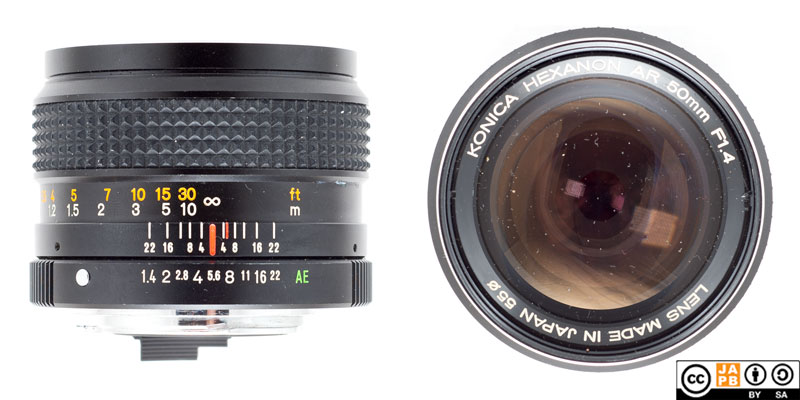
Konica’s final fast fifty. This lens comes in two main variants.
• The first variant had a minimum aperture of f/16 and rubber focus rings (D-Type)
• The second variant had a minimum aperture of f/22 and was slightly more compact, but retained the rubber focus rings (E-Type)
History of Konica AR lenses
Konica is one of those names that will not ring any bells to those who’ve only recently started photographing, but for many years Konica was one of the ‘Great Japanese camera companies’.
After a short-lived and only moderately successful line of SLR cameras known as the Konica F-line (1960-1965), Konica hit pay dirt with the introduction of the Konica Auto-Reflex in 1965 and its new, Konica AR mount. The Auto-Reflex was at the time the first affordable system camera with integrated auto-exposure (albeit the exposure metering was not yet TTL). The Auto-Reflex was followed by a two lines of successful cameras – the more ambitious Autoreflex T-line and the more pedestrian Autoreflex A-line – before Konica (along with the rest of Japanese camera companies) stepped up the automation of their SLR cameras with the 1-series (FS-1, FC-1, FP-1, and FT-1).
But while Konica had often been at the forefront of automation (first shutter priority auto-exposure system, first SLR with integrated winder), Konica’s star had been waning, and Konica decided to not compete against the likes of Minolta, Nikon, Canon, and Pentax in autofocus technology. Instead Konica withdrew from SLR and SLR lens manufacture and focused on compacts and other optoelectronics. Two decades later Konica merged with Minolta to form KonicaMinolta, which subsequently sold its camera business to Sony. So, after a fashion, the DNA of Konica’s camera business lives on in Sony’s camera division.
Relevantly, the Konica AR mount had a relatively good and long (1965–1987) run, and stayed remarkably unchanged throughout. Hence, while Konica changed the design of their AR lenses during those years – moving towards lighter constructions, rubber focus rings, and a more modern look (for more detail, look here) – all AR lenses are physically entirely compatible with all AR-mount bodies.´
Besides an early and seemingly very rare preset version, the Konica Hexanon AR 57 mm f/1.4 was produced in 4–5 versions. While the overall recipe (6 elements, 5 groups) stayed unchanged, ergonomic features (such as AE lock) were added and the lens’ casing was changed in every version, leading to that measurements regarding diameter, length and weight given in the specifications above reflect only the pictured version. For descriptions of the versions, see Andreas Buhl’s fantastic resource.
The lens pictured above (my sample) is of the newest type, meaning it was likely manufactured between 1970 and 1973.
Adapting
n.B! The following applies to all Konica AR mount lenses.
This lens cannot be used natively on any current SLR or dSLRs. To use it in its native environment, you will need a Konica AR-mount film body.
Thanks to being a fully manual lens (manual aperture, manual focus), the lens can be adapted to all mirrorless cameras using a suitable adapter. Moreover, Konica AR lenses are so uncomplicated that a simple ‘dumb adapter’ will do the job perfectly. However, due to Konica AR lenses not being among the most numerously manufactured, special adapters (helicoid adapters, tilt/shift adapters) are not easy to come by and speed boosters are currently unavailable.
Using Konica AR lenses on dSLRs is possible, but difficult. Due to the exceptionally short flange focal distance of the Konica AR mount (at 40,5 mm, a lot shorter than that of any full-frame dSLR mount), any adapter will necessitate some optics to achieve anything near infinity focus.
Footnotes
- Focal length is (unless stated otherwise) given in absolute terms, and not in Full-frame equivalent. For an understanding of whether the lens is wide/tele, see ‘Angle-of-view’. ↩︎
- Picture angle is given in degrees (based on manufacturers’ specs) and concerns the diagonal picture angle. Rule of thumb:
> 90 ° ==> Ultra-wide-angle
70–90 ° ==> Wide-angle
50–70 ° ==> Moderate wide-angle
40–50 ° ==> ‘Standard’ or ‘normal’ lens
20–40 ° ==> Short tele lens
10-20 ° ==> Tele lens
5-10 ° ==> Long tele lens
< 5 ° ==> Ultra-tele lens ↩︎ - Length is given from the mount flange to the front of lens at infinity. ↩︎
- Diameter excludes protrusions such as rabbit ears or stop-down levers. ↩︎
- S=straight; R=rounded; C=(almost)circular at all apertures. ↩︎
- Numbers equal aperture values on aperture ring; • intermediate click; – no intermediate click. ↩︎
- The classification into A, B, C, D etc. types is based on the typology developed by Mr. Jean-Jacques Granas, which you can find here ↩︎