I like to carry my gear easily. Schlepping even one 300 mm lens around (never mind three) is not my understanding of fun. Moreover, as doing any rigorous comparison work with these focal length ranges necessitates a sturdy tripod, moving the needed gear around invariably means that I need a car – not a camera bag. And that’s not how I usually do photography.
However, for once I had the plan of going somewhere by car and parking it close to somewhere where I would find a reasonably interesting yet stable vista for using a 300 mm lens. So I loaded my car’s boot/trunk with a tripod and 900 mm worth of tele lenses, to show you the results. This is not a rigorous comparison review. Rather it is – as the title says – a quick & dirty comparison of three long tele lenses that share a common origin.
Where
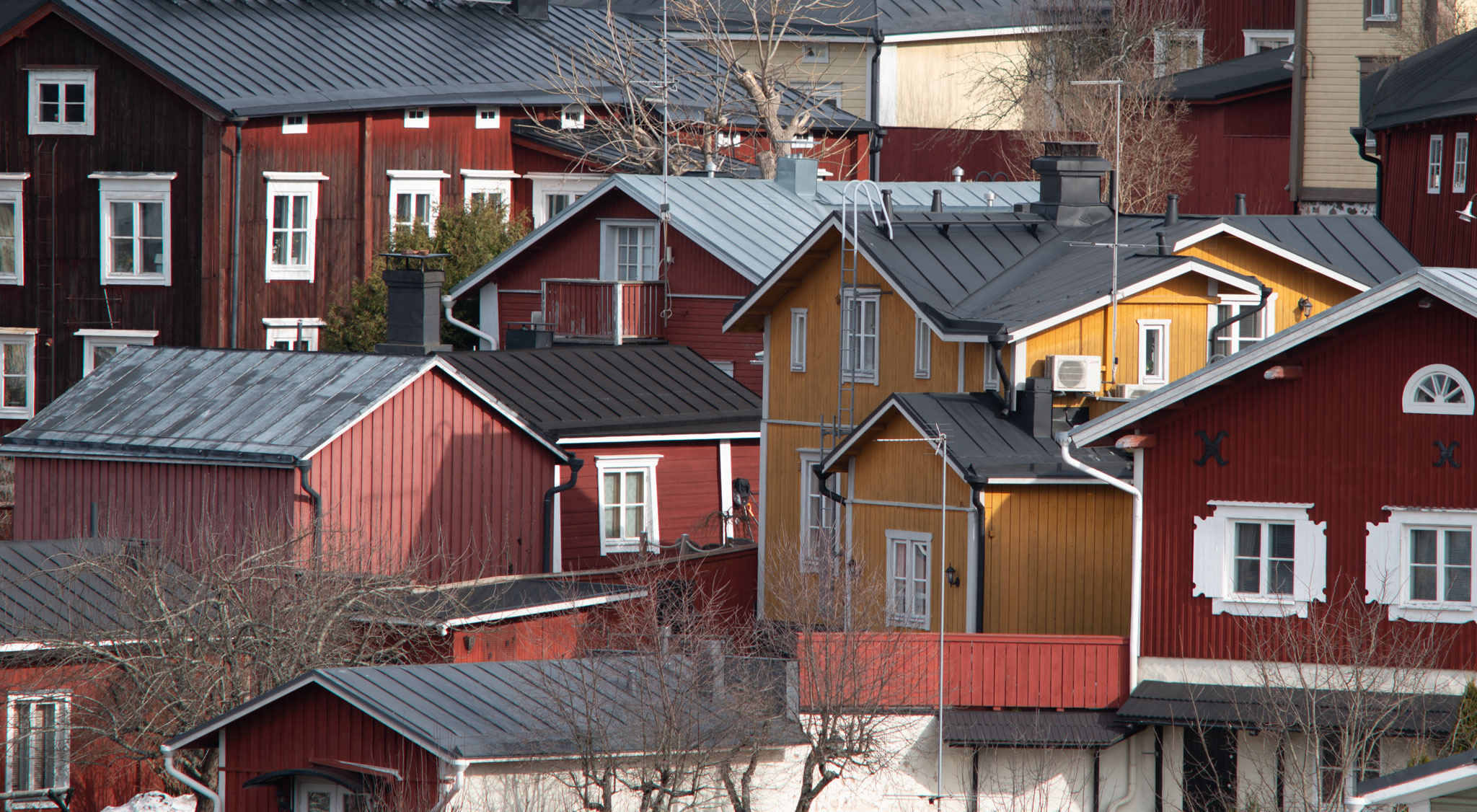
Porvoo is a town/small city on the Finnish southern coast, half an hour drive from Helsinki. Porvoo was founded in ca 1350 and is today the second-oldest settlement in Finland1. What makes Porvoo especially interesting is that it has a relatively well-preserved old town2 which seemed like a perfect spot for a day spent with vintage lenses.
The lenses
I happen to have three 300 mm lenses from the German Democratic Republic in my ‘Arsenal’. Importantly (for this Q&D), they’re not just renames or variations on a theme, but three fundamentally different lenses. From oldest to youngest, they are:
Meyer-Optik Görlitz Telemegor 300 mm f/4.5 (1955)
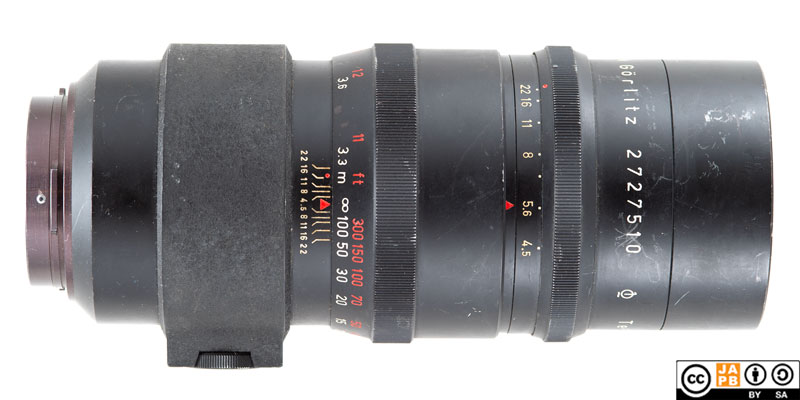
Meyer-Optik Görlitz launched the ‘Telemegor’ (TELE MEyer GORlitz) series of tele lenses in the era between the world wars and the initial line of Telemegor lenses (150/5.5, 180/5.5, 250/5.5 and 400/5.5) are characterised by a maximum aperture of f/5.5 and a 4 elements in 2 elements design. The 300/4.5 (this lens) is a somewhat later (1955) design that was modified (from the original Telemegor recipe) to allow for a brighter maximum aperture. Moreover, as the lens was designed to cover medium format and at one and three quarter kilos, the lens is a brute. You can see the lens’ entire data sheet here.
The pictured sample was shot using a Pentacon Six->Nikon F and Nikon F->Sony FE adapter on a Sony ⍺7R2.
Meyer-Optik Görlitz Orestegor 300 mm f/4 (1965)
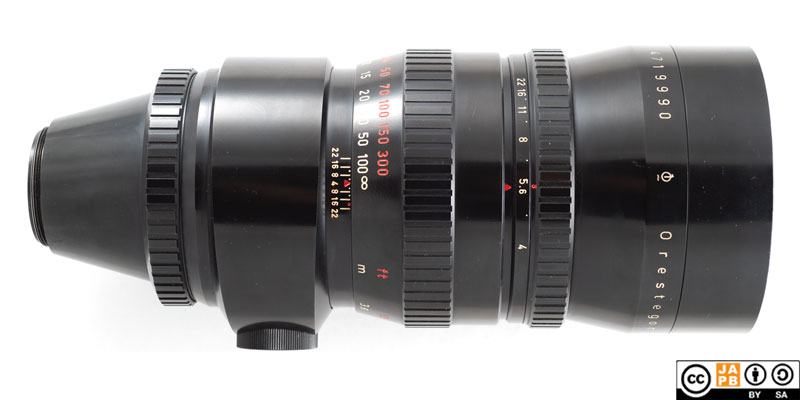
In the 1960s Meyer-Optik set out to modernise its entire lens lineup. As a result, the aged Telemegor line of lenses was replaced by a line of lenses going under the name “Orestegor” (see more about Meyer-Optik’s naming practices in this article) comprising of 200 mm, 300 mm and 500 mm tele lenses. Whereas most of the Telemegor lenses had actually been (optically) closely related, the Orestegor lenses did not so much follow a common design philosophy with each lens using a different lens recipe suited for the design (5 elements in 5 groups for the 200/4; 5 elements in 4 groups for the 300/4 (this lens) and 4 elements in 4 groups for the 500/5.6).
While the 300/4 Orestegor did manage to increase the maximum aperture and generally modernise the design, it resulted in a (marginally) heavier lens at just under 2 kilos (without adapter). You can see the lens’ entire data sheet here.
After the 1969/70 shotgun merger of Meyer-Optik into VEB Pentacon this lens continued to be sold as the Pentacon 300/4 with no fundamental redesigns.
Carl Zeiss Jena Prakticar 300 mm f/4 MC
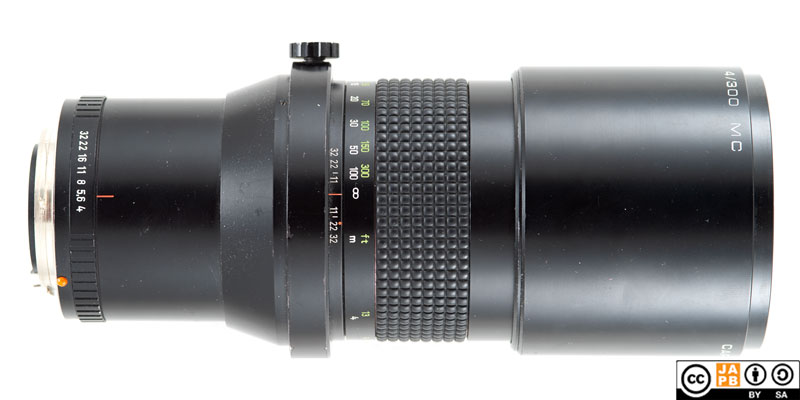
Carl Zeiss Jena had been producing 300 mm lenses based on the venerable 1938(!) 5 elements in 3 groups design on both sides of WWII. That design was updated in 1963 to enable use on the medium format Praktisix (Pentacon Six) system and resulted in a 6 elements in 4 groups design. This design was then used on smaller format cameras using a dedicated series of adapters (for Exakta, M42).
The fundamental issue with that (1960s) design was that it was fundamentally unsuited for the increasing demand on automation and lens<>camera communication that became increasingly evident in the 1970s. Hence a new design was computed in the early 70s, using a new 5 elements in 3 groups design (this time the single lens was at the front, not the back).
In the late 1970s the East German camera industry launched an ambitious push3 for a new camera system (The Praktica B series) and it was evident that this series needed a dedicated ambitious 300 mm lens (not just a medium format lens usable on 135 format film). Hence the designers at Carl Zeiss in Jena sat down and redesigned the 300 mm Sonnar using the latest technology and novel glass sorts. Then a few years later they redesigned the lens again to manage without thoriated glass mixtures. My sample is of the earlier thoriated/radioactive4 type, which (untreated) leads to yellowing, which we will address later.
The resulting lens matches the mainline specifications of the MOG Orestegor, but weighs only a bit under a kilo. See the full specifications in the lens’ data sheet.
Images
Telemegor
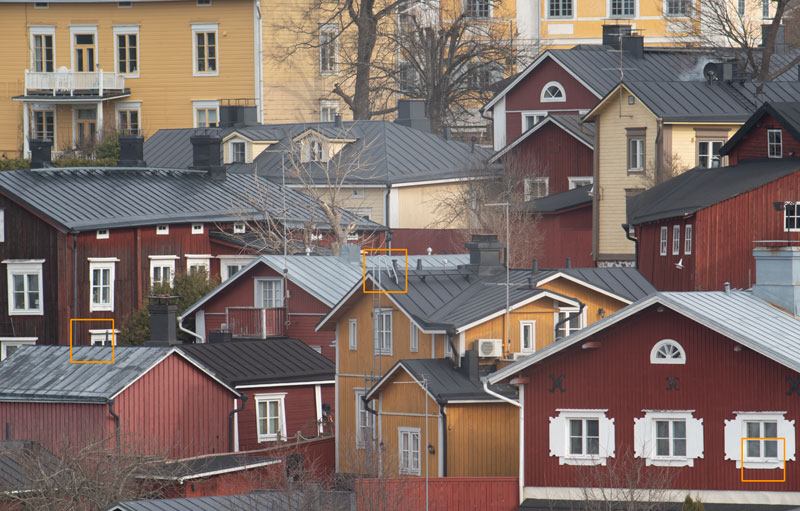
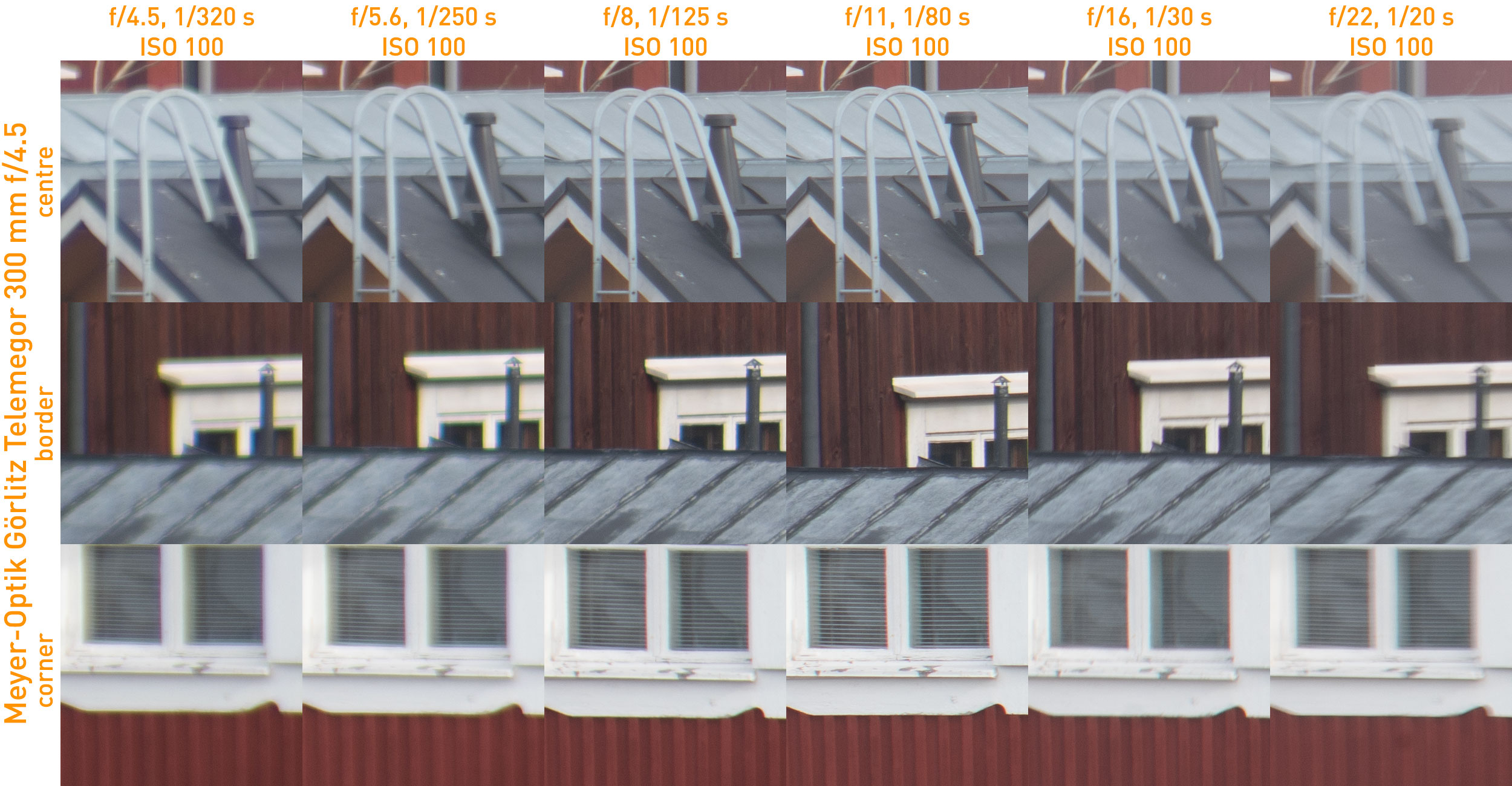
The MOG Telemegor 300/4.5 did pose a mild issue for my test shots, because while it does have a sturdy tripod collar, it uses the heavy-duty (older) UNC 16 thread (3/8″ inch) that did not give a perfect fit for my UNC 20–>UNC 16 adapter. Whether this is an issue with my sample or a more general issue I cannot say. In any case it resulted in that the MOG Telemegor did not feel quite as stable on my tripod as the other two lenses. This means that the dismal image quality of the Telemegor’s longer exposures are less caused by the lens itself and more due to the insufficient stability of the tripod mount (it was a windy day).
Quick analysis
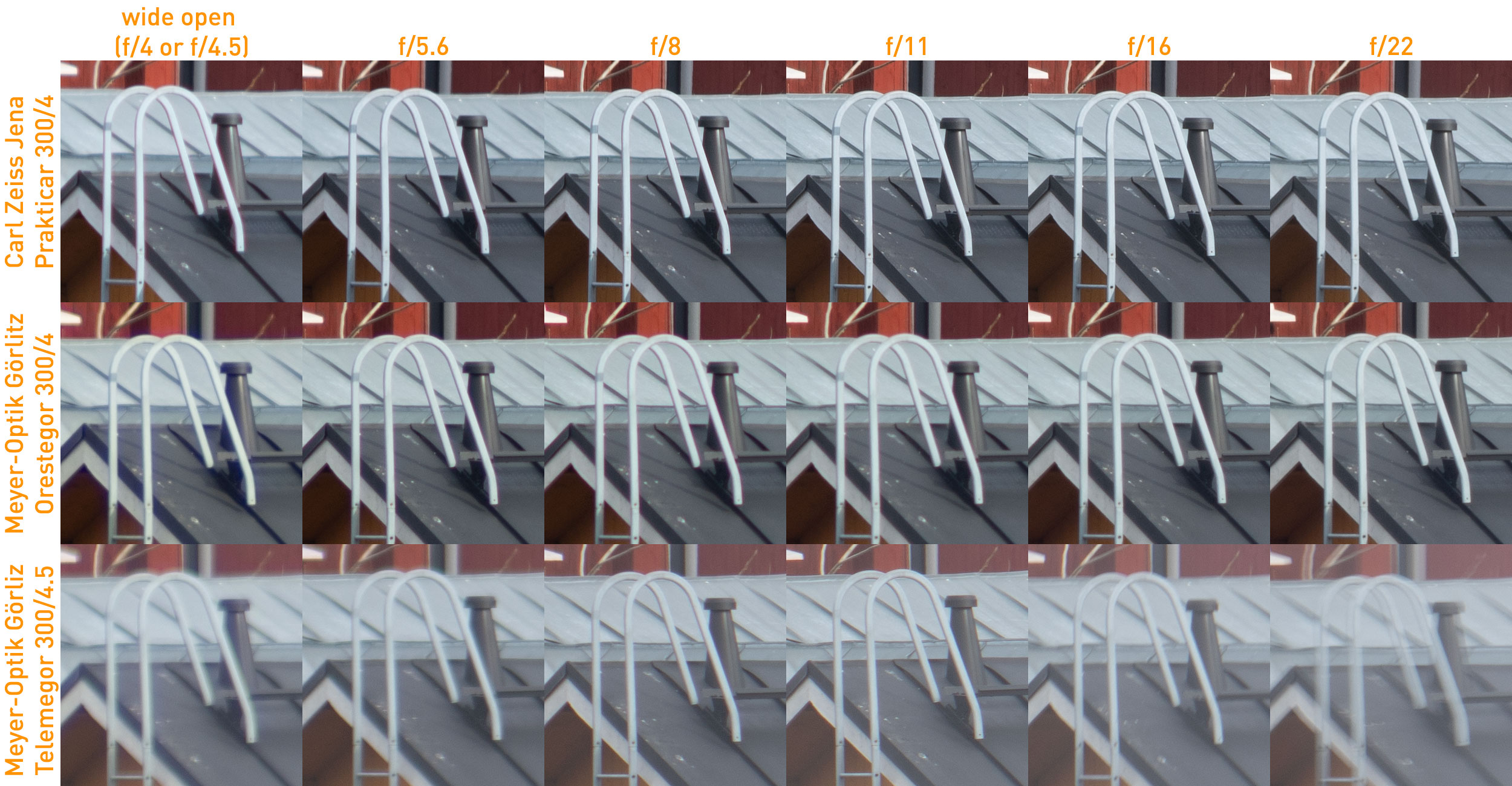
First: please disregard the f/22 and even f/16 shots as they’re likely affected by an unstable tripod.
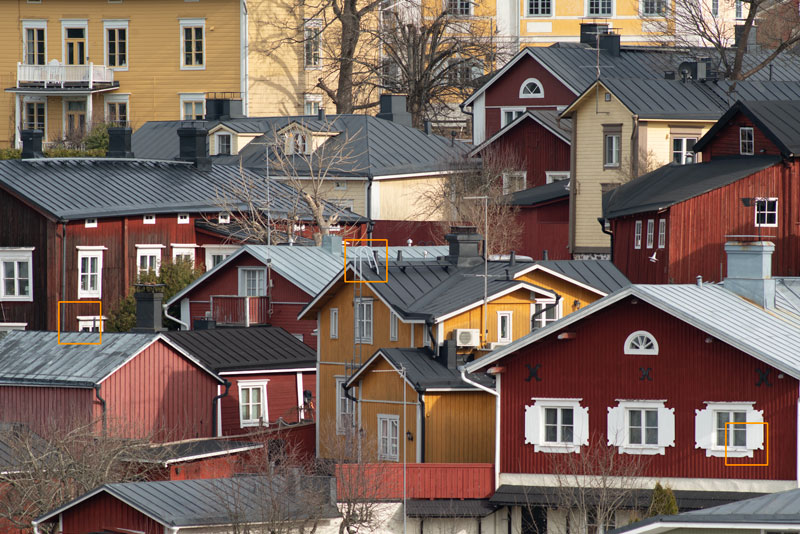
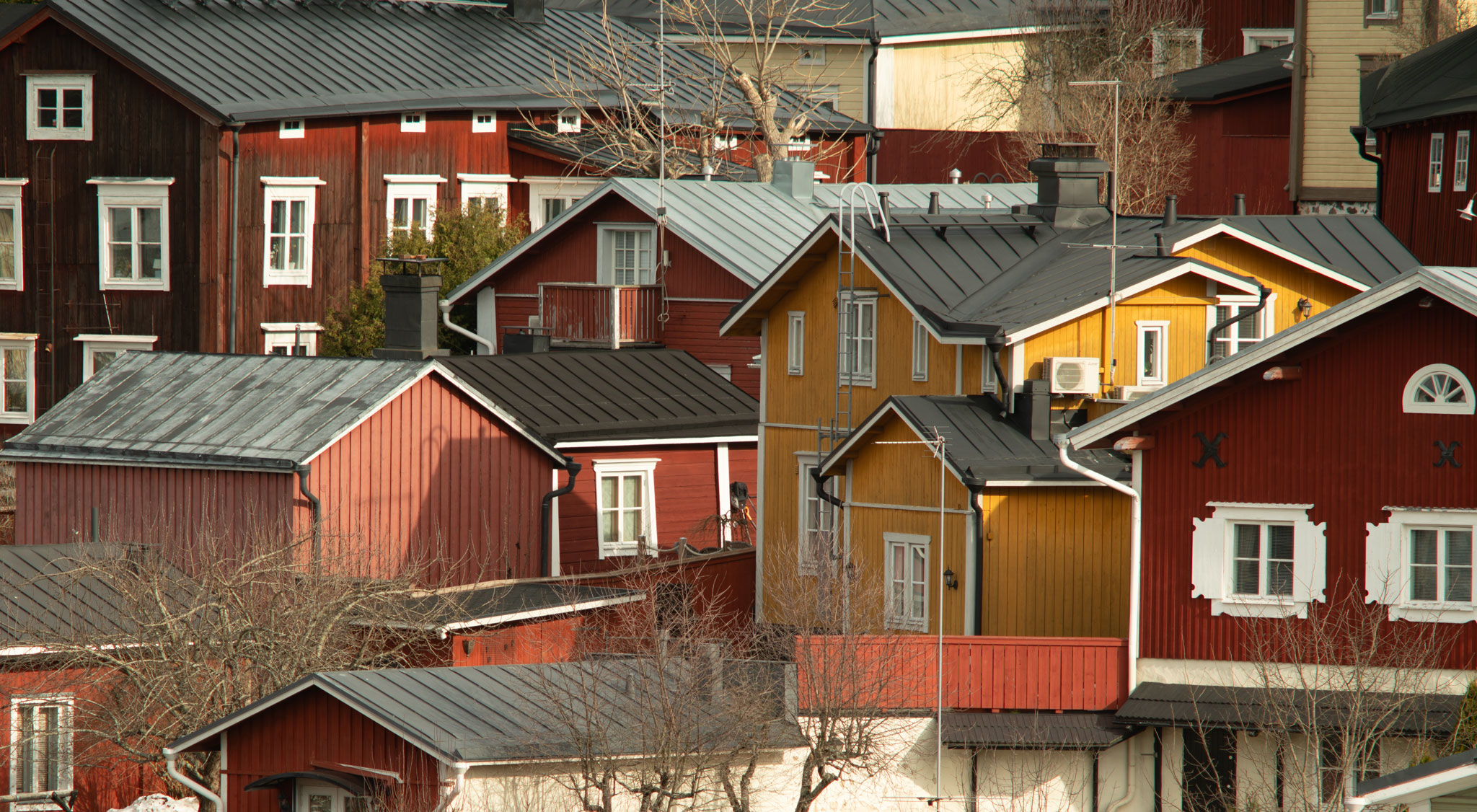
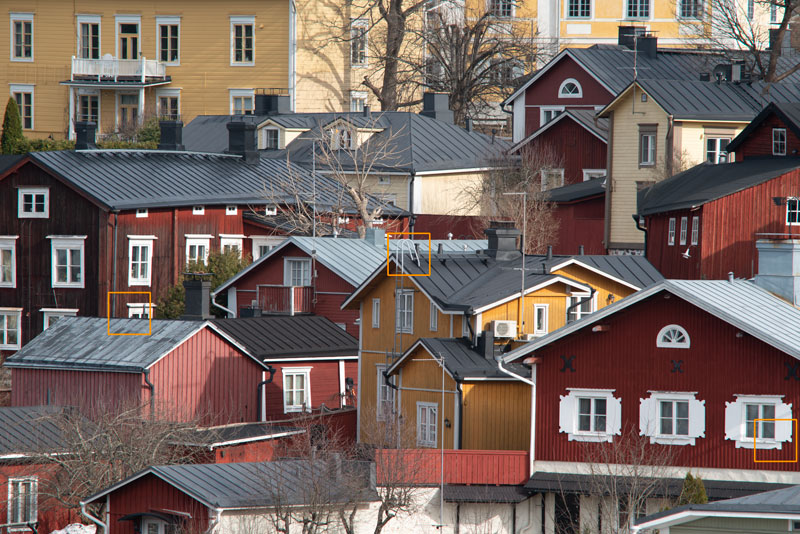
Second: The Telemegor seems to suffer from ghosting caused by internal reflections, which shows up as a loss of darks in the centre-area of the frame. This is quite evident even in the scaled full image above.
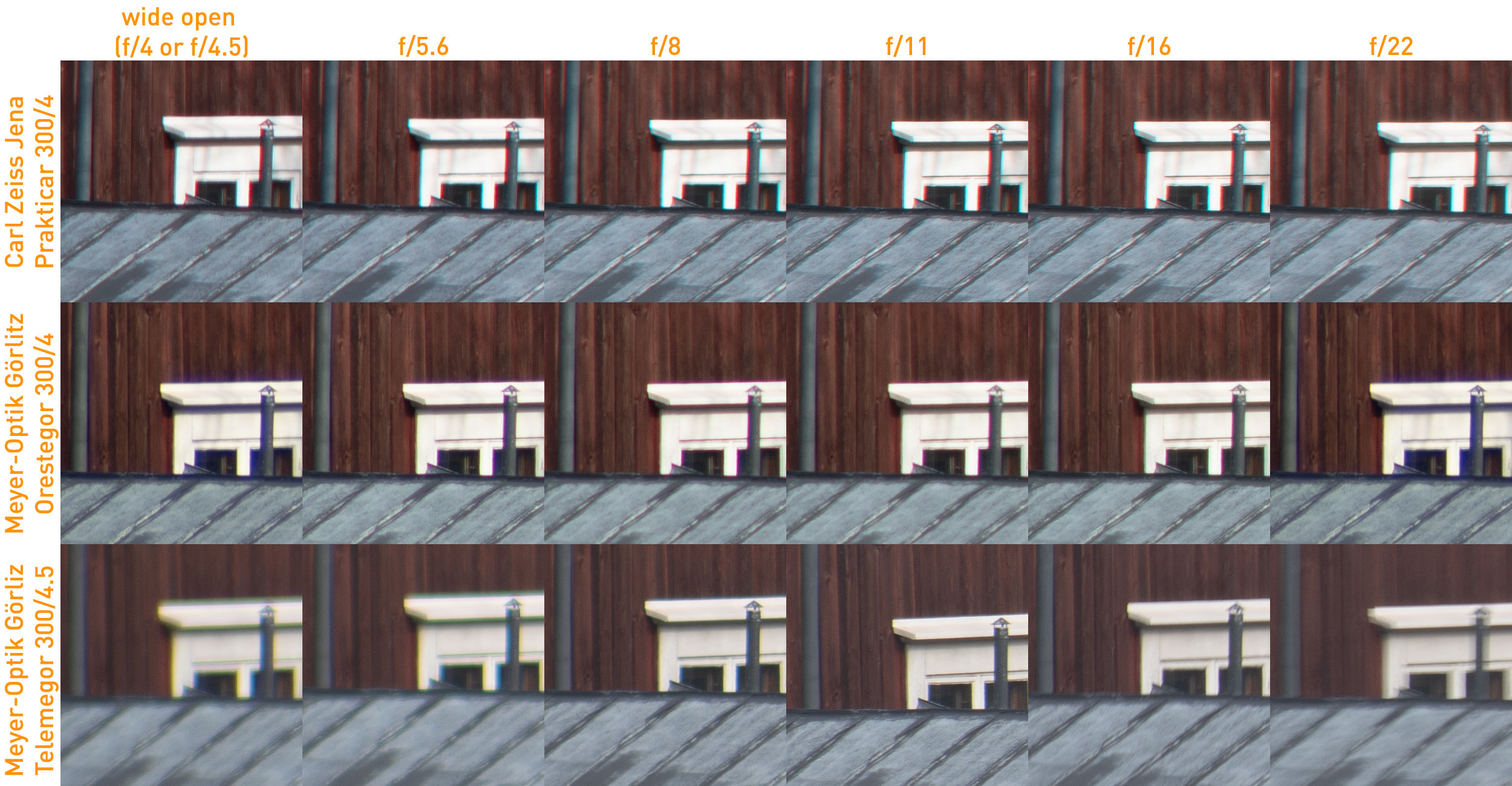
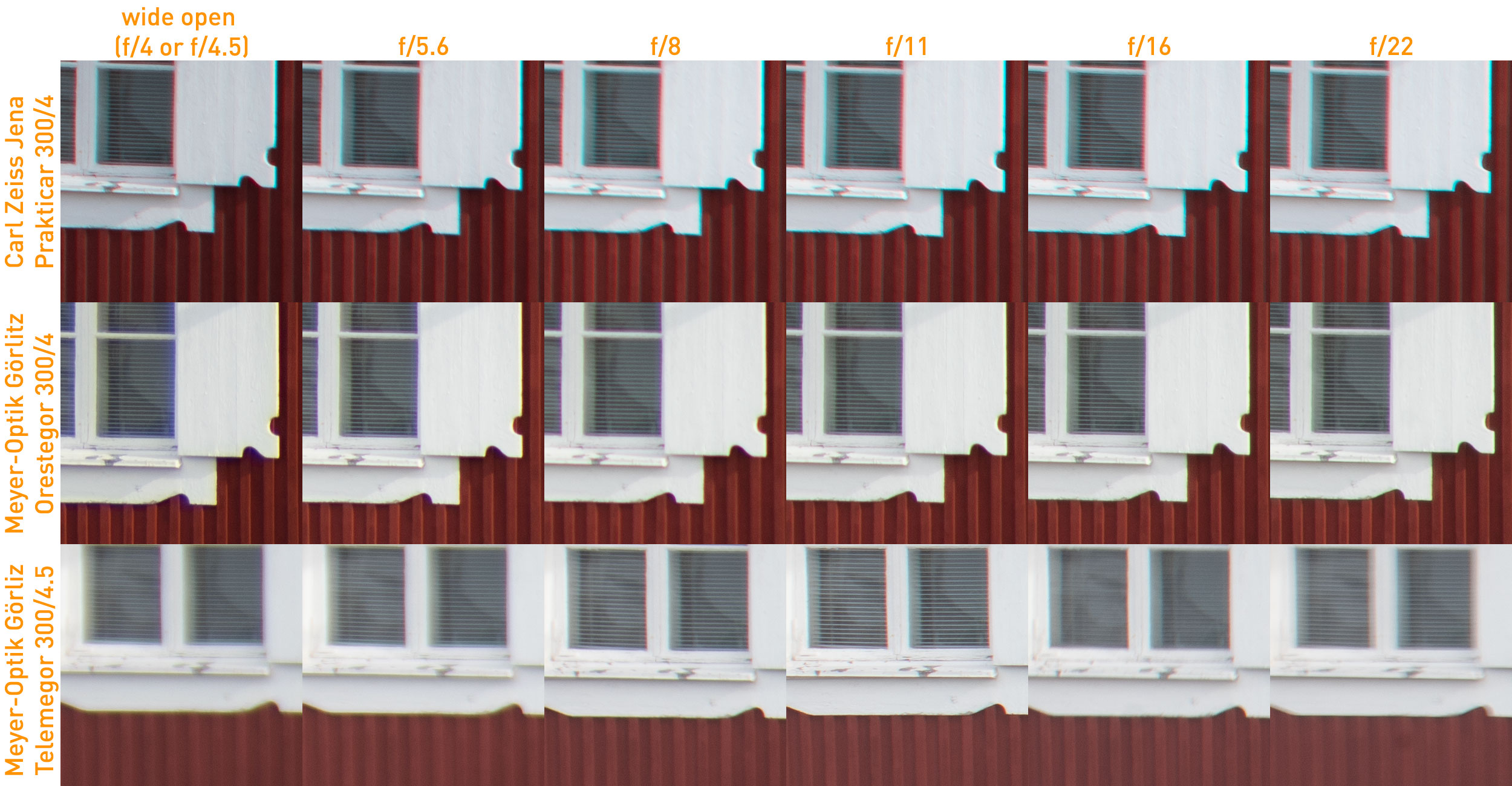
In terms of sharpness, we’re clearly dealing with a 70 years old lens. The image lacks the crispness one has learned to expect from later lenses. At f/8 and f/11 there is decent sharpness, while contrast could be better. At f/4.5 and f/5.6 the centre shows considerable softness while border and corner areas show some chromatic aberrations (which however are no longer as bad at f/8).
Orestegor
Quick analysis
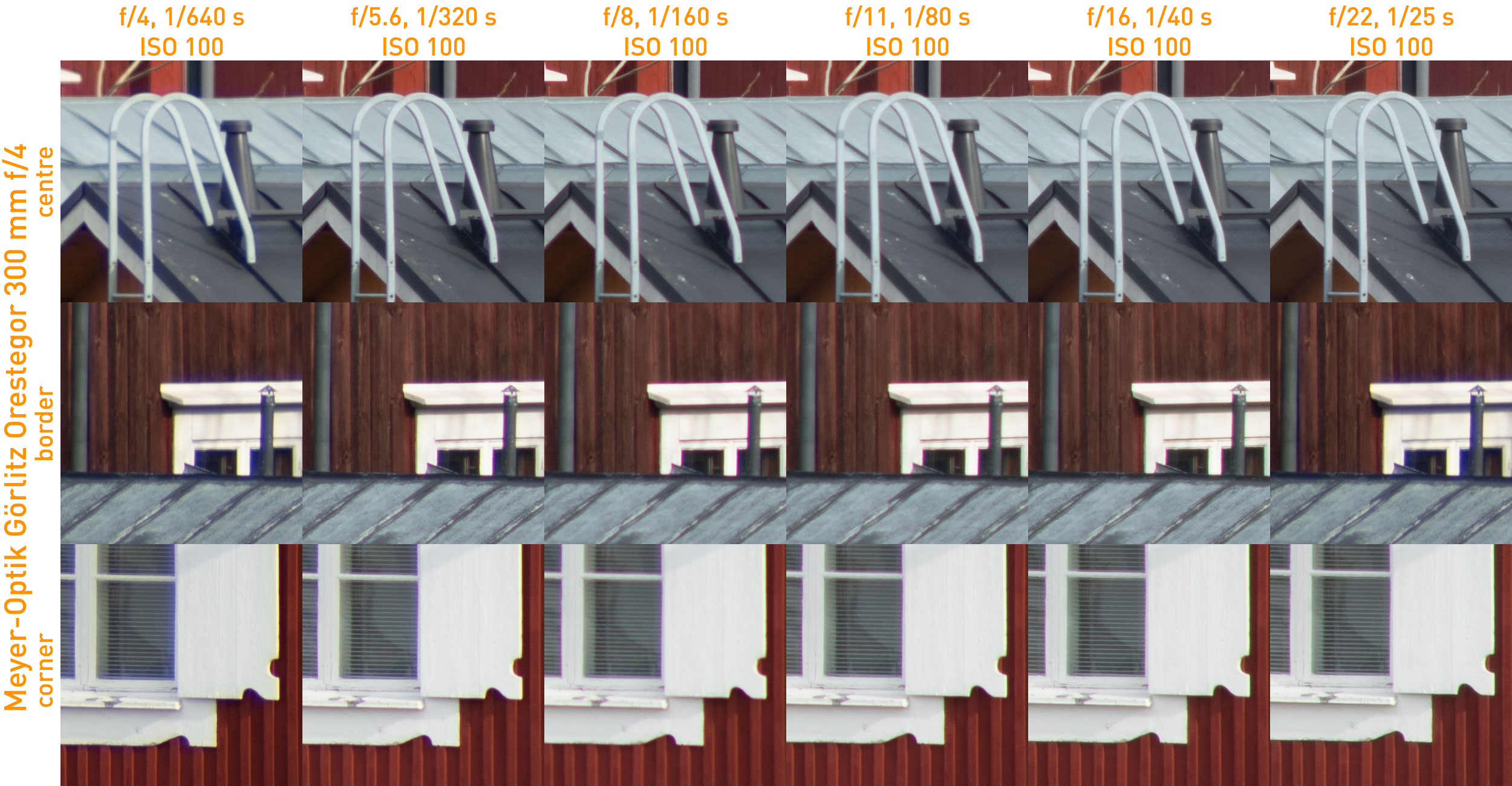
Compared to its predecessor, the Orestegor is optically a very different beast. The image is contrasty and the colours have tremendous punch. In terms of centre sharpness f/5.6 is already fully workable and there is only very little improvement to be had from stopping down beyond f/5.6. Wide open is obviously not as good, but the difference is smaller than one could expect. In the border and corner areas the story is mostly similar, except that there is a smidgeon of chromatic aberrations at all apertures. While those chromatic aberrations show up at 1:1 magnification, they are far from real-world relevant. All in all, the Orestegor shows impressive performance for a 60-year old lens.
Prakticar
Before going on, let’s talk about the elephant in the room. As mentioned, this sample is the earlier variant of the CZJ 300 mm f/4 Prakticar that uses a thoriated element. While radioactive lenses are not a health concern, they have another downside in that the radioactivity of the lens element invariably causes yellowing of the respective lens element leading to a loss of transmittance as well as a colour cast. The severity of these problems is typically proportional to the age of the lens (as the yellowing has progressed longer) as well as other factors. The image comparison below shows the lens at comparable settings (f/8), once shot at WB Sunny (as the MOG lenses) and once at Auto White Balance.
Right: Auto WB (hiding the effect of the yellowed rear lens element)
Subsequent imagery uses Auto WB settings (whereas the MOG lenses are shot in WB Sunny)
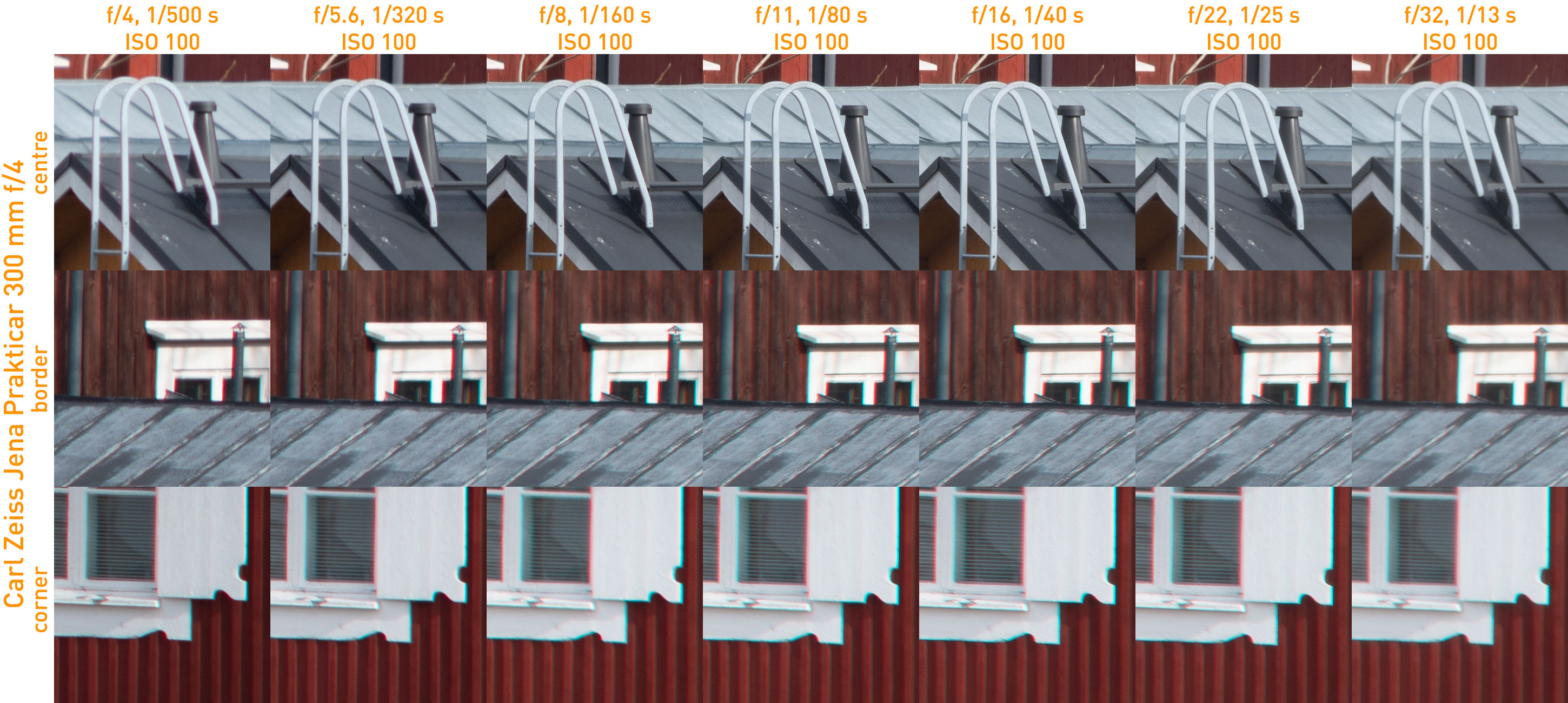
Quick analysis
The Carl Zeiss Jena Prakticar is a bit of a mixed bag. In terms of centre sharpness, the CZJ sweeps the floor with the older Meyer-Optik lenses as the samples invariably show more detail and contrast than the other lenses. Moreover, in the f/8 to f/16 range the Prakticar reaches quite remarkable levels of sharpness.
In the border and corner samples the story is quite different as the Prakticar does not show any more detail than the Orestegor. But what the Prakticar shows tons of is lateral chromatic aberrations at every high-contrast transition. Whether this is a field-relevant show-stopper depends on how big enlargements one wants to make and whether using digital postprocessing to address the colour fringes is impossible
Side-by-side comparisons and closing words.
Centre crops
Border
Corner
Final words:
This Quick & Dirty comparison ends without a clear winner. While the Carl Zeiss Jena Prakticar shows very good centre sharpness, that does not extend to the borders or corners. What’s worse, border and corner areas show significant chromatic aberration. While the MOG Orestegor does not reach the CZJ’s centre sharpness, it offers a very well-rounded package. Your final decision on which lens to pack might well be determined based on weight and other factors.
Footnotes
- Porvoo/Borgå was founded half way between Turku/Åbo (founded ca. 1280) and Viipuri/Vyborg (ca. 1290). Without the 1944 Soviet annexation of Viipuri/Vyborg, Porvoo would be Finland’s third oldest city. ↩︎
- To be clear, none of the houses visible in this article’s images are more than ≈260 years old. ↩︎
- While the Praktica B series of cameras did not fully meet the hopes of its designers (they hoped for a camera line to challenge Japanese predominance, they got a camera line that sold well among price-conscious and left-leaning consumers), the line of lenses that Carl Zeiss Jena designed for the new system did meet all targets but the sales targets. ↩︎
- If you’re worried about radioactivity in lenses, please read this article. ↩︎