Pekka Buttler, 03/2026
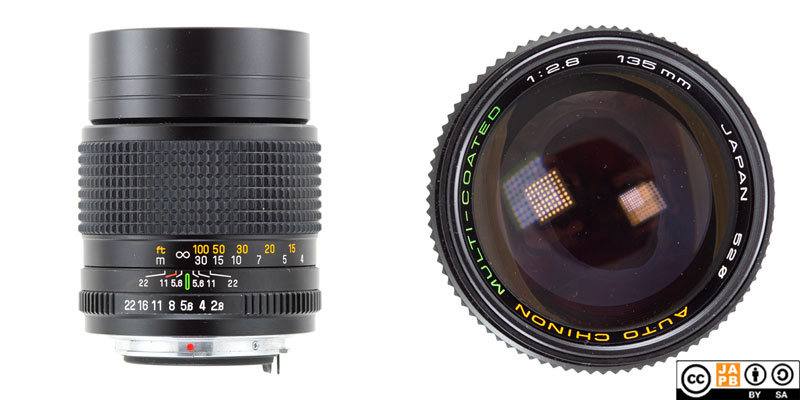
Specifications
The table below summarises the lens’ key specifications (measurements based on pictured sample):
| Brand: | Chinon | Lens name | Auto Multi-coated 1:2.8 135mm |
| Focal length(s) 1 | 135 mm | Angle-of-view 2 | 18 ° |
| Maximum Aperture | f/2.8 | In Production | ≈1975–1985 |
| Lens mount | Pentax K | Subfamily (if applicable) | K-type (see details) |
| Length 3 | 77,8 mm | Diameter 4 | 62,4 mm |
| Filter ring diameter | 52 mm | Weight | 381 grams |
| Lens element count | ? | Lens group count | ? |
| Aperture blades (S/R/C) 5 | 6 S | Focus throw | 210 ° |
| Minimum focusing distance | 152 cm | Maximum magnification | 1:8,9 |
| Has manual aperture ring | YES | Has Manual focus ring | YES |
| Aperture mechanism type | Automatic | Aperture click stops 6 | 2.8-4-5.6-8-11-16-22 |
Further notes:
• This lens was one of Chinon’s portrait primes during the period when its SLR cameras used the Pentax K mount.
• I have been unable to find trustworthy details on production dates, but Chinon quickly saddled over to the Pentax K mount after its introduction (1975) and largely lost its ambition in manufacturing SLRs after Minolta’s introduction of autofocus (1985). The actual production run might be significantly shorter.
• Problematically, there is little hard knowledge about the lens’ optical design (elements & groups).
• Chinon is not known for having manufactured the lenses it sold under the Chinon brand. Hence, the lens likely originates with a Japanese OEM manufacturer (Cosina is a relatively strong bet).
• This lens features an integrated, pull-out lens hood that however does not extend by much.
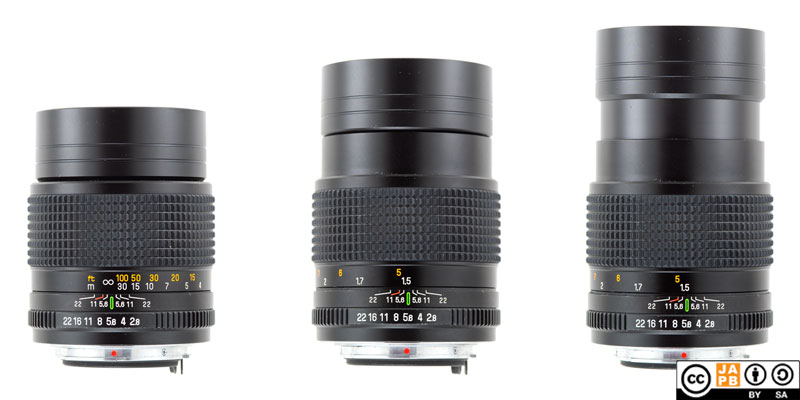
Centre: Lens focused at MFD with hood retracted
Right: Lens focused at MFD with hood extended.
Versions
There are three fundamentally different 135 mm f/2.8 lenses that were sold as Chinon lenses for the Pentax K mount.
One is the pictured lens that is characterised by a 52 mm filter thread and that also being sold as the Revuenon MC 135/2.8 and the Agfa Color Multi-coated 135/2.8. While most of the samples of this lens version have a similar aperture ring as the one pictured above, there is also a variant where the ribbing of the aperture ring extends to the base of the mount.
The other two versions both share a 55 mm filter thread, but are easy to distinguish as one carries a prominent green diamond shape in the depth-of-field scale and the other’s aperture ring is viewable through an opening (see below).
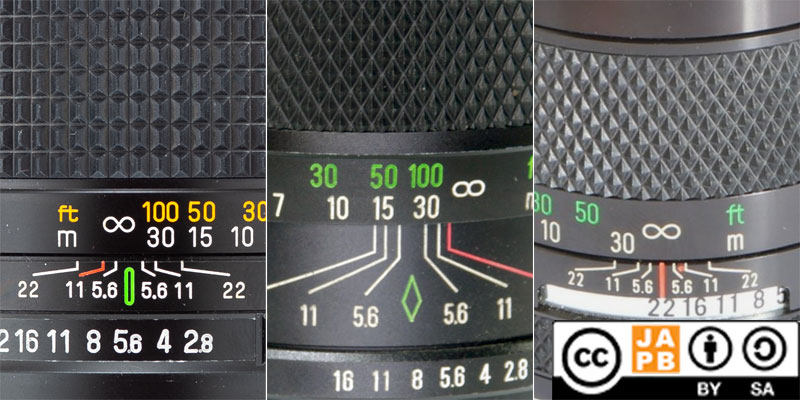
Centre and Right: 55 mm filter thread versions.
While I have no hard information on the origin of the second version of the Chinon 135/2.8, the 3rd (rightmost) version has strong commonalities with a series of lenses that Tamron manufactured for third parties.
Chinon company profile
Chinon is known to still photographers as one of the more advanced 2nd tier Japanese cameramakers. From 1971 to the late 1980s Chinon was known to enthusiast photographers the world over for combining technological advancements in cost-effective cameras bodies. See more details in the Chinon company profile.
Adapting
If you want to natively mount this lens you need to find a functioning Pentax K mount SLR (or a dSLR) camera. Luckily that should be relatively easy as Pentax K film bodies were produced in their millions and most of them – especially those manufactured by Pentax – have a good reliability record. Alternatively, you can use this lens natively on any Pentax dSLR.
Adapting this lens to a mirrorless, full-frame digital camera is a breeze thanks to the lens having full manual controls (aperture ring, focus ring). You simply need a dumb adapter from Pentax K to your mirrorless system.
Due to the medium flange focal distance used by the m42 mount (45,46 mm), whether you can adapt this lens to other than Pentax’ dSLR mounts depends on which dSLR mount: Canon EF, and Four Thirds can mount Pentax K lenses using a simple adapter ring. Minolta/Sony A and Nikon F on the other hand are not as problem-free, and – to retain anything near infinity focus – the adapter will necessitate corrective optics. In all cases, your camera will work only in stop-down metering.
Footnotes
- Focal length is (unless stated otherwise) given in absolute terms (not in Full-frame equivalent), and according to the manufacturer’s naming practice (which does not always reflect the lens’ actual field of view). For an understanding of whether the lens is wide/tele, see ‘Angle-of-view’. ↩︎
- Picture angle is given in degrees and concerns the diagonal picture angle. Rule of thumb:
> 90 ° ==> Ultra-wide-angle
70–90 ° ==> Wide-angle
50–70 ° ==> Moderate wide-angle
40–50 ° ==> ‘Standard’ or ‘normal’ lens
20–40 ° ==> Short tele lens
10-20 ° ==> Tele lens
5-10 ° ==> Long tele lens
< 5 ° ==> Ultra-tele lens ↩︎ - Length is given from the mount flange to the front of lens at infinity. Measured unless stated otherwise. ↩︎
- Diameter excludes protrusions such as rabbit ears or stop-down levers. Measured unless stated otherwise. ↩︎
- S=straight; R=rounded; C=(almost)circular at all apertures. ↩︎
- Numbers equal aperture values on aperture ring; • intermediate click; – no intermediate click. ↩︎