Pekka Buttler, 03/2026
Specifications
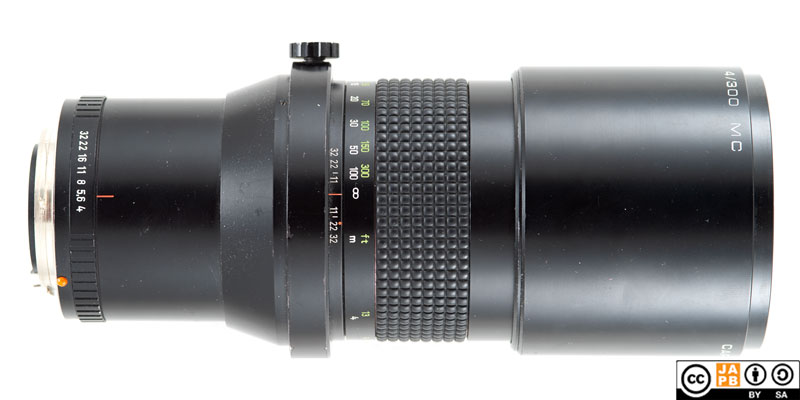
The table below summarizes the lens’ key specifications (measurements based on pictured lens):
| Brand: | Carl Zeiss Jena | Lens name | Prakticar 4/300 MC |
| Focal length(s)1 | 300 mm | Angle-of-view2 | 8 ° |
| Maximum Aperture | f/4 | In Production | 1979–1982 (1st version) 1982–1990 (2nd version) |
| Lens mount (this lens) | Praktica B | Other lens mounts: | none |
| Length3 | 188,1 mm | Diameter4 | 78,6 mm |
| Filter ring diameter | 72 mm | Weight | 973 grams |
| Lens element count | 7 | Lens group count | 5 |
| Aperture blades (S/R/C)5 | 6 S | Focus throw | 315 ° |
| Minimum focusing distance (indicated) | 4 m | Maximum magnification (calculated) | 1:12 |
| Has manual aperture ring | YES | Has Manual focus ring | YES |
| Aperture mechanism type | Automatic | Aperture click stops 6 | 4•5.6•8•11•16•22•32 |
Further notes:
• The 300 mm f/4 Prakticar was developed especially for the Praktica B series and was never produced in any other mount.
• The lens offers a built in tripod mount and a generously proportioned integrated, pull-out lens hood.
• The lens lengthens considerably when focusing to MFD. The filter threads do not rotate while focusing.
• There are (at least) two versions of the 300 mm Prakticar. See below for details.
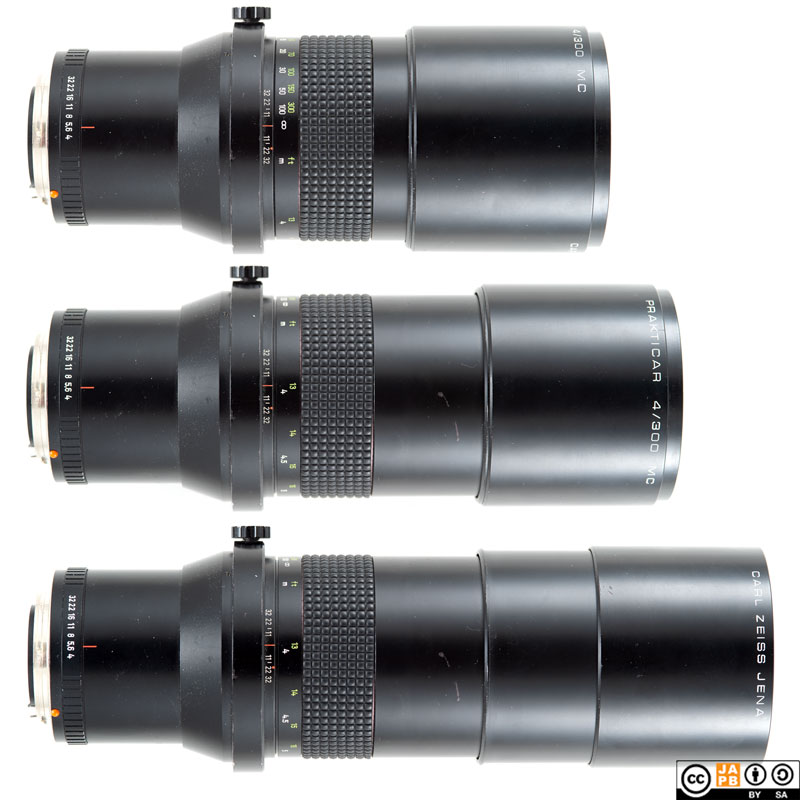
Middle: CZJ Prakticar 300/4 MC focused at MFD with hood retracted
Bottom: CZJ Prakticar 300/4 MC focused at MFD with hood extended
Historical notes
• Carl Zeiss Jena designed its first 300 mm f/4 lens in 1938. That lens was based on the Sonnar recipe, and can – in many respects – be seen as the big brother of the Olympia Sonnar. It went into serial production in 1940 but was (as was most of the world) overshadowed by the war.
• After the war the basic design was modernised several times: once in the 50s, once in the 60s and once in the 1970s resulting in the 1975 Carl Zeiss Jena Sonnar 300/4 MC that was designed to cover both the Pentacon Six Medium format as well as several ‘full frame’ formats.
• While certainly a pro-level lens, that Sonnar-based 300/4 lens was a brute. It was over 20 cm long, had an 86 mm filter thread and weighed on the worse side of 1,5 kilos. For comparison, the comparable Japanese offerings from Konica, Minolta, Nikon, Olympus, Pentax weighed between 965 and 1150 grams, and used 72-77 mm filter threads.
• Carl Zeiss Jena set out to design a bright (f/4) 300 mm lens that would offer high optical quality and be considerably more compact. To do that, Carl Zeiss Jena had to diverge from the traditional Sonnar formula and develop something radically new.
Versions
As described in detail at zeissikonveb.de, there were three different optical designs developed for the 300 mm f/4 Prakticar as well as a design that never existed but nevertheless ended up in brochures (and has been picked up by some online sources).
The brochure design (1978 and 1979 brochures)
Illustrated as 5 elements in 3 groups – classic telephoto design with single positive lens in front.
The first (actual) design (August 1979)
7 elements in 4 groups (three doublets and a single negative lens at the rear). Was not taken into production.
The first production series (November 1979)
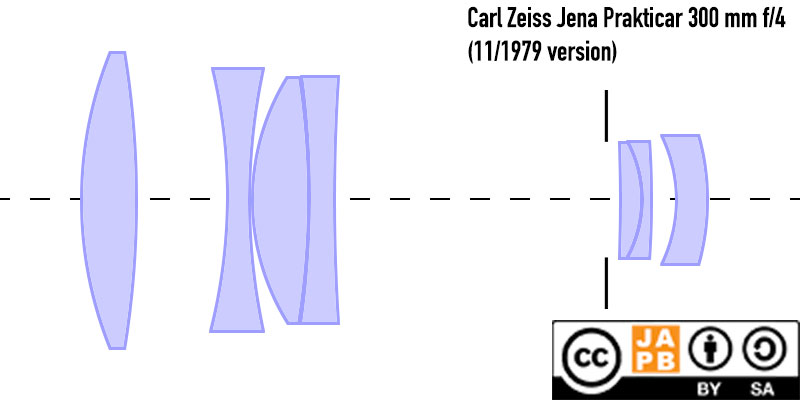
According to documentation at Carl Zeiss Jena only about 1100 copies were made. While the lens otherwise fulfilled its designers’ expectations regarding image quality, the design relied on a radioactive element (the rearmost element). Hence production costs were high7 and the lens would develop a yellow tint over time.
Around this time CZJ embarked on a concerted push to redesign all its lenses that relied on radioactive elements to do find less problematic designs.
The second production series (August 1981)
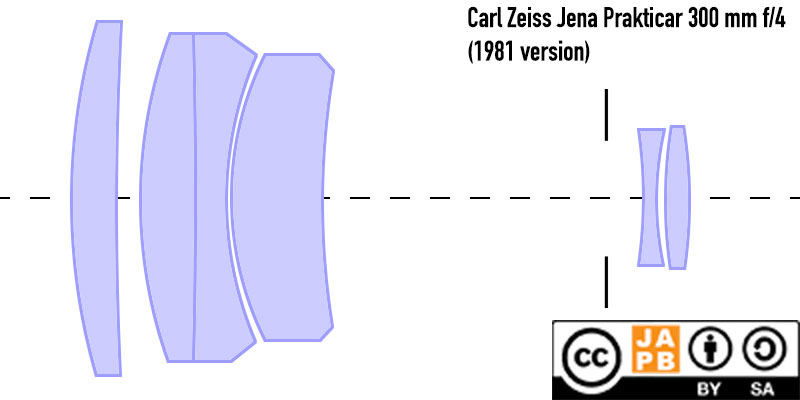
The second production version was – in terms of optics – a considerable redesign, but outwardly the differences are quite minor. During the remaining lifespan of the lens (and not coincidentally of the German Democratic Republic) some ≈4500 copies were manufactured.
How can I identify which version I have (or the version I am looking at)
Here it gets a bit tricky. According to the Carl Zeiss Jena records, all samples of the first version fall into the serial number range above 10 million whereas the launch of the second version coincides with the serial number reset, meaning that all copies should be numbered between 1000 and 10000.
However, it would seem that towards the end of lens production at Carl Zeiss Jena (while the GDR was crumbling around them) there was a tendency to use up old parts stock8. Hence my copy (serial in the 71xx range) should (based on the serial number) be of the second version. At the same time, the lens is clearly yellowed and my Geiger counter gets excited, meaning that (in terms of optics) the sample is of the first type.
This means that while the 10 million + serial number range can be trusted to be of version 1 and while the 1000–5000 serial number range can be trusted to be of type 2, the only way to be certain about a lens in the 5000–10000 range is to measure the lens’ radioactivity.
History of Carl Zeiss Jena
There are few names in camera optics more illustrious than that of Carl Zeiss. The company was founded in the German town of Jena in 1846 by Carl Zeiß (hence: ‘Carl Zeiss Jena‘). During 1846–1945 there are few major developments in lens optics that the company was not involved in. Names that are even today well-known in optics – such as Planar (1896), Tessar (1902), Sonnar (1929), and Biotar (1939) (as well as many names that only optics-buffs know) – were the product of Zeiss’ first century of technological innovation.
After the Second World War Germany was divided into a Soviet zone (subsequently: East Germany) and the west-allied zones (subsequently: West Germany). While the Zeiss works resided in Jena (optics and glasses) and Dresden (cameras), which were in the Soviet sector, a contingent of Zeiss managers decided to move west and ended up setiting up shop in the small town of Oberkochen in the American sector under the name of Opton Optische Werke Oberkochen GmbH. As the relations between the former allied deteriorated and the split into East and West Germany became all the more real, the Oberkochen works changed their name first to Zeiss-Opton and later to Carl Zeiss.
What ensued was a lengthy international trademark dispute with both Zeiss’ (Jena and Oberkochen) laying claim to the name ‘Carl Zeiss’. The resulting stalemate – emblematic of the Cold War in its entirety – resulted in that Carl Zeiss Opton was allowed to use the name Carl Zeiss in the West, but had to use the Opton brand in the East bloc, whereas Carl Zeiss Jena was the only real Carl Zeiss as far as the east bloc was concerned, but could – mostly – not use the Carl Zeiss -name for exports to the West9. The fact remains however, that – starting in 1946 from a shared base – Jena and Oberkochen developed as two independent companies for more than 40 years. During the entire Cold War period, VEB Carl Zeiss Jena was seen by the country’s leadership both as a paragon of the East German technology industry and a showcase of the socialist/communist system as well as a major source of exports (and hence, western currencies). Within the centrally directed economy’s hierarchy, Carl Zeiss Jena therefore had a more prestigious role than other East German optics manufacturers (prominently Meyer-Optik Görlitz and, later, Pentacon), meaning that Carl Zeiss Jena received privileged access to tools and materiel (including the first computer in East Germany) and that its products were always considered the premium alternative.
After German reunification also Zeiss East and Zeiss West were united again, and have since again been at the undoubtable forefront of lens development. Even though it was manufactured after reunification, this lens sample harkens to the time of the cold-war and the East/West split.
Adapting
This lens cannot be used natively on any current SLR or dSLRs. To use it in its native environment, you will need a Praktica B mount film body. Luckily there are a lot of those available, and many of them are still in perfect working order.
Thanks to being a fully manual lens (manual aperture, manual focus), the lens can be adapted to all mirrorless cameras using a suitable adapter. Moreover, Praktica B lenses are so uncomplicated that a simple ‘dumb adapter’ will do the job perfectly (The electronic contacts communicate only from the lens to the camera and do not impinge on adapting). However, due to that the Praktica B mount never was so successful, one should not expect special adapters (helicoid adapters, tilt/shift adapters) to be easily available. Alternatively, one can choose to daisy-chain adapters (e.g. Praktica B->Canon EF; Canon EF –> mirrorless) which not only opens up possibilities for special adapters, but also allows using speed boosters for those photographers that use smaller than full-frame sensors.
Using Praktica B lenses on dSLRs can also be an easy option, depending on which dSLR.
• Canon EF has the shortest flange focal distance among full-frame dSLR’s and Canon’s wide range of dSLRs are able to mount Praktica B lenses perfectly using a suitable adapter ring.
• With other dSLR mounts (Minolta/Sony A; Pentax K; Nikon F) the relationship between flange focal differences becomes an issue, leading to that adapting will necessitate an adapter that uses corrective optics to allow reaching infinity focus
Footnotes
- Focal length is (unless stated otherwise) given in absolute terms, and not in Full-frame equivalent. For an understanding of whether the lens is wide/tele, see ‘Angle-of-view’. ↩︎
- Picture angle is given in degrees (based on manufacturers’ specs) and concerns the diagonal picture angle. Rule of thumb:
> 90 ° ==> Ultra-wide-angle
70–90 ° ==> Wide-angle
50–70 ° ==> Moderate wide-angle
40–50 ° ==> ‘Standard’ or ‘normal’ lens
20–40 ° ==> Short tele lens
10-20 ° ==> Tele lens
5-10 ° ==> Long tele lens
< 5 ° ==> Ultra-tele lens ↩︎ - Length is given from the mount flange to the front of lens at infinity. ↩︎
- Diameter excludes protrusions such as rabbit ears or stop-down levers. ↩︎
- S=straight; R=rounded; C=(almost)circular at all apertures. ↩︎
- Numbers equal aperture values on aperture ring; • intermediate click; – no intermediate click. ↩︎
- In general East German industry did not share the Soviet industry’s cavalier attitude to radiation and toxins. ↩︎
- This phenomenon has also been documented at zeissikonveb.de which has to be considered an authority in these matters. ↩︎
- Online one can find many lengthy and heated disputes stating that only Jena/Oberkochen is the true Carl Zeiss. While many of these discussions are riddled with misconceptions and a poor grasp of facts and timings, they largely also tend to be tainted by ideologies. Those discussions that focus on claims of one or the other Zeiss not really having rights to using designs developed at pre-war Zeiss are especially ludicrous because after the war practically the entire patent catalogue of pre-war German patents was given freely to everyone (the allied saw this as a form of reparations), hence also kickstarting the Japanese optics industry’s ascendancy (the Japanese optics companies were the most avid users of German optics patents). ↩︎